
How Much Does Hard Drive Data Recovery Cost?
Standard air-filled hard drive recovery costs $100–$2,000, and sealed helium drive recovery costs $200–$5,000+, depending on what failed.
How much does hard drive data recovery cost?
Standard hard drive recovery costs $100–$2,000, and sealed helium drive recovery costs $200–$5,000+. A standard drive falls into one of 5 published tiers: $100 for a simple copy, From $250 for file system recovery, $600–$900 for firmware repair on PC-3000, $1,200–$1,500 for a donor-matched head stack swap, and $2,000 for platter surface damage. Helium-sealed enterprise drives (Exos X-series, Ultrastar DC HC5xx and above, MG08ACA) have their own 5 helium tiers.
On top of the tier price, a job can add these lines:
- Tax on every job.
- Donor drive, on head swap and platter jobs: Donor drives are matching drives used for parts. Typical donor cost: $50–$150 for common drives, $200–$400 for rare or high-capacity models. We source the cheapest compatible donor available.
- Helium refill, on helium head swap and platter jobs: $400–$800, plus a helium donor that has to be an exact match.
- Target drive: the new drive your data goes onto. For larger capacities (8TB, 10TB, 16TB and above), target drives cost $400+ extra.
- Rush, on a simple copy: +$100 rush fee to move to the front of the queue.
- Return shipping: we bill it when we mail your drive back.
Evaluation is free, there's no diagnostic fee, and if we can't recover your data you pay no recovery fee.
Hard drive recovery price by failure tier
The hard drive recovery price at our Austin lab is set by what failed, not by drive capacity. A standard air-filled drive has five published tiers: $100, From $250, $600–$900, $1,200–$1,500, and $2,000. A sealed helium drive goes on its own 5-tier list, $200–$5,000+. There's no diagnostic fee to look at the drive.
Data Recovery Cost: Quick Answer
- Logical Recovery: $100 simple copy or From $250 file system recovery (deleted files, formatted drive, partition issues)
- Firmware Issues: $600–$900 (drive not detected, wrong capacity, translator errors)
- Head Swap: $1,200–$1,500 on a standard drive, $3,000–$4,500 plus the helium refill on a sealed helium drive, and both need donor parts. We decide that on the bench, because clicking can also come from firmware, the preamp, or the spindle.
- Platter Damage: $2,000 plus a donor on a standard drive, $4,000–$5,000 plus the helium refill and donor on a sealed helium drive
- RAID/Complex: quoted after evaluation (RAID arrays, multi-drive systems)
We publish every one of these prices before you ship.
Standard hard drive data recovery costs $100–$2,000 depending on the failure type, and sealed helium drives run $200–$5,000+. A data copy from a functioning drive costs $100. File system recovery starts at $250. Firmware repair using PC-3000 costs $600–$900. A head swap requiring matched donor parts costs $1,200–$1,500. Platter surface damage recovery starts at $2,000. Diagnostic evaluation is free. If the data isn't recoverable, there's no recovery fee.
Which Hard Drive Recovery Cost Tier Does My Drive Fall Into?
Standard hard drive recovery runs $100–$2,000, starting at $100 for a working drive. The symptom you can observe sets the tier, not the drive's capacity. Find what your drive is doing in the table and read the price across. There's no diagnostic fee for the evaluation, and under No Data, No Charge a failed recovery costs you no recovery fee.
Before you ship the drive, match what it's doing right now to the published price for that failure class. All work is performed in-house at our Austin, TX lab.
| What your drive is doing | Recovery tier | Cost | Deposit |
|---|---|---|---|
| Your drive works, you just need the data moved off it | Simple Copy | $100 | No deposit |
| Your drive isn't recognized by your computer, but it's not making unusual sounds | File System Recovery | From $250 | No deposit |
| Your drive is completely inaccessible. It may be detected but shows the wrong size or won't respond | Firmware Repair | $600–$900 | No deposit |
| Bench diagnosis found the read/write heads have to be replaced. Clicking can also come from firmware, the preamp, or the spindle | Head Swap | $1,200–$1,500 | 50% deposit |
| Your drive was dropped, has visible damage, or a head crash scraped the platters | Surface / Platter Damage | $2,000 | 50% deposit |
On a simple copy, rush is available: +$100 rush fee to move to the front of the queue. Helium-sealed enterprise drives (Exos X-series, Ultrastar DC HC5xx and above, MG08ACA) run on a separate list, $200–$5,000+, with the refill performed in-house after the sealed chamber is opened. Once you have spotted your row, the full in-house hard drive recovery walkthrough covers what happens on the bench after the drive lands in Austin.
Sealed Helium Drives Have Their Own Price List
Sealed helium drives cost more to recover than air-filled drives, so they're priced on a separate list, $200–$5,000+. That list includes the Seagate Exos X-series, WD Ultrastar DC HC5xx and above, and Toshiba MG08ACA. Air-filled drives from the same families, like the Exos 7E8, the Ultrastar DC HC330 and the Toshiba MG08ADA, are priced as standard drives.
In WD's Ultrastar DC HC550 datasheet, the third character of the model number is listed as “H = Helium (vs. S for Standard)”, so a model number like WUH721818 is a helium drive.
The head swap and platter damage tiers are where a helium drive costs the most. Both open the sealed chamber, so both add a $400–$800 helium refill and a matched helium donor on top of the tier price. Tax and the target drive go on top too. We do that work in-house at our Austin bench.
Low complexity
Simple Copy
Your helium drive works, you just need the data moved off it
Functional drive; data transfer to new media
Rush available: +$100
$200
3-5 business days
Low complexity
File System Recovery
Your helium drive isn't recognized by your computer, but it's not making unusual sounds
File system corruption. Accessible with professional recovery software but not by the OS
Starting price; final depends on complexity
From $600
2-4 weeks
Medium complexity
Most Common
Firmware Repair
Your helium drive is completely inaccessible. It may be detected but shows the wrong size or won't respond
Firmware corruption: ROM, modules, or translator tables corrupted; requires PC-3000 terminal access
$900–$1,200
3-6 weeks
High complexity
Head Swap
Bench diagnosis found the read/write heads have to be replaced. Clicking can also come from firmware, the preamp, or the spindle
Head stack assembly failure. Transplanting heads from a matching helium donor drive on a clean bench. Helium refill required.
50% deposit required. Helium cost ($400-$800) and donor drive cost additional.
50% deposit required
$3,000–$4,500
4-8 weeks
High complexity
Surface / Platter Damage
Your helium drive was dropped, has visible damage, or a head crash scraped the platters
Platter scoring or contamination. Requires platter cleaning, head swap, and helium refill
50% deposit required. Helium cost ($400-$800) and donor drive cost additional. Most difficult recovery type.
50% deposit required
$4,000–$5,000
4-8 weeks
Hardware Repair vs. Software Locks
Our "no data, no fee" policy applies to hardware recovery. We do not bill for unsuccessful physical repairs. If we replace a hard drive read/write head assembly or repair a liquid-damaged logic board to a bootable state, the hardware repair is complete and standard rates apply. If data remains inaccessible due to user-configured software locks, a forgotten passcode, or a remote wipe command, the physical repair is still billable. We cannot bypass user encryption or activation locks.
No data, no fee. Free evaluation and firm quote before any paid work. Full guarantee details. Head swap and surface damage require a 50% deposit because donor parts and helium are consumed in the attempt.
- Rush fee
- +$100 rush fee to move to the front of the queue
- Helium cost
- Helium cost: $400-$800 additional for head swap and surface damage tiers. This covers the helium refill required after opening the sealed chamber.
- Donor drives
- Helium donor drives must be an exact match. Typical donor cost: $200–$600 depending on model and availability, plus helium refill cost ($400–$800) required after opening the sealed chamber.
- Target drive
- The destination drive we copy recovered data onto. You can supply your own or we provide one at cost plus a small markup. For larger capacities (8TB, 10TB, 16TB and above), target drives cost $400+ extra. All prices are plus applicable tax.
Which Lab Costs Never Touch the Drive?
Our price is the published tier, plus a donor on head swap and platter jobs, tax, and the target drive your data goes onto. On a sealed helium drive, the head swap and platter tiers also add a $400–$800 helium refill. Our page on why data recovery costs what it does goes through what each tier covers.
A lab also pays for things that aren't bench work, like how it finds customers and where it opens drives.
Paid Search Ads
In a Google Ads Keyword Planner plan created March 24, 2025 for the United States, Google's top-of-page bid estimate (high range) was $151.47 for “raid data recovery services” and $53.51 for “seagate hdd recovery”. A lab that buys its leads this way has to earn that money back from the jobs it wins. We don't run paid marketing of any kind, and we don't buy Google Ads or any other paid search placement.
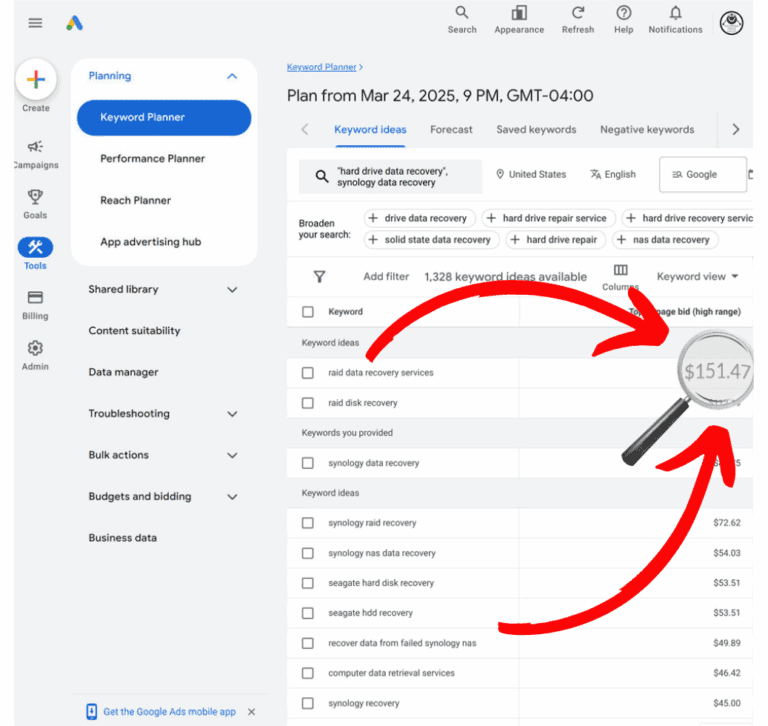
Google Ads Keyword Planner, plan created March 24, 2025, United States: top-of-page bid estimates (high range) for data recovery keywords. The top row, raid data recovery services, shows $151.47. We captured the sponsored results for a hard drive recovery search, and you can see them in why data recovery prices vary so much.
Referral and Reseller Programs
Some labs pay the shops that send them drives, and they publish the programs.
- DriveSavers' reseller page said its program “now supports over 25,000 partners” and listed “Commission on every successful recovery” (drivesaversdatarecovery.com/partner-programs/reseller, archived August 17, 2026).
- Gillware's partner page says “As a partner, you earn 15% commission on successful paid cases you refer to Gillware or resell” (gillware.com/gillware-partner-program).
- SalvageData's partner page lists “Scaling commission rates based on case volume” (salvagedata.com/partners).
- Ontrack's UK partner terms say “Ontrack shall pay to the Partner a percentage of the fees received by Ontrack pursuant to each Customer Agreement” (ontrack.com/en-gb/legal/authorised-partner-terms).
If a shop offers to send your drive out to a lab, ask which lab it is and whether the shop gets paid for the referral. We don't run a partner, affiliate, reseller or referral program, and nobody gets paid to send us your drive.
Quote Ranges Against Published Tiers
DriveSavers' pricing page lists no dollar figures. It says “A successful recovery will generally fall in the top third of the original quote range” and “The final cost will never exceed the initial quote that you receive when you first call DriveSavers” (drivesaversdatarecovery.com/drivesavers-pricing-and-recovery-costs). Our DriveSavers pricing analysis goes through the rest of that page.
Our standard hard drive tiers are $100, From $250, $600–$900, $1,200–$1,500 and $2,000, and the helium list runs $200–$5,000+. They're on the site before you ship. The free evaluation tells you which tier your drive is in. If you decline the quote, we mail the drive back and bill the return shipping.
Room-Scale Cleanroom Overhead
A room-scale cleanroom filters the air in a whole room, and the lab carries the cost of running that room. We open drives on a 0.02 micron ULPA-filtered laminar flow clean bench, which gives the head swap its own filtered work area. The clean room versus clean bench comparison goes through the difference.
Independent Labs on Our List
We keep a list of independent data recovery labs. A lab gets on it for four things. The work happens on its own bench, and its prices or pricing model are on its site before you ship. It charges no diagnostic fee, and its technical claims hold up when they're checked.
What Does Data Recovery Cost by Failure Type?
Hard drive data recovery cost is set by what broke. Logical issues (deleted files, corrupted partitions) run $100 for a simple copy, and file system recovery starts at $250. Firmware repair using PC-3000 costs $600–$900. A head swap with donor parts costs $1,200–$1,500. Platter surface damage starts at $2,000.
The cost of data recovery depends primarily on what is wrong with your drive. A simple file deletion is cheap to fix. A mechanical head crash needs expensive donor parts and clean bench work. If you are unsure whether your drive needs repair or recovery, that distinction affects pricing.
- Logical Recovery
$100 simple copy or From $250 file system recovery
Software imaging and file system repair. Drive reads normally. $100 simple copy or From $250 file system recovery
Partition table repair, MBR/GPT rebuild, RAW file system recovery.$600–$900
ROM transfer, translator repair, Service Area patching via PC-3000.$600–$900
TVS diode replacement, ROM chip transfer, motor driver repair.$1,200–$1,500
Clean bench head transplant from donor drive, careful imaging.$2,000 + donor
Platter cleaning and a head swap. Donor billed on top.$200–$5,000+
Separate helium list. Head swap and platter tiers add the helium refill and a donor.$200–$1,500
5 tiers: simple copy, file system, circuit board repair, firmware, PCB / NAND swap.Quoted after evaluation
Multiple drive imaging, array reconstruction, per-member recovery.- Evaluation Fee
FREE
We diagnose and quote for free.
Hard Drive Recovery Cost by Failure Tier
What broke sets the price, not the brand, the capacity, or how full the drive is. We price the tiers by the failure class the drive falls into at intake. Every number is pulled from the same published hard drive recovery price list the lab works off.
| Failure Tier | Hard Drive Recovery Cost | What the Tier Covers | Typical ETA |
|---|---|---|---|
| Simple Copy | $100 | Functional drive; data transfer to new media | 3-5 business days |
| File System Recovery | From $250 | File system corruption. Accessible with professional recovery software but not by the OS | 2-4 weeks |
| Firmware Repair | $600–$900 | Firmware corruption: ROM, modules, or translator tables corrupted; requires PC-3000 terminal access | 3-6 weeks |
| Head Swap | $1,200–$1,500 | Head stack assembly failure. Transplanting heads from a matching donor drive on a clean bench | 4-8 weeks |
| Surface / Platter Damage | $2,000 | Platter scoring or contamination. Requires platter cleaning and head swap | 4-8 weeks |
- CMR vs SMR pricing:
- SMR (Shingled Magnetic Recording) drives require more work at the firmware and head-swap tiers due to their overlapping track architecture.
- Donor drive cost:
- Donor drives are matching drives used for parts. Typical donor cost: $50–$150 for common drives, $200–$400 for rare or high-capacity models. We source the cheapest compatible donor available.
- Rush on a simple copy:
- +$100 rush fee to move to the front of the queue.
- Large-capacity drives:
- For larger capacities (8TB, 10TB, 16TB and above), target drives cost $400+ extra.
Hard Drive Data Recovery Cost at a Glance
Standard hard drive data recovery at Rossmann Repair Group runs $100–$2,000 across 5 published failure tiers. Simple copy off a working drive is $100. File system recovery on a drive that spins fine but is not recognized starts at $250. Firmware repair using PC-3000 terminal access is $600–$900. A head swap with donor parts on a clean bench is $1,200–$1,500. Platter surface damage with combined head swap and platter cleaning starts at $2,000.
Every tier is a published rate, and those are the rates we charge for in-house hard drive data recovery in Austin, TX. There's no diagnostic fee and no recovery fee if the data can't be returned.
Inside a given tier, the final price moves with capacity and with how easy the donor drive is to find. Donor drives are matching drives used for parts. Typical donor cost: $50–$150 for common drives, $200–$400 for rare or high-capacity models. We source the cheapest compatible donor available.
For larger capacities (8TB, 10TB, 16TB and above), target drives cost $400+ extra.
Sealed helium drives (Exos X-series, Ultrastar DC HC5xx and above, MG08ACA) are quoted from a separate helium price list because the recovery procedure requires a helium refill step.
If the quoted hard drive data recovery cost feels high relative to other services, this breakdown of where the money goes explains the equipment, donor inventory, and clean bench time priced into each tier.
What Does Data Recovery Cost by Device Type?
Standard hard drive recovery runs $100–$2,000, and sealed helium drives run $200–$5,000+. SATA SSD recovery runs $200–$1,500. NVMe SSD recovery runs $200–$2,500. iPhone board-level recovery is a flat $500 for pre-X models and a flat $750 for iPhone X and newer. RAID array recovery is quoted after evaluation based on member count and failure type.
We publish every one of these rates.
SATA SSD Data Recovery Cost
iPhone Data Recovery Cost
RAID and NAS Recovery Cost
See also: NAS recovery details
USB and Flash Media Recovery Cost
Helium Hard Drive Recovery Cost
Sealed helium drives run $200–$5,000+ on their own helium price list.
NVMe SSD Recovery Cost
NVMe SSDs use a different bus protocol and controller architecture than SATA SSDs. We recover them on PC-3000 SSD with the PC-3000 SSD Extended add-on. On an NVMe drive with hardware AES, a chip-off NAND dump is just ciphertext without the original controller. So we work on getting that original controller readable again instead of desoldering the NAND.
Low complexity
Simple Copy
Your NVMe drive works, you just need the data moved off it
Functional drive; data transfer to new media
Rush available: +$100
$200
3-5 business days
Low complexity
File System Recovery
Your NVMe drive isn't showing up, but it's not physically damaged
File system corruption. Visible to recovery software but not to OS
Starting price; final depends on complexity
From $250
2-4 weeks
Medium complexity
Circuit Board Repair
Your NVMe drive won't power on or has shorted components
PCB issues: failed voltage regulators, dead PMICs, shorted capacitors
May require a donor drive (additional cost)
$900–$1,200
3-6 weeks
Medium complexity
Most Common
Firmware Recovery
Your NVMe drive is detected but shows the wrong name, wrong size, or no data
Firmware corruption: ROM, modules, or system files corrupted
Price depends on extent of bad areas in NAND
$900–$1,200
3-6 weeks
High complexity
PCB / NAND Swap
Your NVMe drive's circuit board is severely damaged and requires NAND chip transplant to a donor PCB
NAND swap onto donor PCB. Precision microsoldering and BGA rework required
50% deposit required; donor drive cost additional
50% deposit required
$1,200–$2,500
4-8 weeks
Hardware Repair vs. Software Locks
Our "no data, no fee" policy applies to hardware recovery. We do not bill for unsuccessful physical repairs. If we replace a hard drive read/write head assembly or repair a liquid-damaged logic board to a bootable state, the hardware repair is complete and standard rates apply. If data remains inaccessible due to user-configured software locks, a forgotten passcode, or a remote wipe command, the physical repair is still billable. We cannot bypass user encryption or activation locks.
No data, no fee. Free evaluation and firm quote before any paid work. Full guarantee details. NAND swap requires a 50% deposit because donor parts are consumed in the attempt.
- Rush fee
- +$100 rush fee to move to the front of the queue
- Donor drives
- A donor drive is a matching SSD used for its circuit board. Typical donor cost: $40–$100 for common models, $150–$300 for discontinued or rare controllers.
- Target drive
- The destination drive we copy recovered data onto. You can supply your own or we provide one at cost plus a small markup. All prices are plus applicable tax.
USB Flash Drive and SD Card Recovery Cost
Flash media recovery ranges from simple file system repair to full chip-off NAND extraction. Monolithic flash drives (where the controller and NAND are fused into a single package) require direct pin-out identification and raw data reconstruction.
Low complexity
Simple Copy
Your flash drive or SD card works, you just need the data moved off it
Functional media; data transfer to new storage
Rush available: +$100
$200
3-5 business days
Low complexity
Most Common
File System Recovery
Your flash drive or SD card isn't showing up, but it's not physically damaged
File system corruption. Visible to recovery software (R-Studio, UFS) but not to OS
Starting price; final depends on complexity
$300–$600
2-4 weeks
Medium complexity
PCB Repair
Your flash drive or SD card has shorted components or won't power on
PCB issues: simple shorts, failed components on the drive's circuit board
May require a donor drive (additional cost)
$600–$900
3-6 weeks
High complexity
Chip-off Data Recovery
Your flash drive or SD card needs physical NAND chip extraction to recover the data
NAND chip extraction via soldering, pin-out identification, and raw data reconstruction
50% deposit required
50% deposit required
$1,200–$1,500
4-8 weeks
Hardware Repair vs. Software Locks
Our "no data, no fee" policy applies to hardware recovery. We do not bill for unsuccessful physical repairs. If we replace a hard drive read/write head assembly or repair a liquid-damaged logic board to a bootable state, the hardware repair is complete and standard rates apply. If data remains inaccessible due to user-configured software locks, a forgotten passcode, or a remote wipe command, the physical repair is still billable. We cannot bypass user encryption or activation locks.
No data, no fee. Free evaluation and firm quote before any paid work. Full guarantee details. Chip-off recovery requires a 50% deposit because the extraction process is destructive to the original media.
- Rush fee
- +$100 rush fee to move to the front of the queue
All prices are plus applicable tax.
Controller-Specific Firmware Failures and Recovery Prices
The $600–$1,200 firmware recovery price applies across SSD controller families because the engineering labor is similar: connect the drive to PC-3000 in technological mode, bypass the corrupted boot sequence, and reconstruct the Flash Translation Layer from surviving NAND page data. The specific controller determines which mode and command set the technician uses, not the price tier.
- Silicon Motion SM2259 and SM2258
- These controllers drop into ROM mode or a BSY safe state when the Flash Translation Layer corrupts during a write operation or when NAND degradation corrupts the boot area. The drive appears in Disk Management showing exactly 0 bytes of capacity. Consumer SSD recovery software requires a valid block device capacity to scan and will not detect the drive. We use PC-3000 SSD to load a volatile loader into the controller's RAM, which gets around the stalled boot sequence. Then we rebuild the FTL mapping tables from the NAND. Price: $600–$1,200.
- Phison PS3111-S11
- When this controller loses access to the FTL after an unclean shutdown, the drive resets its identity string to "SATAFIRM S11" in BIOS. The drive appears to be a different device entirely. Recovery requires connecting via PC-3000, entering Techno Mode, and rebuilding the translator from the NAND directly. Price: $600–$1,200.
Both failure types fall under the drive not detected symptom category. If your SSD shows 0 bytes, displays "SATAFIRM S11," or is invisible to the operating system, the firmware recovery price tier applies.
What Does Laptop Data Recovery Cost?
Laptop data recovery costs depend on the drive type, not the laptop brand. Older laptops with 2.5-inch mechanical drives follow HDD pricing: $100 for a data copy, $600–$900 for firmware repair, and $1,200–$1,500 for a head swap. Modern laptops with NVMe SSDs follow SSD pricing: $200–$2,500.
Laptop recovery cost depends on the drive inside the machine, not the laptop brand. A laptop with a 2.5-inch mechanical drive gets standard HDD pricing: $100 for a data copy, $600–$900 for firmware repair, and $1,200–$1,500 for a head swap.
Laptops with NVMe SSDs follow SSD pricing: $200–$2,500.
One critical difference: recovering deleted files from a modern laptop SSD is typically impossible. TRIM is on by default on Windows 7 and later and on Apple's built-in Mac SSDs. When you delete a file, TRIM tells the SSD controller to unmap those blocks. Recovery software can't get back data the controller has already unmapped. If the SSD has a controller or firmware failure (not a deletion), recovery through laptop drive recovery follows standard SSD pricing tiers.
What Does Seagate Hard Drive Recovery Cost?
Seagate hard drive data recovery costs $100 for a data copy, $600–$900 for firmware corruption requiring PC-3000 terminal access, and $1,200–$1,500 for a head swap on clicking drives. On a standard drive the failure sets the price, not the capacity. Sealed helium Exos X-series drives go on the helium list, $200–$5,000+.
Standard Seagate drive recovery is priced by the failure mechanism, not by capacity. A functioning Seagate Barracuda needing a data copy costs $100. Firmware corruption costs $600–$900 and requires PC-3000 terminal access to repair translator modules or Service Area data. The Seagate Rosewood family (ST1000LM035, ST2000LM007) is covered on our Seagate recovery page.
A 1TB Seagate with firmware corruption that needs PC-3000 module reconstruction costs $600–$900 no matter how much data is on the platters. A 4TB Seagate with a simple deletion costs $100. Capacity doesn't move the tier. A sealed helium Seagate, such as an Exos X-series drive, is priced on the helium list.
What Does External Hard Drive Recovery Cost?
External hard drive recovery costs the same as internal drive recovery, $100–$2,000 for a standard drive. The price is set by what failed on the drive inside, not by the plastic enclosure. A sealed helium drive in a desktop external goes on the helium list. A simple copy is $100, firmware corruption is $600–$900, and a head swap on a clicking drive is $1,200–$1,500.
If the enclosure has a removable bridge board, we take the drive out of its USB shell and connect it directly. The enclosure brand doesn't change the failure tier. A Seagate Backup Plus Slim is an ordinary hard drive behind a removable bridge board, so it follows the same hard drive recovery tiers.
A simple data copy is $100; firmware corruption is $600–$900; a head swap on a clicking drive is $1,200–$1,500.
The same logic drives our external hard drive recovery service: price the mechanism, not the box around it.
One genuine external-specific wrinkle shows up on modern WD portables like the My Passport. These are native-USB drives: the USB controller is built onto the drive's own circuit board rather than a removable bridge, and WD's hardware encryption is keyed by a wrapped Data Encryption Key stored in the drive's Service Area, which the PC-3000 WD utility reads from the platters.
A physically broken USB port is a board-level repair, not a data loss event, because the key material lives on the drive, not in the port.
The one true dead end is a user-set WD Security password, which we don't promise to defeat. Running chkdsk or Windows "Scan and Fix" on an external drive that keeps dropping offline can overwrite the file table. That turns a $600–$900 firmware or bad-sector recovery into a harder logical case. Bad sectors are a physical failure of the heads or media.
Enclosure Electronics: Shell Removal, Bridge Repair and Key Recovery
Getting the mechanism out of the shell costs nothing. A clipped or screwed plastic case takes us minutes to open, and then the drive inside sits on the same bench as any internal drive. An external simple copy is still $100, and an external head swap is still $1,200–$1,500 plus a donor.
One enclosure design does move the price. Some drives have the USB controller built onto the drive's own circuit board, with no SATA connector to fall back to once that port or controller dies. Then it's firmware-level work at the $600–$900 tier: we carry the drive's own adaptive ROM data onto a compatible SATA donor board before the platters will read.
Dead enclosure electronics with the key material intact stays a priced, recoverable job at that same $600–$900 firmware tier. WD writes the wrapped Data Encryption Key into the Service Area, so we read it out over vendor-specific commands on the PC-3000 and decrypt the sector image in software. There is no separate decryption fee bolted onto that tier.
A lost user-set WD Security password is the opposite outcome, and no tier applies to it. That password gates the key that unwraps the DEK, so without it the image stays ciphertext no matter how healthy the mechanism is; it is a cryptographic dead end rather than a bench problem we can put a number on. You pay nothing on a job that ends there, under the same No Data, No Charge policy that covers every other tier.
If the enclosure passes the drive through unencrypted and only its electronics died, the healthy drive inside is a data copy at the $100 tier.
That cheap path stops at WD's encrypting enclosures. Most modern My Book desktop units run hardware AES at the bridge even when the customer never set a password, so if you pull the bare SATA drive and image it directly, all you get is ciphertext. We have to recover the key material before any image is readable. That puts the same dead bridge on the $600–$900 firmware tier.
| External-specific condition | What gets charged |
|---|---|
| Opening a clipped or screwed plastic shell to reach the mechanism | No line item; billed at the mechanism's own failure tier |
| Dead enclosure electronics, unencrypted pass-through, healthy mechanism | $100 copy |
| USB controller built onto the drive's own board, no SATA fallback | $600–$900 firmware tier, ROM and adaptives migrated to a donor board |
| Dead bridge on a WD enclosure that encrypts at the bridge | $600–$900 firmware tier, key recovery and software decryption included |
| Clicking mechanism inside an external enclosure | $1,200–$1,500 plus a donor |
| Lost user-set WD Security password | No tier applies; No Data, No Charge |
We quote every one of these after a free evaluation on our Austin bench, with no diagnostic fee and no recovery fee if the data doesn't come back.
What Determines Data Recovery Cost?
The type of failure sets the tier. Donor parts, tax and the target drive get added on top of it. Logical issues cost $100 for a simple copy, with file system recovery from $250. Firmware repairs cost $600–$900. Mechanical head swaps requiring exact-match donor drives cost $1,200–$1,500. Platter damage starts at $2,000, and sealed helium drives run $200–$5,000+.
- Type of Failure
- The single biggest factor. Logical issues cost $100 for a simple copy or from $250 for file system corruption. Firmware corruption requiring PC-3000 terminal access costs $600–$900. Mechanical failures requiring donor heads and clean bench work cost $1,200–$1,500. Each tier reflects the complexity, parts, and time required.
- Donor Parts
- Head swaps require exact-match donor drives. The donor must share the same model number, firmware revision, and head configuration. Rare or high-capacity models cost more because the donor parts cost more to source.
- Drive Capacity
- Larger drives take longer to image. A 500GB drive might image in hours; an 8TB drive can take days. That changes the timeline, not the tier. For larger capacities (8TB, 10TB, 16TB and above), target drives cost $400+ extra.
- Severity of Damage
- A clicking drive caught early has better odds than one that was powered on repeatedly or opened at home. More damage means more donor attempts, longer imaging passes, and higher cost. A head crash that scores the platters pushes the case into the $2,000 tier.
- Urgency
- Each tier carries its own turnaround: 3-5 business days for a simple copy, 2-4 weeks for file system recovery, 3-6 weeks for firmware repair, 4-8 weeks for a head swap, and 4-8 weeks for platter surface damage. On a simple copy, rush service is available: +$100 rush fee to move to the front of the queue.
What Recovery Engineering Happens at Each Price Tier?
Each pricing tier reflects a different category of engineering work. Tier 1 ($100) is a hardware-level data copy using DeepSpar. Tier 2 (From $250) rebuilds corrupted file system metadata. Tier 3 ($600–$900) requires PC-3000 Service Area access. Tier 4 ($1,200–$1,500) is a clean bench head transplant with donor matching. Tier 5 ($2,000) adds platter cleaning before imaging.
- Tier 1: Simple Copy ($100)
The drive is functional but the owner can't access or transfer data normally. We connect it to a DeepSpar Disk Imager or PC-3000 Data Extractor, bypassing the operating system entirely. The hardware imager controls the SATA link directly, setting custom read timeouts at the millisecond level so a single bad sector doesn't stall the entire transfer.
Consumer software relies on the OS storage stack, which forces the drive into aggressive retry loops on failing sectors. Each retry drags degraded heads across the same magnetic tracks. That throws off debris and speeds up the damage. The DeepSpar skips unstable sectors on the first pass and images all the stable data. Then it comes back to the problem areas. A $100 copy using professional hardware is not the same operation as dragging files in Windows Explorer.
- Tier 2: File System Recovery (From $250)
The drive spins and is detected, but the partition table, MBR/GPT, or file system metadata is corrupted. This happens after accidental formatting, abrupt power loss during a write, or a failed OS update that damaged the volume header. The platters and heads are fine. The problem is in the logical structure that maps file names to physical sectors.
We image the drive first (protecting the original), then reconstruct the file system from the clone. For NTFS volumes, this means rebuilding the Master File Table. For HFS+/APFS, it means reconstructing the Catalog File or Object Map. For ext4, we parse the journal and inode tables.
The price starts at $250 because the physical drive is healthy; the engineering work is in metadata reconstruction, not mechanical intervention.
- Tier 3: Firmware Repair ($600–$900)
The drive powers on, may spin normally, but is not detected by the BIOS or reports 0 bytes. The problem is in the drive's firmware: a hidden set of modules stored in a reserved area of the platters called the Service Area (SA). The SA holds the translator tables and defect lists the drive needs to run.
Recovery requires PC-3000 Portable III or PC-3000 Express to force the drive into factory/technological mode, bypassing standard SATA communication. The technician reads the corrupted SA modules, identifies which ones failed, and patches or rebuilds them. Common repairs include clearing an overflowed defect reallocation list (Module 32 on Western Digital drives), rebuilding the translator table that maps logical addresses to physical sectors, and regenerating corrupted ROM data.
SMR drives cost more ($900) because they add a second translation layer, such as the Media Cache Management Table (MCMT) or T2 translator. When firmware corruption hits an SMR drive, we have to reconstruct both the primary translator and the Media Cache mapping tables. CMR drives have a simpler translator structure and cost $600.
- Tier 4: Head Swap ($1,200–$1,500)
This tier is priced from what the bench finds, not from the sound the drive makes. A drive that has started clicking persistently or grinding has a hardware fault and should be powered down before any further troubleshooting; clicking can also come from firmware, the preamp, or the spindle. A beeping external drive is most often not getting enough power, so the cable, port and power supply are ruled out before any mechanical diagnosis. When bench diagnosis finds the read/write heads have failed, the head stack assembly is transplanted from a compatible donor drive in a 0.02 micron ULPA-filtered clean bench.
Donor matching is the bottleneck. A donor drive must share the same model, firmware revision, head count, and compatible preamplifier circuitry.
For Western Digital Marvell-architecture drives, the microjog values (radial alignment offsets between the read and write elements, stored in ROM) must fall within a narrow tolerance range. On a Seagate, the donor's part number, site code and date code all have to match. A donor that doesn't match won't initialize, and it can score the platters.
Right after the transplant, we image the drive with DeepSpar or PC-3000 Data Extractor in multi-pass mode. We pull the stable sectors first, before we go near any weak areas. Donor drives are matching drives used for parts. Typical donor cost: $50–$150 for common drives, $200–$400 for rare or high-capacity models. We source the cheapest compatible donor available.
- Tier 5: Platter Surface Damage ($2,000)
A head crash physically gouges the ferromagnetic coating off the platter surface, generating microscopic debris. That debris is abrasive, and it can destroy a freshly installed set of donor heads. At this tier we clean the platters, do the head swap, and run targeted multi-pass imaging.
Before we install donor heads, we inspect the platters under magnification and clean off loose particulate. If the drive arrived with stiction (heads seized to the platter surface), model-specific head combs separate the sliders without shearing the mechanisms or scratching additional media.
On a multi-platter drive with one deeply scored surface, we can use the PC-3000 to disable the head over that surface in RAM. The drive then initializes from the heads that are left.
Does a Failed Circuit Board Cost the Same as a Head Swap?
No. A failed circuit board with intact heads and platters goes to the $600–$900 board-repair and ROM-transplant tier. A clicking drive that needs a clean-bench head swap goes to the $1,200–$1,500 tier. The free evaluation tells the two apart before any quote, and a board-only fault never gets clean-bench head work.
The free evaluation routes the quote before the lid ever comes off. From the outside, a board fault and a head fault look identical: a drive that won't mount. On the bench they read as two different faults. We watch current draw on a lab supply, sweep a FLIR thermal camera across the printed circuit board to find any component pulling current it shouldn't, and listen to spin-up against click acoustics. A shorted board usually shows a dead short on a power rail and a component heating under the FLIR lens.
A drive that took a power surge often shows a shorted transient-voltage-suppression diode. A TVS diode clamps an overvoltage by sending the surge to ground. When the surge is too much for it, the diode fails as a dead short to ground, and the surge never reaches the motor-controller IC behind it. The heads and platters are usually untouched. That puts the case on the electronics path instead of the mechanical one.
Dropping a bare donor board onto the drive almost never works. The original board carries a small serial-flash ROM holding adaptive data unique to your drive, the calibration the heads and preamp were tuned to at the factory. A donor board runs its own, wrong, adaptives. A real board repair migrates that ROM and adaptive content onto the matched donor board on the PC-3000 Portable III, or replaces the shorted protective component on your original board so the rest of the electronics power back up. The exact part changes from model to model, so we won't name one. Guess a part number off a forum and you can turn a recoverable board into an unrecoverable one.
Here is where each one lands on the published scale. A board repair with a ROM and adaptive transplant sits at the $600–$900 firmware-repair tier. A head transplant in the 0.02 micron ULPA-filtered clean bench sits at the $1,200–$1,500 head-swap tier, plus the donor.
Every one of these starts with the same free evaluation, carries no diagnostic fee, and runs under No Data, No Charge, all in-house at our Austin, TX lab. See how the board path and the mechanical path fit into the full failure-tier breakdown on the hard drive data recovery overview.
What Drives the Cost Difference Between Recovery Tiers?
Each tier is a different job: where the work happens, whether a donor gets used up, and how long the drive sits open on the clean bench. A firmware repair at $600–$900 runs on the PC-3000 terminal and uses no donor. A head swap at $1,200–$1,500 uses a matched donor stack, and the donor is billed on top.
| Failure Tier | Hard Drive Recovery Cost | Where the Labor Happens | Donor Parts + Sourcing | Clean-Bench Time |
|---|---|---|---|---|
| Simple copy | $100 | Host imaging bench. DeepSpar Disk Imager streams a working drive to fresh media. | None. No part is harvested. | None. The sealed chamber is never opened. |
| File system recovery | From $250 | Host imaging bench, then metadata reconstruction off the clone in PC-3000 Data Extractor. | None. The platters and heads read normally. | None. Work runs on the image, not inside the drive. |
| Firmware repair | $600–$900 | PC-3000 Portable III terminal. Service Area module and translator repair over the diagnostic port. | None for a pure firmware fault. Terminal time, not parts. | None. The lid stays on; the repair is electronic. |
| Head swap | $1,200–$1,500 | 0.02 micron ULPA-filtered clean bench. Head-stack transplant, then selective imaging. | Matched donor head stack consumed. Days to weeks to source a firmware-and-head-map match. | Open-chamber bench time for the swap, plus imaging. |
| Surface / platter damage | $2,000 | Clean bench. Platter cleaning, head swap, and reverse multi-pass imaging. | Matched donor head stack consumed. | Longest open-chamber occupancy of any tier. |
The full failure-tier breakdown is in our hard drive data recovery overview, and how hard drive firmware works goes through what we repair over the diagnostic port.
No Data, No Charge Guarantee
At Rossmann Repair Group, if we cannot recover your files, you pay nothing for the recovery attempt. Evaluation is always free. You only pay return shipping if you want the original drive back. This no data, no charge policy applies to all cases, regardless of complexity, including head swaps and firmware repairs.
Learn more about our guarantee →How the 50% Donor Deposit Works
Two failure tiers take a 50% deposit before bench work starts: a head swap ($1,200–$1,500) and platter surface damage ($2,000). Both consume donor parts that are physically destroyed during the repair and cannot be returned or resold. The deposit is half of the quoted price you already agreed to, not an extra line item on top of it.
A head swap pulls the read/write head stack out of a matched donor drive and transplants it into your drive in a 0.02 micron ULPA-filtered clean bench. Once we harvest those heads, the donor is scrap. Donor drives are matching drives used for parts. Typical donor cost: $50–$150 for common drives, $200–$400 for rare or high-capacity models. We source the cheapest compatible donor available. It's the same on a platter surface damage recovery at $2,000: we clean the surfaces in the ULPA bench, and the donor heads get used up reading the scored platters.
That is why these two tiers collect 50% up front while the $100 simple copy and $600–$900 firmware repair tiers do not. A simple copy reads a working drive. A firmware repair patches the Service Area through PC-3000 Portable III without opening the drive or burning a donor. No consumable part leaves inventory, so no deposit is needed against parts the lab can never recover.
The deposit does not weaken the No Data, No Charge guarantee. The recovery fee stays contingent on results: if we open your drive, swap the heads, and still cannot pull your files, you pay no recovery fee for the attempt. Return shipping is billed.
The deposit exists because donor parts are physically consumed to even attempt the repair, not as a charge against a failed outcome. Read the exact terms on the No Data, No Charge guarantee page, and see how the deposit sits inside the published hard drive recovery tiers above.
What Is the Total Out-of-Pocket Cost Beyond the Recovery Tier?
The recovery fee, the published tier matched to your failure, is the bulk of the bill, and it is the only line item the No Data, No Charge guarantee makes contingent on success. Depending on the case, a few other costs can go on top, and those don't depend on whether we get your data back. That can mean a target drive, donor parts on the mechanical tiers, rush on a simple copy, tax, and return shipping if you want the original mailed back.
The recovery fee is whatever tier your drive falls into: $100 for a simple copy, From $250 for file system work, $600–$900 for a Service Area firmware repair, $1,200–$1,500 for a head swap, or $2,000 for platter surface damage. That single number is the only part of the invoice the outcome-based guarantee zeroes out if we cannot pull your files.
Recovered data has to land somewhere, so a target drive is its own line item separate from the recovery fee. A standard target drive is a small add-on, but capacity drives the cost. For larger capacities (8TB, 10TB, 16TB and above), target drives cost $400+ extra.
Donor parts are billed on top of the tier, and only on the two mechanical tiers: the $1,200–$1,500 head swap and the $2,000 surface damage recovery. The $100 copy, From $250 file system, and $600–$900 firmware tiers don't open the drive or harvest a head stack, so they carry no donor cost. Donor drives are matching drives used for parts. Typical donor cost: $50–$150 for common drives, $200–$400 for rare or high-capacity models. We source the cheapest compatible donor available.
Rush is available on a simple copy: +$100 rush fee to move to the front of the queue. Sales tax applies to the total as it does on any Austin invoice, and return shipping is a real cost only if you ask us to mail the original drive back after the recovery; declining the quote outright still costs nothing toward the recovery itself.
There is no separate diagnostic, attempt, or evaluation fee anywhere in this list.
Helium-sealed enterprise drives run on a separate price list at $200–$5,000+. Opening the sealed chamber adds an in-house helium refill, $400–$800, on top of the donor and head work. We do that work at our Austin bench and never outsource it. The split between a fee that the guarantee can refund by outcome and ancillaries that are real costs on a successful, accepted job is the same across both lists; see how each fee sits inside the five published recovery tiers.
Does a Prior Failed Recovery Attempt Cost More?
Sometimes, yes. A prior attempt can push a drive into a higher published tier, because the tier is set by failure type and a failed attempt can change the failure type itself. Recovery software or opening the drive outside a clean bench can turn a $600–$900 firmware case into a $1,200–$1,500 head swap or a $2,000 surface-damage job.
The published tier is set by what failed, not by how the drive arrived. A working-drive copy is $100, file system work From $250, firmware repair $600–$900, a donor-matched head swap $1,200–$1,500, and platter surface damage $2,000. A prior attempt can move a case up that ladder when it changes the failure type underneath. We never bill you for an attempt that failed somewhere else; we quote the state the drive is in when it lands on our Austin bench.
A drive with reallocated or pending sectors, or one that reads unstably, has a physical failure. The media surface or the read/write heads are giving out, not the file system. Software that keeps hammering a weak head across marginal sectors can finish those heads off, turning a case that might have imaged near the From $250 file-system or $600–$900 firmware level into a $1,200–$1,500 head swap once the heads degrade. The software doesn't rewrite a Service Area it can't reach. It runs over standard ATA and stresses the heads.
Opening a drive outside a 0.02 micron ULPA-filtered clean bench can do it too. If particulate lands on the platters, it can score the surface when the drive spins back up. That pushes a clean head swap ($1,200–$1,500) toward platter cleaning and surface-damage handling ($2,000), the top tier on the standard list.
None of this changes the price unless it changed the drive. The free evaluation still tells us the current failure state before we quote. There's no diagnostic fee either, and No Data, No Charge covers the outcome the same way. We quote the tier the drive is in when it arrives, and we'll tell you if an earlier attempt moved it. See how each tier sits inside the hard drive recovery overview, and read the exact terms on the No Data, No Charge guarantee page.
What Affects the Donor Drive Cost on a Mechanical Recovery?
The donor drive is a separate line on top of the tier, and it appears only on the two mechanical tiers: the $1,200–$1,500 head swap and the $2,000 surface-damage job. Donor cost tracks scarcity, not your drive's capacity. A donor has to match firmware revision, head count, and preamplifier circuitry, so rare or high-capacity models cost more to source.
We bill the donor as its own line, separate from the $1,200–$1,500 head-swap fee and the $2,000 surface-damage fee. The donor is physical hardware we use up on the bench, and we quote it on top of the tier.
What moves the donor cost is availability, not how much data sits on your platters. A donor has to match the patient drive on firmware revision, head count, and preamplifier circuitry before its heads will track your surfaces. A common consumer model has cheap, plentiful donors. A rare or high-capacity model has far fewer compatible candidates on the market.
Donor drives are matching drives used for parts. Typical donor cost: $50–$150 for common drives, $200–$400 for rare or high-capacity models. We source the cheapest compatible donor available. The exact criteria we check before a part qualifies are laid out in how we match a donor to your drive.
The other three tiers carry no donor cost at all. A $100 simple copy, From $250 file system recovery, and $600–$900 firmware repair never open the drive or harvest a head stack, so there is no part to source and no donor line on the invoice. Firmware work runs entirely through the PC-3000 Portable III against the drive's own Service Area; it spends terminal time, not hardware.
Helium-sealed enterprise drives sit on their own, pricier donor list. Helium donor drives must be an exact match. Typical donor cost: $200–$600 depending on model and availability, plus helium refill cost ($400–$800) required after opening the sealed chamber. Those donors are scarcer than air-drive parts, and once we open the sealed chamber we have to refill it with helium, at $400–$800 on top of the tier.
In every case we source the cheapest compatible donor available that still matches; you don't pay for the first part we pull off the shelf. Before we quote, the free evaluation tells us the failure tier and whether a donor is even needed. You pay no diagnostic fee, and the No Data, No Charge policy still applies to the outcome. See how the donor cost sits beside each tier on the hard drive recovery overview, or read the exact terms on the No Data, No Charge guarantee page.
Does a BitLocker-Locked Drive Cost More to Recover?
No. A BitLocker-locked drive is quoted at whatever tier its hardware condition earns it unencrypted: $100 for a simple copy, $600–$900 for firmware repair, $1,200–$1,500 for a head swap. Encryption adds no line to the invoice. What it can change is the outcome instead of the number.
An encrypted drive is not a different mechanical job. The host applies software encryption above the drive interface, so the head stack, the preamplifier, and the translator in the Service Area all work below the point where the data got scrambled. Those components move sectors. They do not parse what the sectors hold. Ciphertext reads back off the platters the way plaintext does, with the same retries on the same weak media, which is why the tier a seized motor or a scored surface sets does not move when the volume turns out to be locked.
The order we work in is fixed: image the locked volume sector by sector first, then apply your credential to the finished image. If you unlock the volume in place and read it through the file system, a drive that's already degrading has to handle a large volume of extra reads. A failing surface doesn't give you unlimited attempts. Every unlock attempt after the image runs against the copy on our bench while the patient drive goes back on the shelf.
What decides the outcome is whether usable key material exists, not whether the data was encrypted. Hand us the drive and your BitLocker recovery key, and the job prices out the same as the unencrypted version of that failure. On a standard drive that runs up to the $2,000 surface-damage tier plus a donor. On a sealed helium drive it runs up to the $4,000–$5,000 helium platter tier, plus the $400–$800 refill and a donor. The credential is a customer-supplied input to the last step, not a service we bill for.
We don't claim to defeat, crack, or work around the encryption. A perfect sector image of a volume nobody can unlock is still an unreadable volume, so that case ends with a bill of zero under the same No Data, No Charge policy that covers every tier above. The full breakdown of which encrypted cases are recoverable and which are dead ends is on the encrypted drive recovery page.
Data Recovery Cost: Common Questions
What is the average hard drive recovery cost?
Why does physical hard drive recovery cost more than logical?
Is hard drive recovery cost determined by capacity or by failure type?
How much does data recovery cost?
How much do data recovery services cost?
How much does hard drive data recovery cost?
How much does hard disk data recovery cost?
What is the hard drive recovery price for each failure type?
What are hard drive data recovery prices at this lab?
Is the donor drive included in the head swap price, or is it a separate cost?
Why is professional data recovery so expensive?
Is data recovery worth the cost?
Is there a fee if you cannot recover my data?
How does Rossmann pricing compare to DriveSavers?
What does a hard drive head swap involve?
Why does firmware repair require PC-3000 hardware?
How are donor drives matched for a head swap?
How do I get an accurate data recovery quote?
Should I try data recovery software first?
How much does it cost to recover data from an external hard drive?
Does it cost more to recover a high-capacity hard drive?
Does SSD data recovery cost more than hard drive recovery?
What is the average cost of hard drive data recovery?
How much does it cost to recover a 1TB hard drive?
Do you charge per gigabyte for data recovery?
How much does it cost to recover deleted files from a modern laptop SSD?
How much does laptop data recovery cost?
How much does Seagate data recovery cost?
Why does firmware repair on SMR hard drives cost more than older CMR drives?
What are non-refundable attempt fees in data recovery?
What does SSD firmware recovery cost for specific controller failures?
Does turnaround time affect the price of data recovery?
Does a manufacturer warranty cover hard drive data recovery prices?
How do I compare data recovery prices between labs?
What is a reasonable fee for data recovery from a crashed laptop hard drive?
How much do people pay for hard drive recovery?
What is the typical hard drive recovery cost?
Is hard drive repair price the same as hard drive recovery cost?
Does this lab's price include paid advertising or referral commissions?
Do I pay anything if I decline the quote after the free evaluation?
Does it cost more if I already ran recovery software on the drive?
What am I actually paying for in a data recovery quote?
Does the donor sourcing time change the price or just the timeline?
Since 2008
Established
As Featured In
Data Recovery Standards & Verification
Our Austin lab operates on a transparency-first model. We use industry-standard recovery tools, including PC-3000 and DeepSpar, combined with strict environmental controls to maintain drive integrity. This approach allows us to serve clients nationwide with consistent technical standards.
Localized Clean Zone
Open-drive work is performed in a 0.02 micron ULPA-filtered laminar clean bench.
Transparent History
Serving clients nationwide via mail-in service since 2008. Our lead engineer holds PC-3000 and HEX Akademia certifications for hard drive firmware repair and mechanical recovery.
Media Coverage
Our repair work has been covered by The Wall Street Journal and Business Insider, with CBC News reporting on our pricing transparency. Louis Rossmann has testified in Right to Repair hearings in multiple states and founded the Repair Preservation Group.
Aligned Incentives
Our "No Data, No Charge" policy means we assume the risk of the recovery attempt, not the client.
Technical Oversight
Louis Rossmann
Our engineers review all lab protocols to maintain technical accuracy and honest service. Since 2008, his focus has been on clear technical communication and accurate diagnostics rather than sales-driven explanations.
We believe in showing the bench rather than just describing it. Open-drive work runs on a 0.02 micron ULPA-filtered laminar clean bench, and we filmed it.
See the particle counter test at the benchRelated services
Related Pages
Pricing by failure type, donor parts and helium refill
Full HDD recovery overview
Step-by-step head transplant procedure
Firmware revision, head map, preamplifier criteria
Service Area modules, translator tables, ROM
Why SMR firmware repair costs more
Published price lists for every device
Our guarantee policy
How to choose a trustworthy recovery lab
Get an accurate quote for your drive
Free evaluation. No data, no charge. Mail-in from anywhere in the U.S.