
Bait-and-Switch Pricing in Data Recovery
Disclosure. Rossmann Repair Group operates an independent data recovery lab in Austin, TX, and competes directly with every company analyzed on this page. The data below is aggregated from public platforms (BBB, Reddit, Trustpilot) so you can check it without trusting us.
We take no payment from any company named here and none from the labs we recommend. Our editorial standards and corrections policy sets out how these claims are sourced and how to dispute one, and we publish a list of competitors we would send you to instead of us.
Multiple data recovery companies quote $2,400 to $6,000+ for standard hard drive and SSD recovery, then drop the price 30-90% when customers decline. These discounts are documented in BBB complaints, Reddit threads, and Trustpilot reviews. Labs that publish fixed pricing tiers do not offer discounts because the listed price reflects the actual cost of parts and labor.
How Does Bait-and-Switch Pricing Work in Data Recovery?
The pattern repeats across companies and complaint platforms. The FTC defines deceptive pricing practices as advertising one price and charging another. In data recovery, this follows a consistent sequence that turns the customer's desperation into leverage.
- Free evaluation offer. The company advertises free diagnostics. No upfront cost. Shipping is sometimes prepaid. The customer ships their drive.
- High initial quote. After receiving the drive, the lab quotes $2,000 to $6,000+. The quote is a range, not a fixed price. No specific diagnosis is provided with the number.
- Emotional leverage. The customer's drive is now in the lab's possession. Declining means paying return shipping ($40 to $50 at some labs) and waiting weeks to get it back. Some labs charge cancellation fees of $500+.
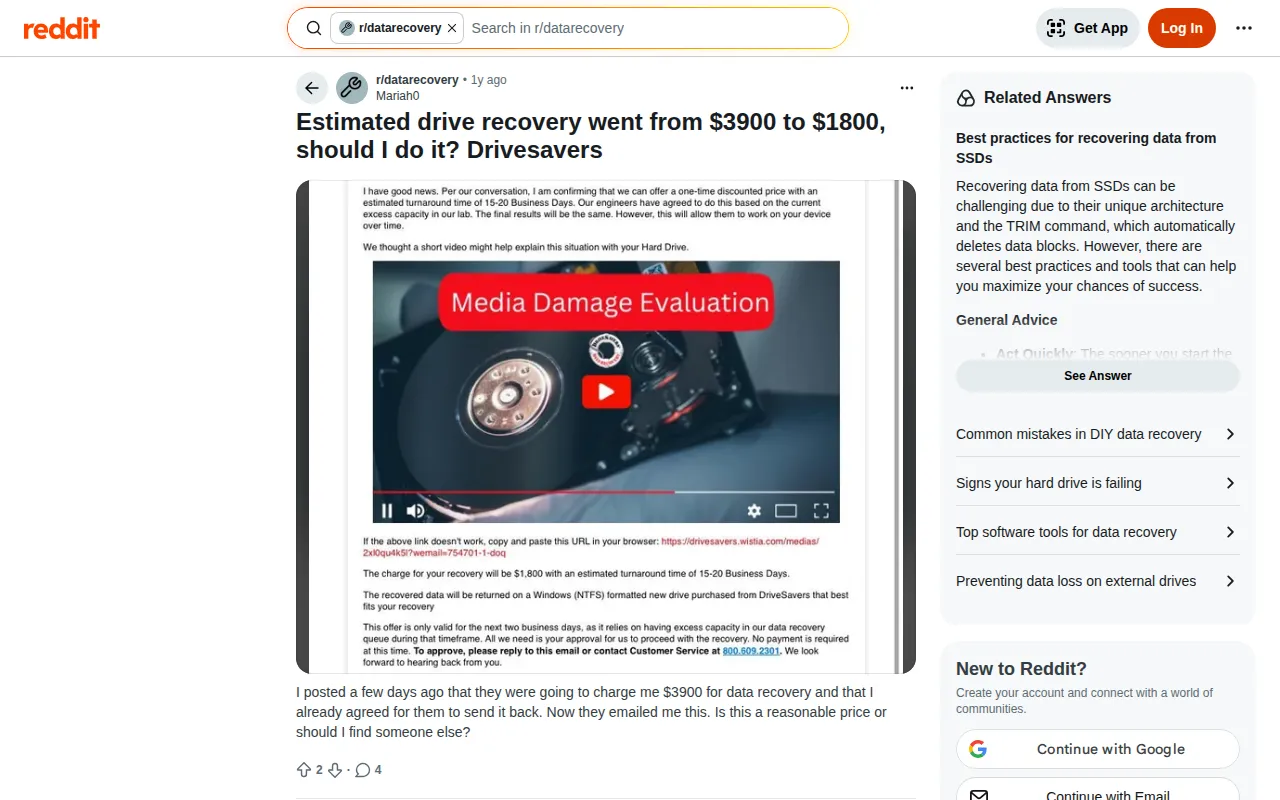
- Discount on decline. When the customer says the price is too high, the lab drops it 30-90%. A $3,900 quote becomes $1,800. A $6,000 quote becomes $1,260. A $1,760 quote becomes $900. These are documented instances, not hypotheticals.
Check the Pricing Page Before You Ship
Before shipping your drive anywhere, check whether the company publishes dollar amounts on their pricing page. Here is what four major national data recovery brands show:
| Company | Pricing Page | Dollar Figures? |
|---|---|---|
| DriveSavers | drivesaversdatarecovery.com/drivesavers-pricing-and-recovery-costs/ | No. "Contact Us" form only. |
| SalvageData | No /pricing/ page exists | No pricing page at all. |
| SecureData | securedatarecovery.com/services/how-much-does-data-recovery-cost | Vague "$100-$300/hour." Custom quotes. |
| PITS Global | pitsdatarecovery.com | No. "Get A Free Evaluation" only. |
A Pricing Model That Only Works When You Cannot Compare
A grocery store with no price tags on the shelves. You fill your cart, reach the register, and the cashier looks you over before naming a total. If you flinch, the total drops 30%. The original number was never based on the cost of the items. It was based on what the cashier thought you would accept.
This is how opaque data recovery pricing works. You ship your drive. The lab runs a diagnostic. The quote that comes back is not anchored to a published price list because no price list exists. The number reflects your perceived willingness to pay. The evidence documented above shows the result: a 53% instant discount at one lab, a 90% instant discount at another.
Labs that publish fixed pricing tiers cannot play this game. Their prices are on their website, indexed by Google, and visible to every prospective customer before a drive ships. The diagnosis determines the tier. The tier determines the price. There is no cashier sizing you up at the register.
The pricing patterns documented on this page are not new. Charging different customers different prices for the same work, based on perceived ability to pay, is a business model built on information asymmetry. It is why this company exists.
What to Do When a Lab Quotes $3,000+ and Will Not Name the Failure
When a lab quotes $3,000 or more for a standard hard drive and will not explain which specific component failed, politely decline and cite budget constraints. If you have a helium drive with platter damage that is one thing, but the evidence documented on this page shows that this is often standard cases where what happens next is the price drops 30-90%. A $3,900 SSD quote dropped to $1,800. A $12,000+ quote for two laptops dropped to $1,260.
Four steps to test whether a quote is cost-based:
- Get the quote in writing. Ask what specific failure was diagnosed. "Mechanical failure" is not specific enough. Head failure, firmware corruption, and platter damage are three different procedures at three different price points.
- Politely decline. Say the price exceeds your budget. Do not counter-offer. Do not negotiate.
- Wait for the counter-offer. If the price drops, the original quote was not cost-based. A lab that loses money at the lower price would not offer it. A lab that still profits at the lower price set the original number above cost.
- Compare the counter-offer to published pricing tiers. Search for labs that list dollar amounts on their websites. If the discounted price still exceeds published tiers for the same failure type, the margin is still inflated.
At labs with published pricing tiers, this entire exercise is unnecessary. The diagnosis determines the tier. The tier determines the price. There is nothing to negotiate because the price was never a negotiating position; it was the cost of parts, labor, and equipment time for that specific failure mode.
What Do DriveSavers Customers Report About Pricing?
DriveSavers is a legitimate enterprise-grade laboratory operating since 1985 in Novato, California. They hold manufacturer authorizations from Apple, Western Digital, and Seagate, and their website states they maintain SOC 2 Type II compliance for enterprise clients including hospitals, government agencies, and Fortune 500 corporations. Maintaining audited security controls at that level is expensive, and those costs are built into every quote. Consumer complaints center on pricing, not capability. The issue is that individual consumers recovering personal files are funneled into the same enterprise cost structure. Documented quotes on Reddit range from $2,600 to $3,900 for standard consumer devices. Full analysis of DriveSavers pricing.
| Device | Quote | Outcome | Source |
|---|---|---|---|
| SSD | $3,900 | Dropped to $1,800 after decline (53% discount) | reddit.com/r/datarecovery/comments/1j69aiz/, 2025 |
| iPhone (crushed) | $2,600 | iPad Rehab recovered it for $810 (68% less) | reddit.com/r/datarecovery/comments/1e5mxwf/, 2024 |
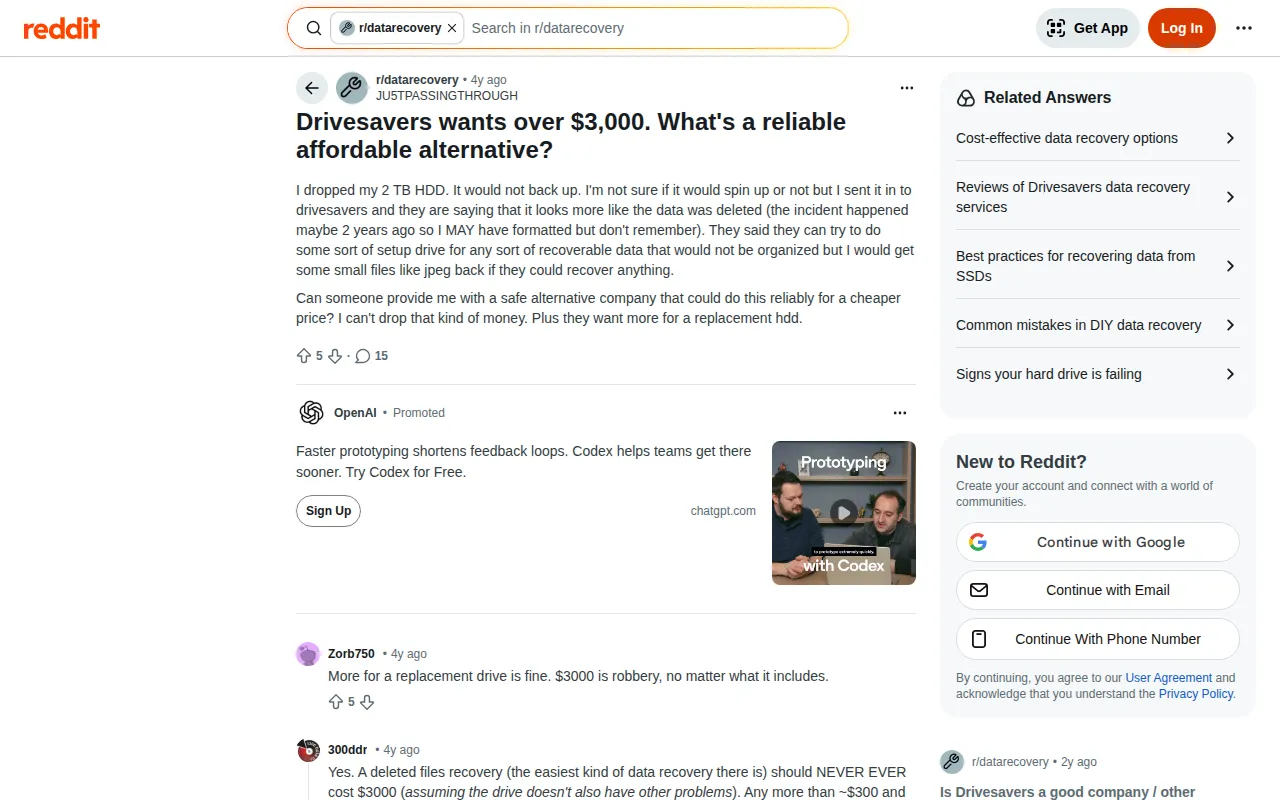
| 2TB HDD (logical/deleted files) | $3,000+ | Community response: "should NEVER cost $3,000" | reddit.com/r/datarecovery/comments/vjgz37/, 2022 |
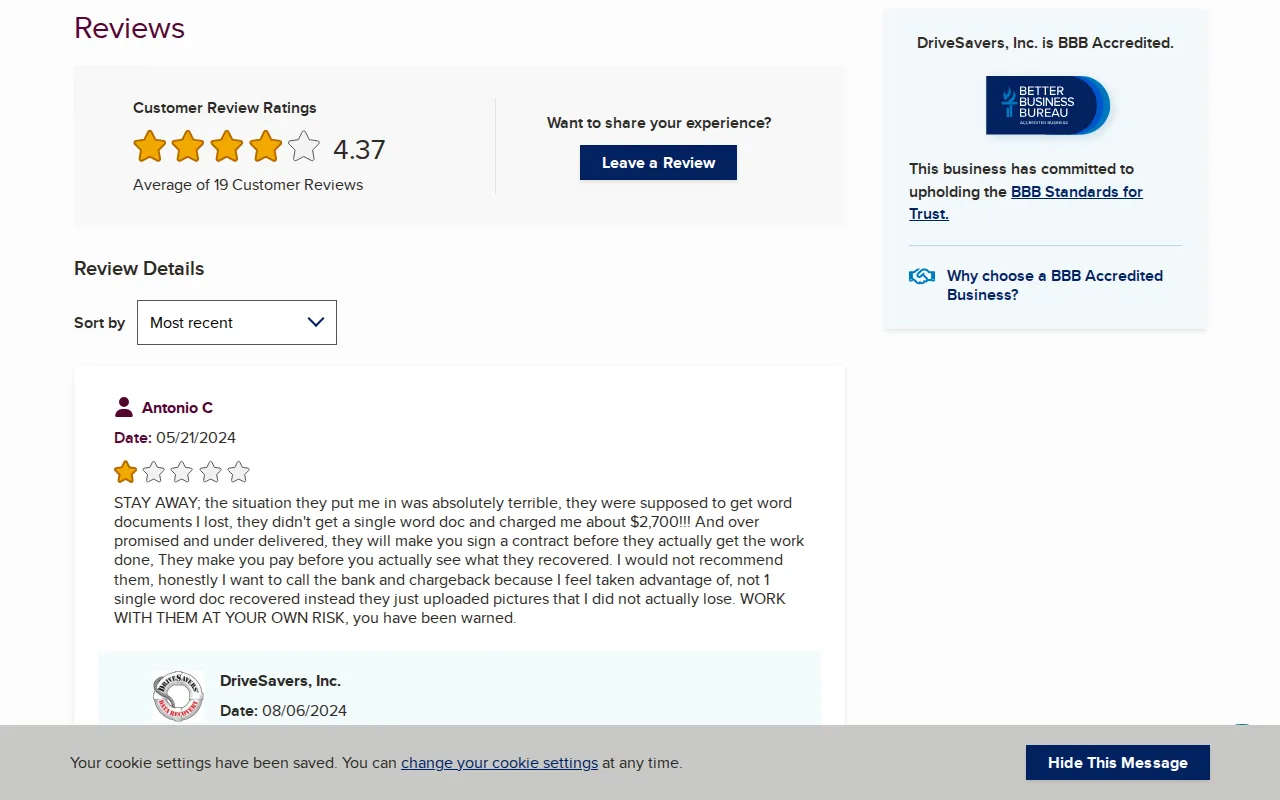
| Unspecified (Word docs) | ~$2,700 (charged) | Paid in full; zero target files recovered | bbb.org/us/ca/novato/profile/data-recovery/drivesavers-inc-1116-15889/customer-reviews, 2024 |
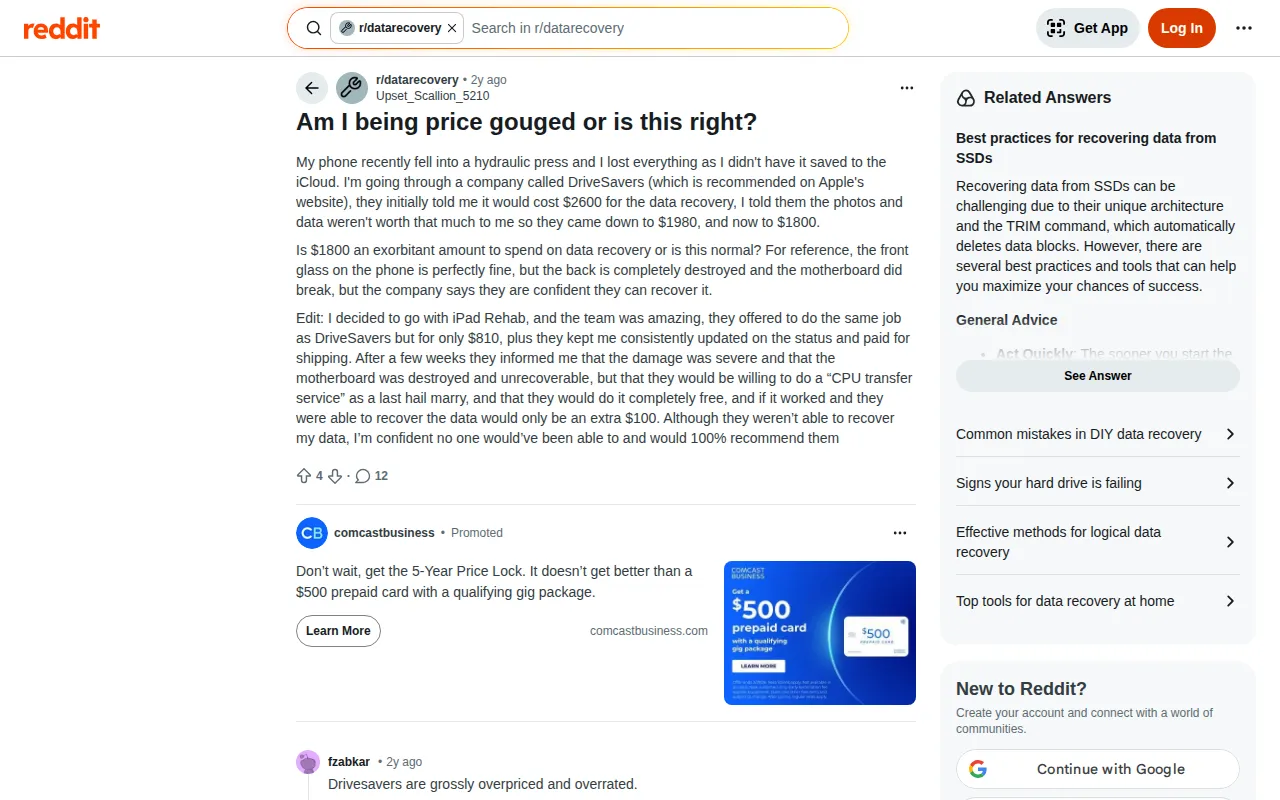
iPad Rehab (Jessa Jones, PhD) has documented multiple cases where DriveSavers quoted $2,800 to $3,500 for iPhones that needed only a screen replacement. Source: ipadrehab.com/article.cfm?ArticleNumber=55
What Do SalvageData Customers Report About Pricing?
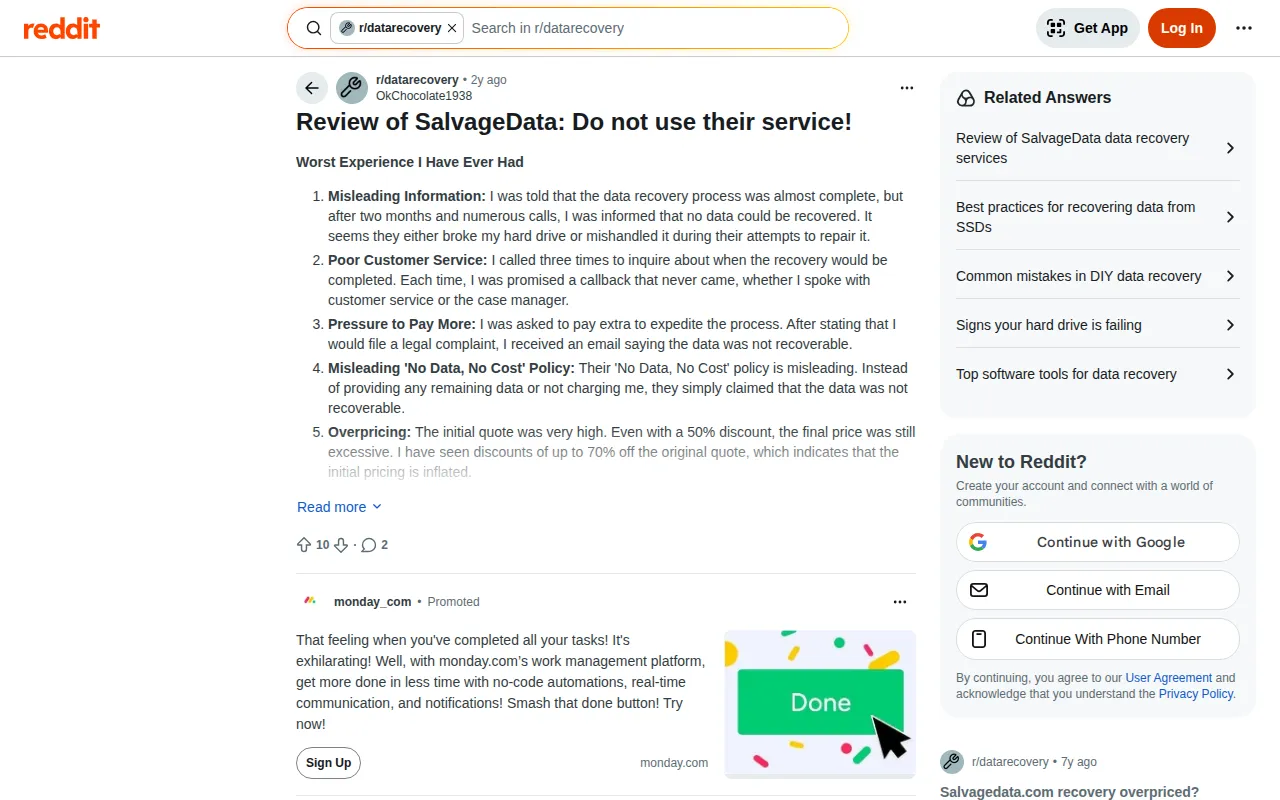
SalvageData is a data recovery company headquartered in Highland Heights, Ohio. They operate a centralized lab with drop-off locations across the United States and perform mechanical, firmware, and logical recoveries. Consumer complaints center on pricing practices, not technical capability. Documented patterns include initial quotes that drop 50-90% after the customer declines. Full analysis of SalvageData.
| Device | Quote | Outcome | Source |
|---|---|---|---|
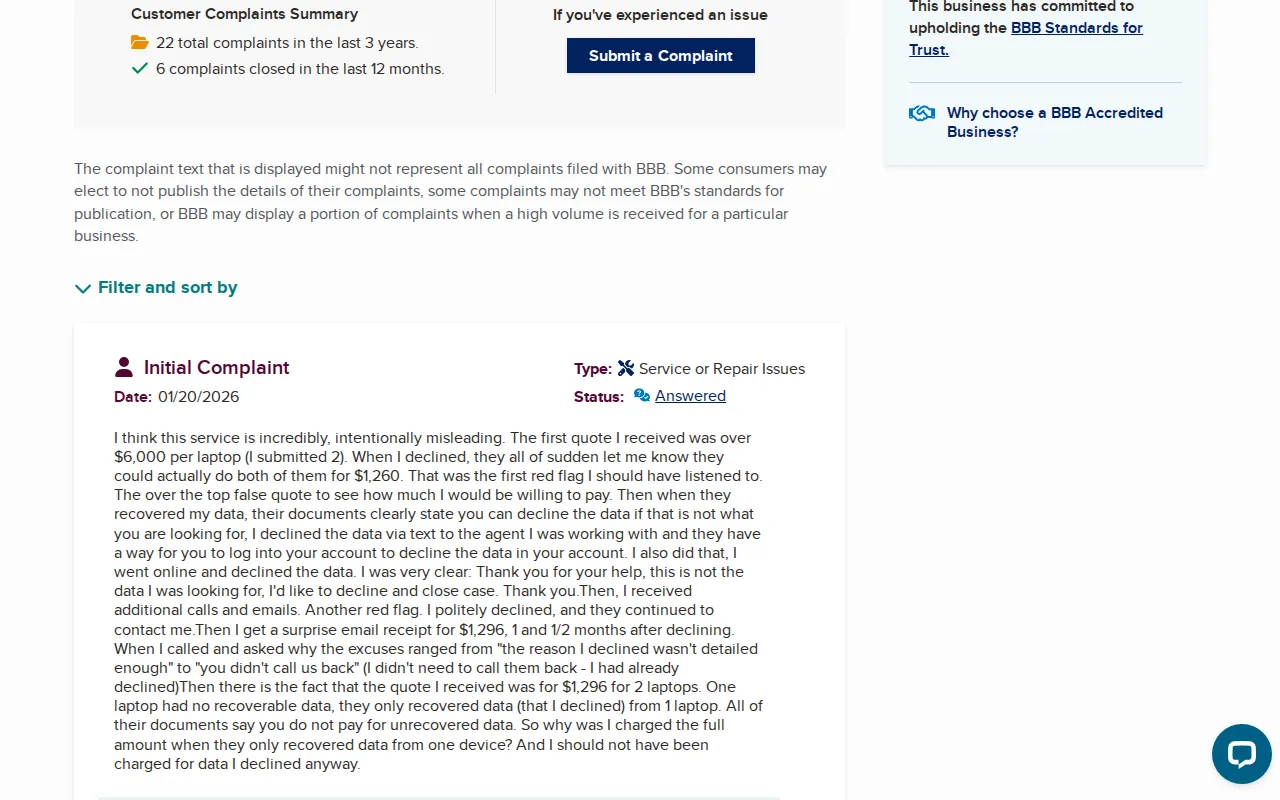
| 2 Laptops | $6,000+ each ($12,000+ total) | Dropped to $1,260 total after decline (90% discount) | bbb.org/us/oh/highland-heights/profile/data-recovery/salvagedata-recovery-services-0312-92037668/complaints, Jan 2026 |
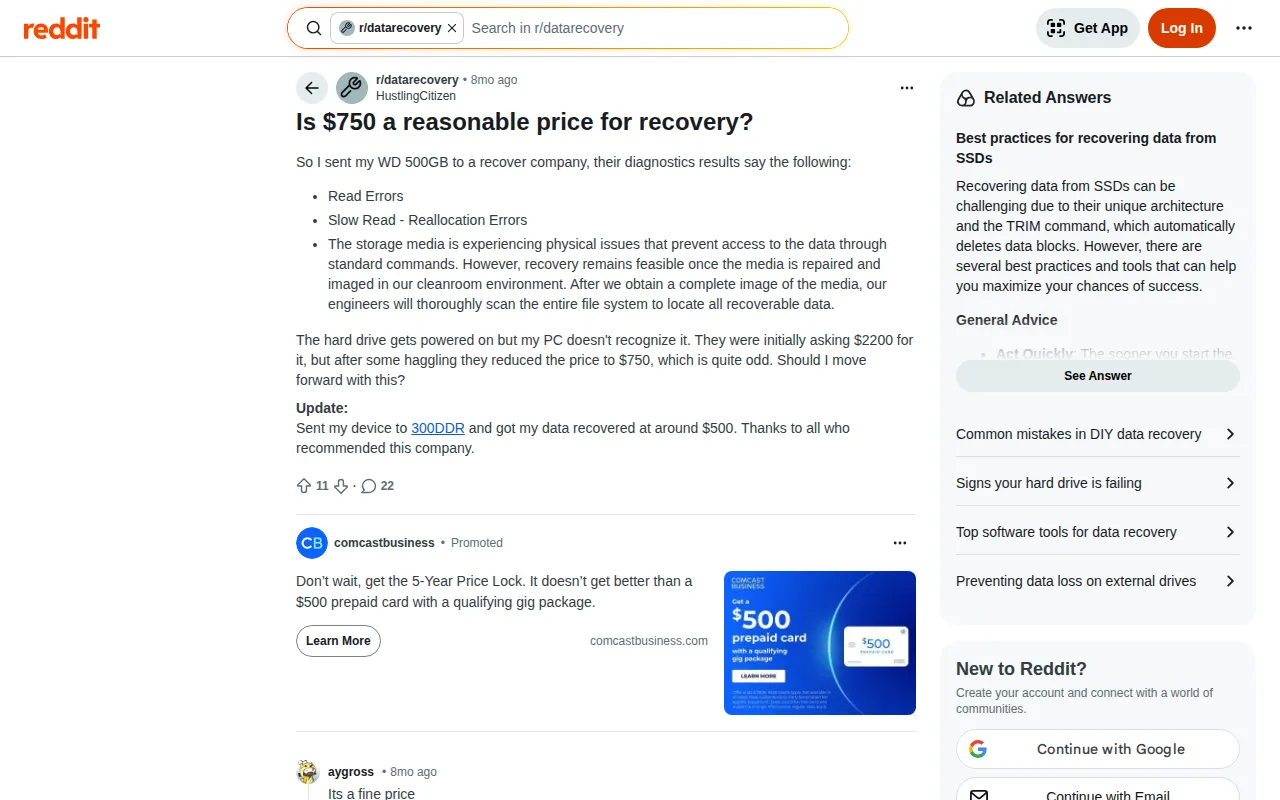
| WD 500GB HDD | $2,200 | Haggled to $750. $300 Data Recovery did it for $500. | reddit.com/r/datarecovery/comments/1m0rnc6/, 2025 |
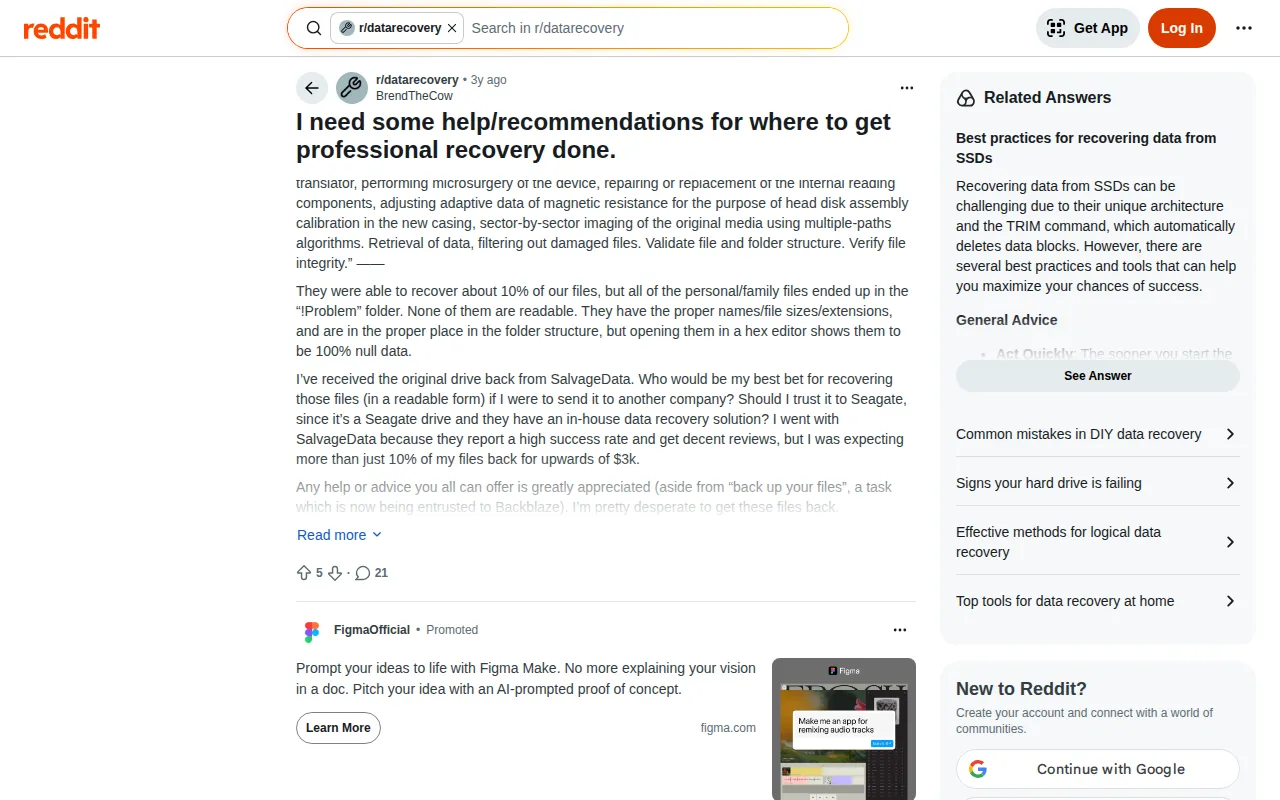
| Seagate drive | $3,000+ | Only 10% of files recovered. $500 non-refundable "fast eval" fee. | reddit.com/r/datarecovery/comments/16zmssl/, 2023 |
| Hard drive / SSD | "Very high" (50-70% discounts offered) | Still "excessive" after 50% off. Drive returned without casing. | reddit.com/r/datarecovery/comments/1fidel0/, 2024 |
"The first quote I received was over $6,000 per laptop (I submitted 2). When I declined, they all of sudden let me know they could actually do both of them for $1,260."
BBB complaint, January 2026. bbb.org/us/oh/highland-heights/profile/data-recovery/salvagedata-recovery-services-0312-92037668/complaints
What Do SecureData Customers Report About Pricing?
SecureData Recovery operates a centralized lab with intake locations across the United States. They advertise ISO 4 / Class 10 cleanroom certification and list over 50 locations. Their website states they hold SOC 2 and SOC 3 certifications for enterprise data handling. Like DriveSavers, maintaining that compliance infrastructure adds real cost. Consumer complaints on r/datarecovery center on pricing, not technical capability. Documented patterns include high initial quotes, discounts on pushback, and one case where a price reduction was conditioned on the removal of a negative review. Full comparison with SecureData.
| Device | Quote | Outcome | Source |
|---|---|---|---|
| Water-damaged iPhone | $1,760 | Offered $900 if customer removed negative review. Phone worked without repair on return. | reddit.com/r/datarecovery/comments/1aq44d3/, 2024 |
| Hard drive(s) | Phone: $395-$1,000. Actual: $2,000 | Price doubled after drive was shipped. $1,500 after decline. $40 return fee. | reddit.com/r/datarecovery/comments/1aq44d3/, 2023 |
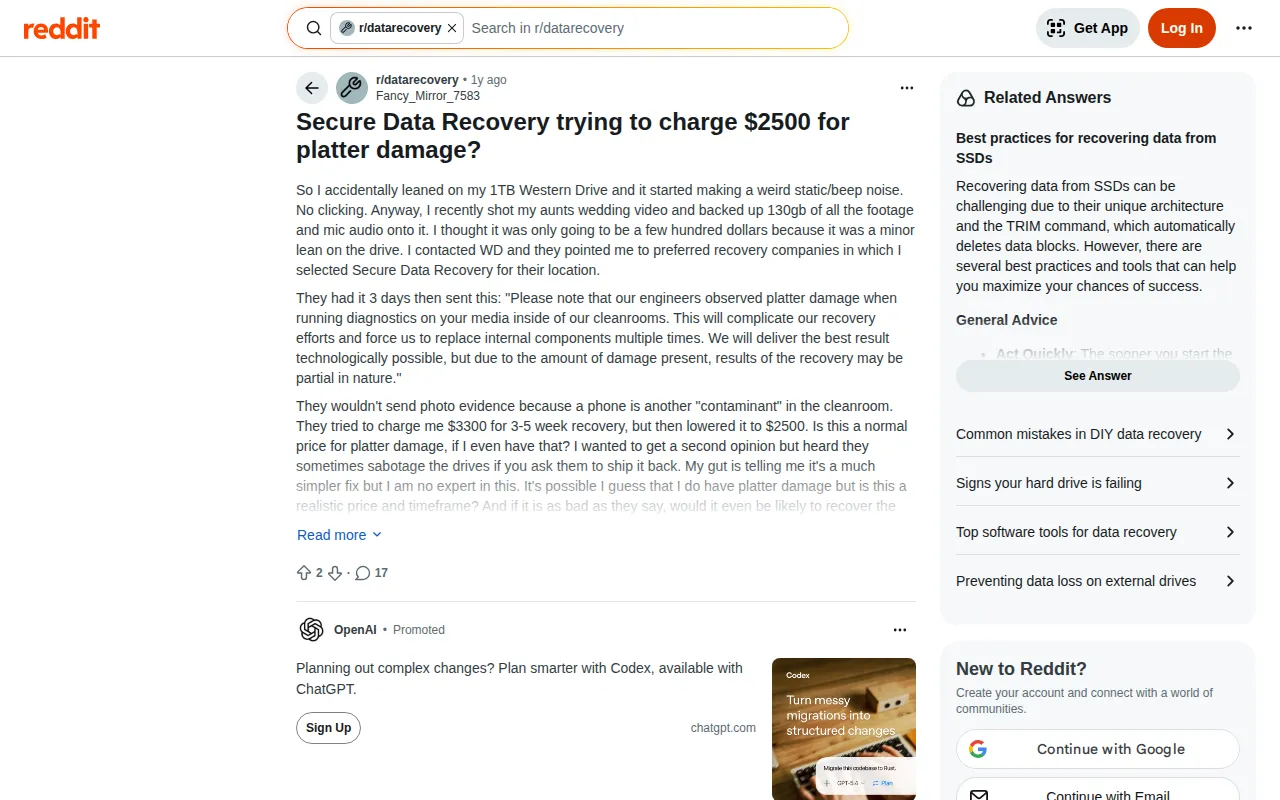
| 1TB Western Digital | $3,300 | Dropped to $2,500 after pushback (24% discount) | reddit.com/r/datarecovery/comments/1grd2nw/, 2024 |
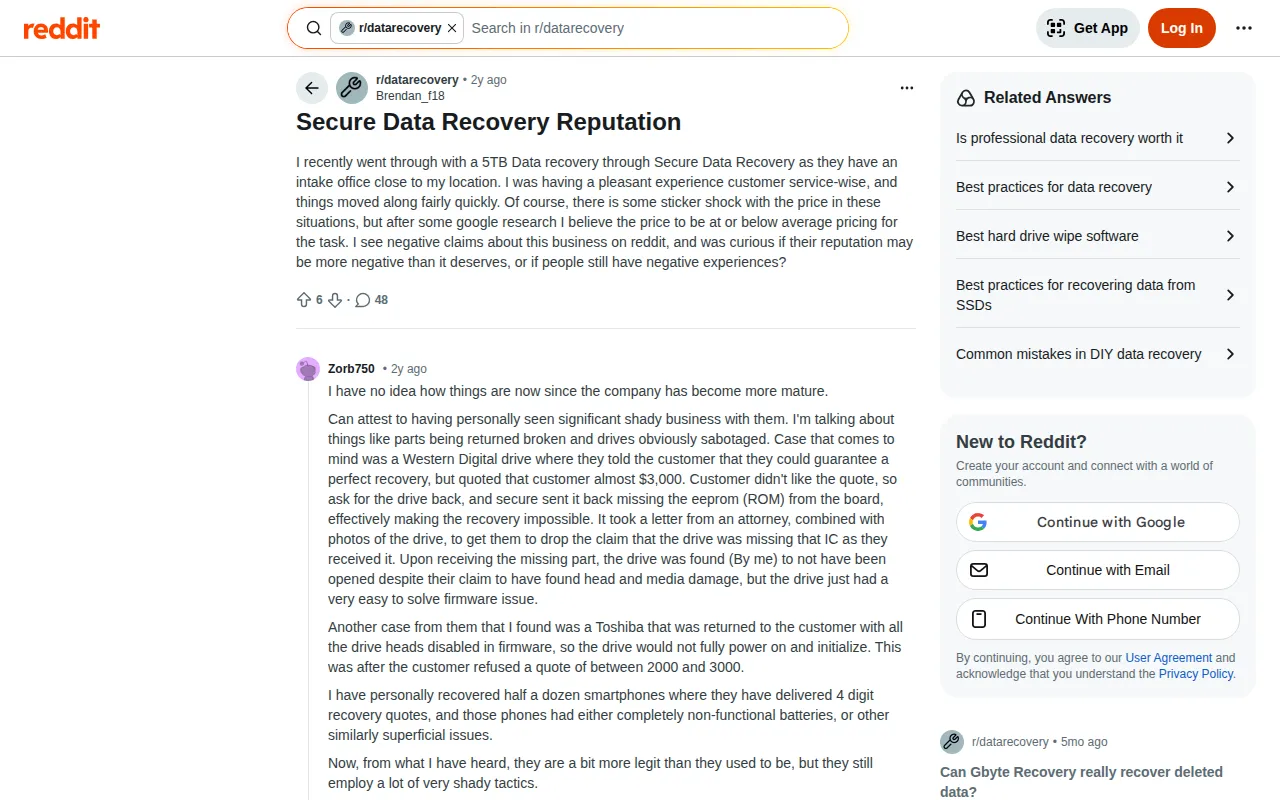
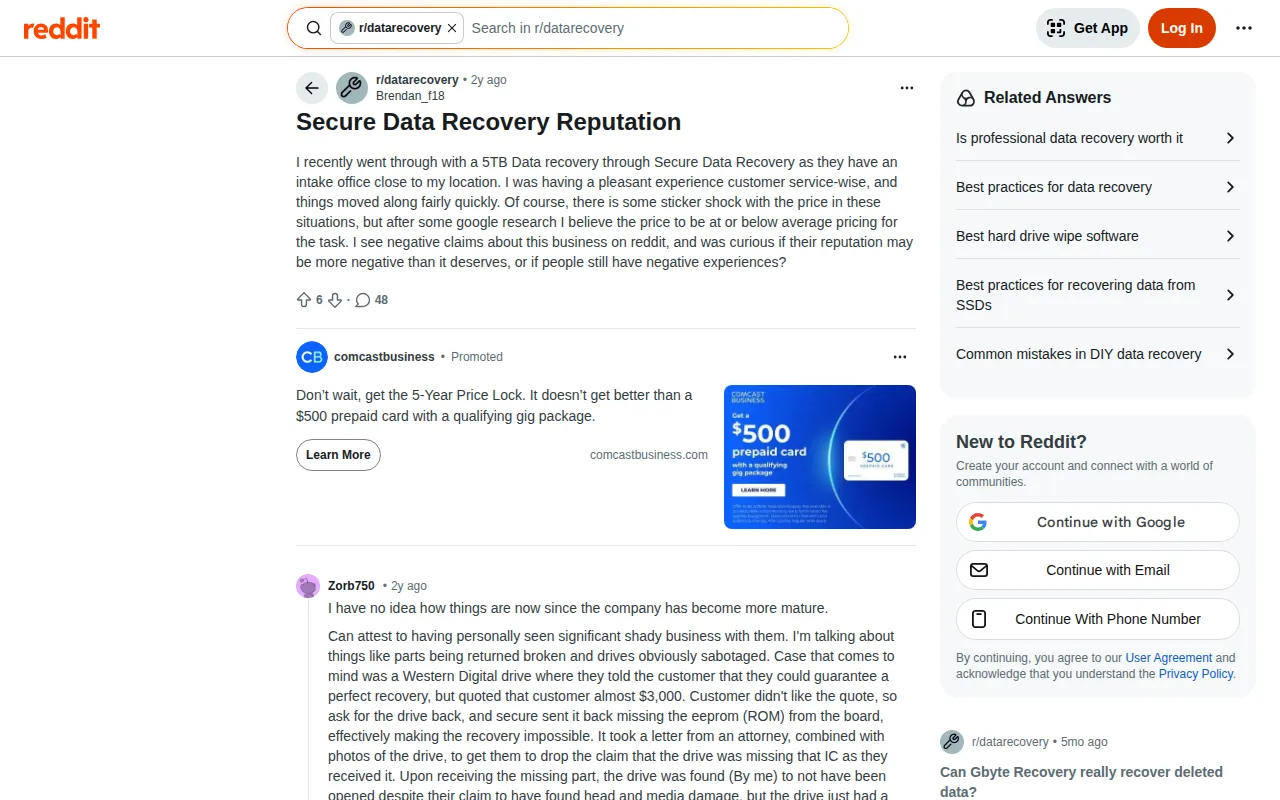
| WD and Toshiba drives | ~$3,000 and $2,000-$3,000 | Drives returned with EEPROM removed from PCB. Recovery made impossible. Required attorney. | reddit.com/r/datarecovery/comments/1aq44d3/, 2022 (Zorb750) |
"Secure Data quoted me $1,760... if I removed a negative review... they would lower the price to $900... it worked perfectly."
r/datarecovery, 2024. reddit.com/r/datarecovery/comments/1aq44d3/secure_data_recovery_reputation/
archive.org snapshot
In the same thread, Zorb750, a data recovery professional posting on r/datarecovery, describes one Western Digital drive returned to a customer who declined a quote of almost $3,000, “missing the eeprom (ROM) from the board, effectively making the recovery impossible.” Without that ROM, the drive's adaptive parameters are lost and recovery at any other lab becomes far more difficult. The same comment opens by saying “I have no idea how things are now since the company has become more mature,” so read it as an account of past conduct rather than a description of the company today.
What Do PITS Global Customers Report About Pricing?
PITS Global Data Recovery (also operating as Pitts Technology) is based in Brooklyn, New York, and performs hard drive, SSD, and RAID recovery. Consumer complaints center on pricing and business practices, not technical capability. BBB complaints describe cancellation fees applied to a minor and debt collection for failed recoveries.
| Device | Quote | Outcome | Source |
|---|---|---|---|
| 4TB WD Passport | $2,400 (standard) / $4,700 (rush) | Competitor quoted $500 max for same drive | reddit.com/r/datarecovery/comments/x10eef/, 2022 |
| Hard drive (minor customer) | $2,000 total; $1,139 cancellation fee (60%) | Minor signed contract. Drive held until fee paid. | bbb.org/us/ny/brooklyn/profile/data-recovery/pits-data-recovery-0121-87139625/complaints, 2025 |
| 6TB External HDD | $1,975 + $75 | Recovered 320GB of 4.5TB (7%). Threatened with debt collectors. | bbb.org/us/ny/brooklyn/profile/data-recovery/pits-data-recovery-0121-87139625/complaints, 2024 |
"She is a minor... demanding a $1,139.40 cancellation fee (60%)... refusing to return our hard drive."
BBB complaint, 2025. bbb.org/us/ny/brooklyn/profile/data-recovery/pits-data-recovery-0121-87139625/complaints
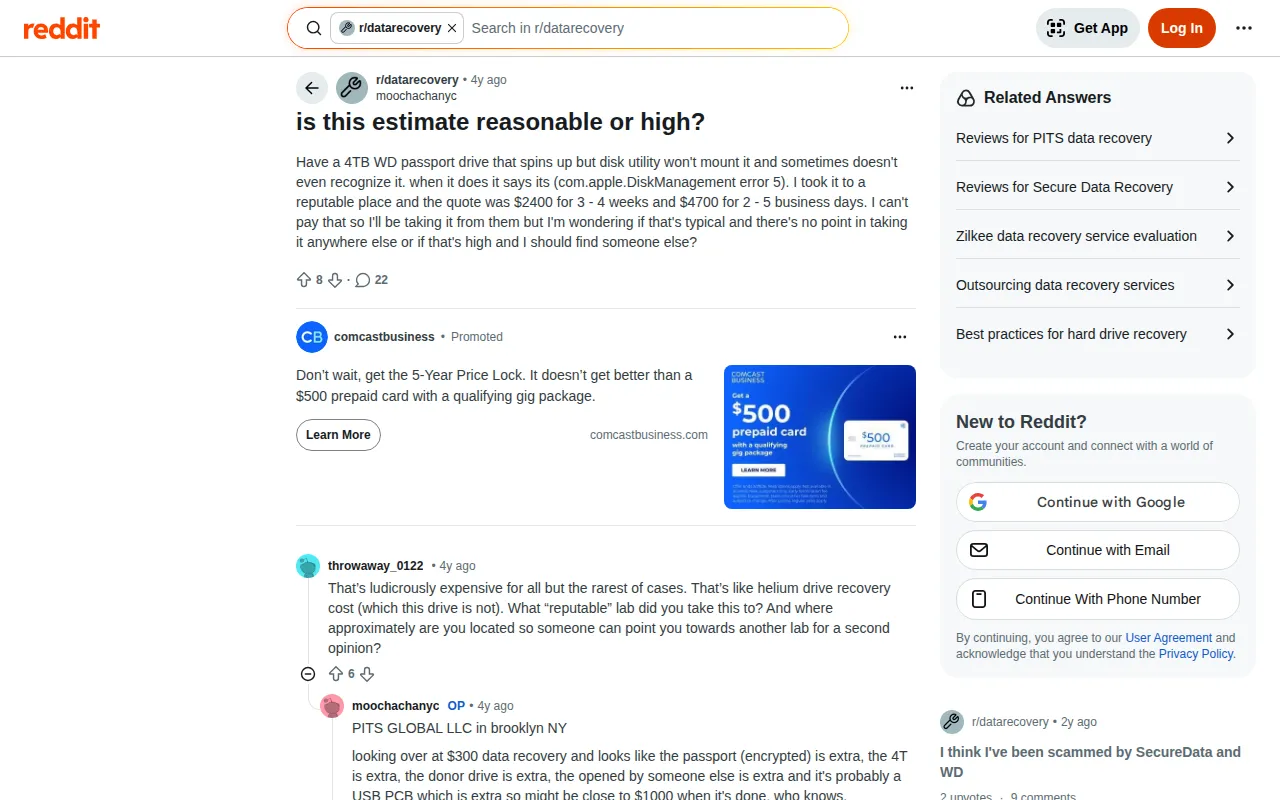
SalvageData and DonorDrives: Disclosed Business Relationship
DonorDrives is a used hard drive parts supplier that sells donor drives and PCBs to data recovery labs. SalvageData publicly states that DonorDrives is its "owned parts supplier." Consumers should be aware of these business relationships when evaluating where to send their drives.
Confirmed Facts
- Bogdan (Don) Glushko is CEO of both SalvageData and DonorDrives.Source: donordrives.com About page; corporate profiles
- SalvageData's website states: "Easy access from SalvageData's owned parts supplier, Donor Drives LLC, to expedite and reduce cost."Source: salvagedata.com/about
- DonorDrives operates at 41 Alpha Park, Cleveland, OH. SalvageData operates at 43 Alpha Park, Highland Heights, OH. Adjacent suites in the same business complex.
- SalvageData's Terms of Service state: "Any property left with SALVAGEDATA Recovery and unclaimed for 14 calendar days, will be securely disposed of" and "SALVAGEDATA Recovery reserves the right to securely dispose of or keep the original media for further research and development."
DonorDrives Pricing vs. Open Market
DonorDrives prices used hard drives based on firmware rarity rather than capacity. DonorDrives states on its product pages: "This donor hard drive is priced, based on its rarity, rather than capacity or condition."
| Source | Seagate 1TB ST1000DM010 | Condition |
|---|---|---|
| DonorDrives | $156 - $199 | Used / Tested |
| DonorDrives (PCB only) | $59.50 | Used |
| eBay | $30 - $40 | Used / Refurbished |
| Newegg | $50 - $115 | Brand New |
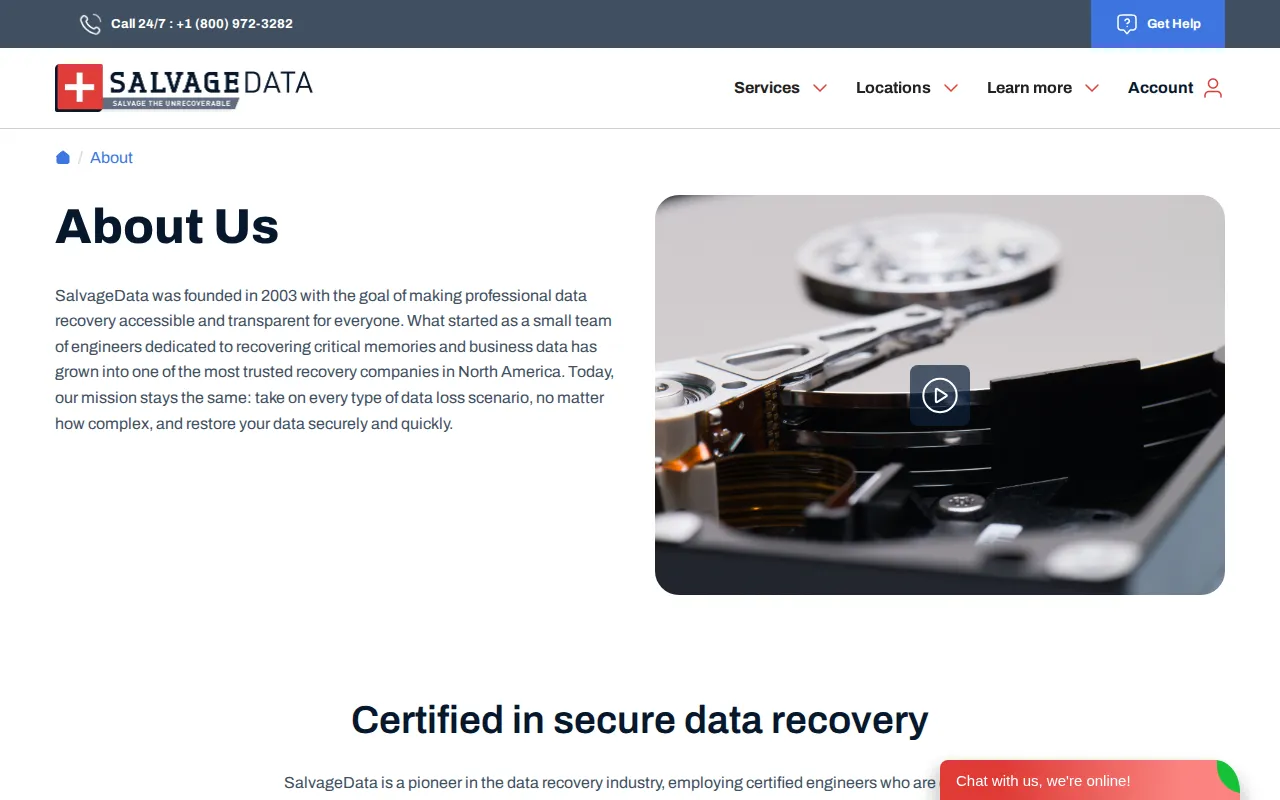
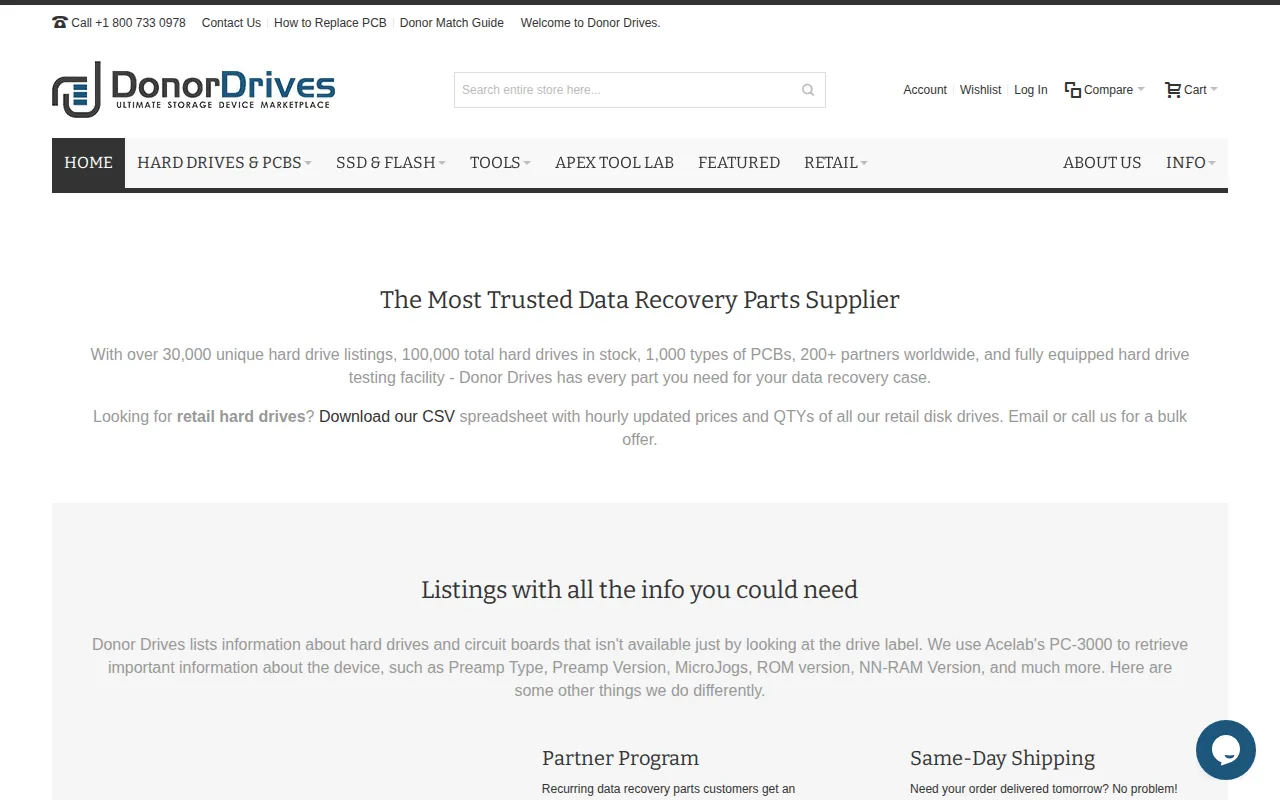
The Terms of Service and corporate ownership structure are public record. Consumers should evaluate these disclosed relationships when deciding where to send their drives.
How Do Published Prices Compare to Documented Quotes?
The left column shows prices published on lab websites. The right column shows prices documented in consumer complaints on Reddit, BBB, and Trustpilot. Every figure in the right column traces to a specific, verified public source.
| Factor | Rossmann (Published) | Documented Competitor Quotes |
|---|---|---|
| HDD: Logical Recovery | $100 simple copy; file system recovery from $250 | $1,050 - $3,000+ |
| HDD: Head Swap | $1,200–$1,500 + donor | $2,400 - $4,700 |
| Helium HDD: Head Swap | $3,000–$4,500 + helium + donor | Not disclosed upfront; quoted as standard head swap |
| SSD Recovery | $200–$1,500 | $1,600 - $3,900 |
| iPhone Recovery | $500–$750 | $1,760 - $4,000 |
| Diagnostic Fee | $0 | $0 - $500 |
| Prices Published Online | Yes (5 tiers per device type) | No (all four companies) |
| Discount After Decline | N/A (fixed tiers) | 24% - 90% documented |
Competitor quotes are from consumer complaints on Reddit (r/datarecovery, r/DataHoarder), the Better Business Bureau, and Trustpilot. Every figure is sourced from a specific post or complaint. You can see our published data recovery cost ranges for comparison. For the full methodology, see why data recovery costs so much.
What Does Transparent Data Recovery Pricing Look Like?
Transparent pricing means publishing fixed tiers on your website so customers know the cost before shipping their drive. The tier is determined by the diagnosis, not by negotiation. Below are our published pricing tables for hard drive and SSD recovery.
Hard Drive Recovery: 5 Published Tiers
- Low complexity
Simple Copy
Your drive works, you just need the data moved off it
Functional drive; data transfer to new media
Rush available: +$100
$100
3-5 business days
- Low complexity
File System Recovery
Your drive isn't recognized by your computer, but it's not making unusual sounds
File system corruption. Accessible with professional recovery software but not by the OS
Starting price; final depends on complexity
From $250
2-4 weeks
- Medium complexity
Firmware Repair
Your drive is completely inaccessible. It may be detected but shows the wrong size or won't respond
Firmware corruption: ROM, modules, or translator tables corrupted; requires PC-3000 terminal access
CMR drive: $600. SMR drive: $900.
$600–$900
3-6 weeks
- High complexity
Head Swap
Bench diagnosis found the read/write heads have to be replaced. Clicking can also come from firmware, the preamp, or the spindle
Head stack assembly failure. Transplanting heads from a matching donor drive on a clean bench
50% deposit required. CMR: $1,200-$1,500 + donor. SMR: $1,500 + donor.
50% deposit required
$1,200–$1,500
4-8 weeks
- High complexity
Surface / Platter Damage
Your drive was dropped, has visible damage, or a head crash scraped the platters
Platter scoring or contamination. Requires platter cleaning and head swap
50% deposit required. Donor parts are consumed in the repair. Most difficult recovery type.
50% deposit required
$2,000
4-8 weeks
Hardware Repair vs. Software Locks
Our "no data, no fee" policy applies to hardware recovery. We do not bill for unsuccessful physical repairs. If we replace a hard drive read/write head assembly or repair a liquid-damaged logic board to a bootable state, the hardware repair is complete and standard rates apply. If data remains inaccessible due to user-configured software locks, a forgotten passcode, or a remote wipe command, the physical repair is still billable. We cannot bypass user encryption or activation locks.
No data, no fee. Free evaluation and firm quote before any paid work. Full guarantee details. Head swap and surface damage require a 50% deposit because donor parts are consumed in the attempt.
- Rush fee
- +$100 rush fee to move to the front of the queue
- Donor drives
- Donor drives are matching drives used for parts. Typical donor cost: $50–$150 for common drives, $200–$400 for rare or high-capacity models. We source the cheapest compatible donor available.
- Target drive
- The destination drive we copy recovered data onto. You can supply your own, or we'll provide one. For larger capacities (8TB, 10TB, 16TB and above), target drives cost $400+ extra. All prices are plus applicable tax.
Sealed helium drives are on their own price list, $200–$5,000+. When a head swap or platter repair opens one, we refill it with helium. That adds $400–$800, and the donor has to be an exact match. Helium drive prices
SSD Recovery: 5 Published Tiers
Low complexity
Simple Copy
Your drive works, you just need the data moved off it
Functional drive; data transfer to new media
Rush available: +$100
$200
3-5 business days
Low complexity
File System Recovery
Your drive isn't showing up, but it's not physically damaged
File system corruption. Visible to recovery software but not to OS
Starting price; final depends on complexity
From $250
2-4 weeks
Medium complexity
Circuit Board Repair
Your drive won't power on or has shorted components
PCB issues: failed voltage regulators, dead PMICs, shorted capacitors
May require a donor drive (additional cost)
$450–$600
3-6 weeks
Medium complexity
Most Common
Firmware Recovery
Your drive is detected but shows the wrong name, wrong size, or no data
Firmware corruption: ROM, modules, or system files corrupted
Price depends on extent of bad areas in NAND
$600–$1,200
3-6 weeks
High complexity
PCB / NAND Swap
Your drive's circuit board is severely damaged and requires NAND chip transplant to a donor PCB
NAND swap onto donor PCB. Precision microsoldering and BGA rework required
50% deposit required; donor drive cost additional
50% deposit required
$1,200–$1,500
4-8 weeks
Hardware Repair vs. Software Locks
Our "no data, no fee" policy applies to hardware recovery. We do not bill for unsuccessful physical repairs. If we replace a hard drive read/write head assembly or repair a liquid-damaged logic board to a bootable state, the hardware repair is complete and standard rates apply. If data remains inaccessible due to user-configured software locks, a forgotten passcode, or a remote wipe command, the physical repair is still billable. We cannot bypass user encryption or activation locks.
No data, no fee. Free evaluation and firm quote before any paid work. Full guarantee details. NAND swap requires a 50% deposit because donor parts are consumed in the attempt.
- Rush fee
- +$100 rush fee to move to the front of the queue
- Donor drives
- A donor drive is a matching SSD used for its circuit board. Typical donor cost: $40–$100 for common models, $150–$300 for discontinued or rare controllers.
- Target drive
- The destination drive we copy recovered data onto. You can supply your own, or we'll provide one. All prices are plus applicable tax.
No diagnostic fee. No evaluation deposit. No data, no recovery fee. The tier is assigned after diagnosis. The price does not change based on how much your data is worth to you. Read verified customer reviews from 1,837+ Google ratings.
Know the Price Before You Ship
Five published pricing tiers. No diagnostic fee. No data, no recovery fee. The price is based on the failure type, not on how much your data is worth to you.
Why Does Fixed-Tier Pricing Benefit Consumers?
Fixed-tier pricing removes negotiation from the recovery process. The diagnosis determines the tier. The tier determines the price. The customer's emotional state, the perceived value of their data, and their willingness to pay do not affect the number.
In a tier-based system, a PC-3000 diagnosis identifies the failure mode: logical corruption, firmware fault, mechanical head failure, or platter surface damage. Each failure mode maps to a fixed price range that covers the cost of parts, labor, and equipment time. A head swap costs $1,200–$1,500 plus a donor drive (typically $50–$150) whether the drive contains wedding photos or corporate financial records. Helium-sealed drives carry a separate tier at $3,000–$4,500 because the sealed chamber must be opened and refilled with helium ($400–$800), and exact-match donors for helium drives cost more ($200–$600).
Head stack assembly replacement performed at the Rossmann Repair Group lab in Austin, TX. This is the procedure referenced at the $1,200–$1,500 tier.
When a company does not publish pricing, the quote becomes a negotiation. The lab has your drive. You need your data. The lab names a number based on what it thinks you will pay, not what the repair costs. The evidence documented on this page shows what happens next: the customer declines, the lab drops the price, and the final number bears no relationship to the original quote.
A 53% instant discount (DriveSavers: $3,900 to $1,800) or a 90% instant discount (SalvageData: $12,000+ to $1,260) means the original quote was not based on cost. If it were, the lab would lose money at the discounted price. The discount proves the initial number was a test.
Where the Money Goes: Recovery Labor vs. Marketing Overhead
Opaque pricing is not random. It reflects a cost structure built on customer acquisition costs that independent labs do not carry. The price difference between a $300 recovery and a $3,000 recovery is overhead, not capability.
- Google Ads
- Competitive keywords in the data recovery vertical cost $50 to $150+ per click in Google Ads (per Google Keyword Planner 2025 data for "data recovery service" and related terms). A lab running a large PPC campaign needs each customer to cover the cost of acquiring them plus the cost of every click that did not convert. If a lab spends $50,000 per month on ads and converts 50 customers, each customer carries $1,000 in advertising overhead before parts or labor.
- Referral Commissions
- DriveSavers operates a Reseller Partner Program with over 20,000 partners. Apple's support page (support.apple.com/en-us/102020) lists DriveSavers as a recommended recovery provider. Each referral generates a commission that is built into the customer's final quote. Labs without referral networks do not carry this cost.
- Sales Infrastructure
- Labs that do not publish pricing need sales teams to handle quote calls, follow-up emails, and price negotiation. A sales floor, CRM system, and support staff add fixed overhead that gets distributed across every recovery job.
- Facility Overhead
- SSD and iPhone recovery do not require a cleanroom. SSDs contain no spinning platters and no read/write heads flying over exposed surfaces. Labs that charge cleanroom-tier pricing for solid-state device recovery are applying a facility cost to work that does not use the facility. For more detail, see why data recovery costs so much.
How to Evaluate a Data Recovery Quote
Before approving any data recovery quote, run through this checklist. Every item is based on the pricing patterns documented in the complaint data above.
- Demand a specific diagnosis. "Mechanical failure" is not a diagnosis. Ask: which component failed? Is it a head failure, firmware corruption, PCB failure, or platter surface damage? Each has a different cost. A proper diagnostic process identifies the exact failure mode before quoting a price.
- Check for published pricing. Search the company's website for dollar figures. If the pricing page says "Contact Us" or "Free Evaluation," the price will be whatever the lab decides after receiving your drive.
- Ask about fees before shipping. What is the diagnostic fee? The evaluation deposit? The cancellation fee? The return shipping fee? Get every answer in writing before your drive leaves your possession.
- Compare to published tiers at other labs. If one lab quotes $3,000 for a standard hard drive and another publishes $1,200–$1,500 for the same failure type, the difference is not capability. Both labs use PC-3000. Both do head swaps. The difference is overhead.
- Test the quote with a decline. If the price drops, the original quote was not cost-based. See the polite decline section above for the full strategy.
- Never approve work without understanding the failure mode. A clicking drive needs a head swap. A firmware-locked drive needs a PC-3000 firmware rebuild. A physically damaged platter needs surface imaging. Each failure mode has a well-understood cost range. If the quote does not correspond to a specific procedure, ask why.
Frequently Asked Questions
What is bait-and-switch pricing in data recovery?
A lab advertises "free evaluation" or a wide price range ($500 to $2,800). After you ship your drive, the quote lands at the top of that range or higher. When you decline and request your drive back, the lab drops the price 30-90%. The initial quote was never based on the cost of the work; it was a test of how much you would accept.
Why do some data recovery companies refuse to publish prices?
Publishing prices caps your revenue per customer. Without published prices, a lab can quote based on perceived data value rather than repair difficulty. A $300 firmware fix becomes a $2,400 quote when the customer mentions irreplaceable photos. Labs with published tiers cannot inflate quotes because the price list is public and searchable.
How can I tell if a data recovery quote is inflated?
Ask for a specific diagnosis before approving work. If the lab quotes a price range wider than 3x (e.g., $500 to $2,800), they have not diagnosed the drive. If the price drops when you decline, the original quote was not based on cost. Compare the quote to published pricing tiers from labs that list prices on their websites.
Which data recovery companies publish their prices?
Rossmann Repair Group publishes five HDD tiers ($100–$2,000) and five SSD tiers ($200–$1,500) on its website. $300 Data Recovery in Los Angeles charges a flat $300 for most hard drives. Desert Data Recovery in Phoenix publishes pricing on their website. iPad Rehab publishes per-service pricing for iPhone and iPad recovery.
Can a data recovery company charge me after I decline their quote?
Some data recovery companies include cancellation fees or binding terms in their service agreements. Review the terms of service before shipping your drive. Ask whether a deposit or cancellation fee applies and get the answer in writing.
Why does the price drop when I ask for my drive back?
The initial quote includes maximum margin. When you decline, the lab faces two options: earn nothing or earn something. A 50% discount on an inflated quote still yields profit. Labs with fixed pricing tiers do not offer discounts because the published price is the actual cost of parts and labor for that failure type.
What is a fair price for hard drive data recovery?
At independent labs with proper equipment: a simple data copy runs $100, file system recovery From $250, firmware repair $600–$900, and a head swap $1,200–$1,500 (plus a donor drive, typically $50–$150). Surface damage cases can reach $2,000. Helium-sealed drives (common in NAS units, servers, and drives 8TB+) have a separate tier: head swap at $3,000–$4,500 plus helium refill ($400–$800) and donor drive. If a lab quotes $3,000+ for a single standard consumer hard drive, ask what specific failure justifies that price.
Is $1,000 too much for data recovery?
It depends on the failure. For logical corruption or file system recovery, $1,000 exceeds independent lab pricing; file system recovery starts at $250. For mechanical head swap requiring a donor drive, fair pricing is $1,200–$1,500 plus donor cost (typically $50–$150). Helium-sealed drives cost more ($3,000–$4,500 plus helium and donor) because the sealed chamber must be opened and refilled. Demand a specific diagnosis that names the failure mode before approving any quote.
Can a data recovery company hold my drive hostage?
Some companies include cancellation fees or binding terms in their service agreements. BBB complaints against PITS Global document a 60% cancellation fee charged to a minor, with the drive withheld until payment. Read the terms of service before shipping. Ask about deposits, cancellation fees, and drive return policies in writing before your drive leaves your possession.
Why do data recovery prices drop so fast?
The initial quote includes maximum margin, not the cost of parts and labor. When you decline, the lab faces earning nothing or earning something. A 50% discount on an inflated quote still yields profit. Labs with published fixed-tier pricing do not offer discounts because the listed price reflects actual parts, labor, and equipment time.
Why the quotes get accepted
Why So Many People Trust DriveSavers
A four-figure quote for a job an independent lab does for a few hundred dollars usually gets paid, and the reason is not that customers fail to notice the price. It is that the name arrives pre-trusted. When your drive dies and you walk into an Apple Store, the person at the Genius Bar often points you to DriveSavers. Coming from Apple, that reads as an official blessing, so the quote that follows feels like the price of doing it right rather than a number to question.
That referral is not new marketing. It goes back to a 1999 Apple support memo in which Apple agreed to accept drives that DriveSavers had opened without voiding the hardware warranty. Apple was careful to say the mention was "neither an endorsement nor a recommendation" and that DriveSavers is not an Apple Authorized Service Provider, but the practical effect over the following decades was a steady stream of Apple Store referrals and a trust halo that no amount of advertising can buy. Apple still lists DriveSavers on its current data-recovery support page today.
Understanding that causality is the point. The trust is real, but it traces to a warranty-logistics arrangement from 1999, not to any finding that the work is better or the pricing is fair. DriveSavers publishes no rate card, so the number arrives after the drive does; independent labs that publish their pricing let you check it first. For the full breakdown of the referral and what it costs you, see is DriveSavers legit.
Since 2008
Established
As Featured In
Related services
Need Recovery for Other Devices?
How we source claims and correct mistakes
Five published pricing tiers from $100–$2,000. No diagnostic fee.
SATA and NVMe SSD recovery from $200. Firmware repair, chip-off, NAND transplant.
Board-level microsoldering for dead iPhones. $500 or $750 depending on model.
The advertising tax, referral commissions, and cleanroom theater behind $3,000+ quotes.
How to choose a lab. Red flags, green flags, and price comparison tables.
What each failure type costs and why. Pricing breakdown by repair complexity.