
Helium Drive Data Recovery
We recover helium-sealed hard drives across all failure types, including mechanical head swaps with helium refill. Firmware repairs, PCB component work, and head replacements are all performed in-house at our Austin, TX lab. Helium cases use the same tier structure as standard hard drive data recovery, with additional helium refill cost for mechanical work. Five published pricing tiers from $200–$5,000+.

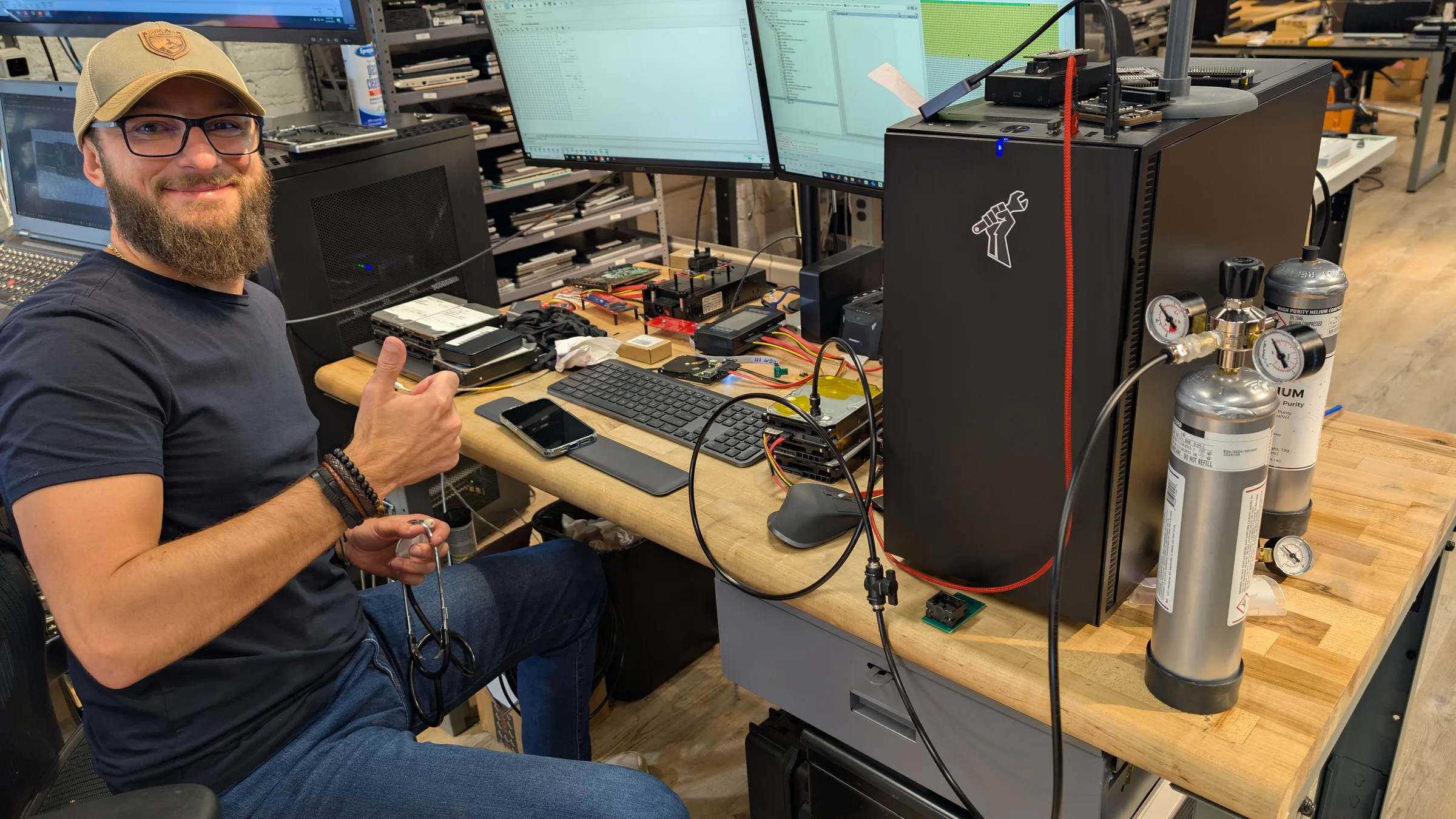
Full In-House Helium Recovery
Firmware and Electronic Failures
Many helium drive failures are firmware corruption, PCB component failure, or Service Area damage. These do not require opening the hermetic seal. We diagnose and repair these using PC-3000 with the appropriate Hitachi/HGST, Seagate, or WD modules.
- Firmware corruption and Service Area repair
- PCB component-level repair (motor driver IC, TVS diode, preamp power)
- ROM extraction and transplant (seal stays intact)
- Adaptive parameter correction via PC-3000
Mechanical Head Swaps with Helium Refill
When the read/write heads have failed, the motor has seized, or the platters are damaged, the hermetic seal must be breached. The drive is opened unpowered on a laminar flow bench, and it never spins again until the chassis is resealed and the helium is back. The read/write heads are aerodynamically tuned for helium's low density; running them in atmospheric air destabilizes head flight and risks head-platter contact.
We perform these mechanical recoveries in-house at our Austin lab. The head swap is done on our 0.02µm ULPA-filtered clean bench, then we refill the drive with helium and connect to PC-3000 for imaging.
- Head stack replacement with helium refill
- Motor and bearing failure repair
- Platter cleaning and surface damage recovery
How do helium drives differ from air-filled drives?
| Characteristic | Air-Filled HDD | Helium-Sealed HDD |
|---|---|---|
| Internal gas | Filtered atmospheric air (28.96 g/mol average) | Helium (4 g/mol) |
| Typical platter count | Up to 6 platters, up to 12 heads | Up to 9 platters, up to 18 heads |
| Enclosure design | Screwed top cover with breather filter | Laser-welded hermetic seal, no breather hole |
| Recovery environment | 0.02µm ULPA clean bench, atmospheric air | 0.02µm ULPA clean bench + helium refill after opening |
| Donor matching | Model, firmware rev, head map | Model, firmware rev, head map, sealed chamber generation |
The lower gas density inside a helium drive reduces aerodynamic drag on the read/write head sliders. Manufacturers use this to pack more platters into the same 3.5″ form factor. More platters means more heads, tighter tolerances, and a sealed enclosure that can't be reopened without helium replacement. Every aspect of the recovery is more constrained than a standard air-filled drive.
Why does in-house helium capability matter?
Some labs advertise helium drive recovery but open the drive on a standard bench without helium refill capability. In atmospheric air the heads experience the wrong aerodynamic lift for their design, flight becomes unstable, and head-platter contact can strip the magnetic coating from the platters. A failed recovery attempt on a helium drive does not just fail; it can destroy the chance of a second attempt.
Other labs that lack the equipment send the drive to a third party, adding cost, transit time, and a middleman between you and the engineer doing the work. You lose visibility into the process and cannot communicate directly with the technician handling your drive, which is worth weighing when evaluating local data recovery options versus a specialized mail-in lab.
We keep the entire process under one roof. From the initial PC-3000 diagnosis through the head swap, helium refill, and final imaging, your drive stays at our Austin lab. You speak directly with the technician working on your case.
How is a helium drive recovered?
- Diagnose with PC-3000. We connect the drive to PC-3000 and run the appropriate HGST, WD, or Seagate module. The diagnostic reads SMART data, including the helium telemetry each family actually reports (attribute 22 on WD and HGST, attributes 23 and 24 on Toshiba, terminal pressure readings on Seagate), tests head functionality, and identifies whether the failure is firmware, electronic, or mechanical.
- Identify the failure category. Firmware corruption (translator table damage, Service Area errors) is repaired directly through PC-3000 terminal commands. PCB failures are repaired at the component level. If the diagnostic confirms head failure, we proceed to mechanical recovery.
- Source a matching helium donor. The donor drive must match the target's model number, firmware revision, head map configuration, and sealed chamber generation. We maintain cataloged donor inventory and source from supplier networks when needed.
- Open on the clean bench and swap heads. The hermetic seal is breached on our 0.02µm ULPA-filtered clean bench. We remove the failed head stack assembly and transplant the donor heads. On drives with up to nine platters, each platter must be stabilized during the swap to prevent rotational offset.
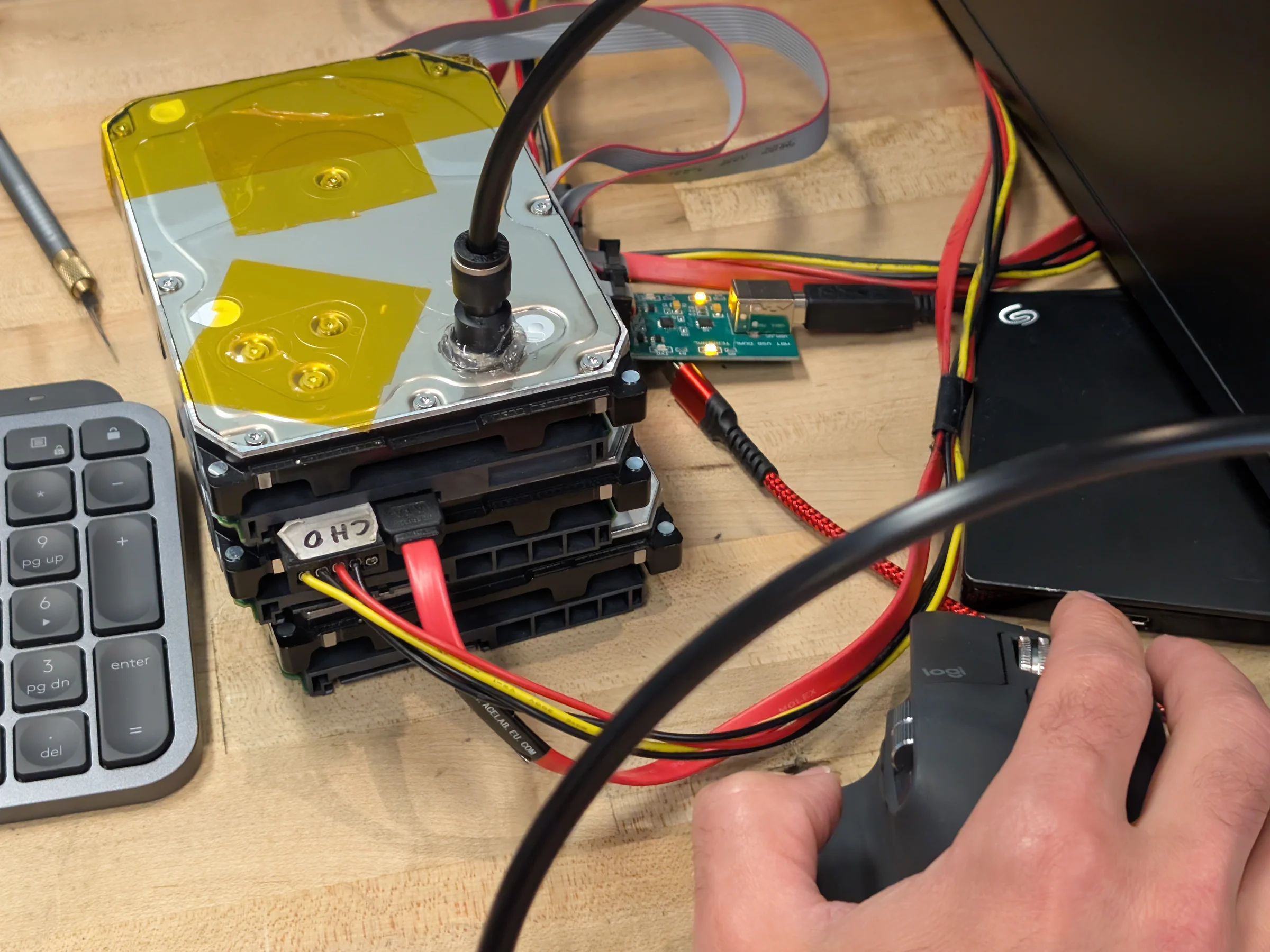
- Seal and refill with helium. After the head swap, the chamber is closed, sealed, and refilled with helium so the heads fly in the gas density they were designed for. The seal has to hold through the imaging window, not for the drive's original service life.
- Image sector-by-sector via PC-3000 or DeepSpar. The drive is connected to PC-3000 Express or DeepSpar Disk Imager for sector-level imaging. We build a selective head map to maximize yield from each head before donor heads degrade, skipping bad sectors on the first pass and returning to them at adjusted read parameters.
- Extract and verify files. Once the full image is captured, we extract the file system, verify file integrity, and copy recovered data to the target drive.
What are the failure modes of helium drives?
- Helium Leak and Permeation
- Helium atoms are small enough to permeate through micro-imperfections in the welded seal over years of operation. As helium escapes, the gas density inside the chamber rises toward air and the firmware works harder to hold the heads on track. On WD and HGST platforms the loss shows up as SMART attribute 22 (Helium Level) declining from its factory baseline of 100; Toshiba MG platforms report helium condition under attributes 23 and 24 instead. What recovery requires depends on what the loss has already done inside the chamber: a drive whose heads and platters survived may need inspection, reseal, and refill, while a drive that progressed to head-platter contact needs a head swap with fresh helium refill, and possibly platter cleaning.
- Preamp Failure in High-Platter Drives
- Helium drives with up to nine platters can have up to 18 individual read/write heads. Each head connects to a preamp IC mounted on the head stack assembly. Thermal stress from continuous operation in enterprise or NAS enclosures degrades preamp components over time. When a preamp channel fails, the associated head stops reading. If multiple channels fail, the drive reports as inaccessible. PC-3000 head maps identify which heads are functional, and we image from working heads first to capture maximum data before swapping to donor heads for the failed channels.
- Firmware Corruption
- HGST and WD helium platforms are susceptible to translator table corruption from sudden power loss. The translator maps logical block addresses to physical platter locations; if this table is damaged, the drive may report 0 bytes capacity or fail to initialize entirely. Seagate Exos models can experience Service Area module corruption that prevents the drive from completing its startup sequence. Both failure types are repairable through PC-3000 terminal access without breaking the hermetic seal.
- Motor Bearing Seizure
- Spindle motor failure in a helium drive is the hardest recovery scenario. With up to nine tightly packed platters, a motor swap requires removing the entire platter stack, transferring it to a donor chassis, refilling with helium, and imaging. If the seized motor caused the platters to shift rotationally, alignment errors compound across every platter surface. The platter damage tier ($4,000–$5,000) covers this scenario, plus helium cost and donor.
How does donor matching work for helium drives?
A donor drive for a helium head swap must match more parameters than a standard air-filled HDD donor. The sealed chamber design means the head stack, platter geometry, and firmware must all be compatible with the target drive's specific generation.
| Manufacturer | Matching Criteria | Where to Find |
|---|---|---|
| WD / HGST Ultrastar | Model, DCM (Drive Configuration Matrix), country code, microcode revision, head map | PCB label and firmware ROM via PC-3000 |
| Seagate Exos | Model, firmware revision, site code, head map, platter count | Drive label and Service Area via PC-3000 Seagate module |
| Toshiba MG | Model number, HDD code, firmware revision, head count | Drive label and ROM data via PC-3000 |
Helium donors cost more than standard HDD donors for two reasons: the drives themselves are enterprise models with lower production volume, and the matching requirements are stricter. Donor drives are matching drives used for parts. Typical donor cost: $50–$150 for common drives, $200–$400 for rare or high-capacity models. We source the cheapest compatible donor available. Helium donor drives must be an exact match. Typical donor cost: $200–$600 depending on model and availability, plus helium refill cost ($400–$800) required after opening the sealed chamber.
Why does helium recovery cost more than standard HDD recovery?
Three factors push helium recovery pricing above standard hard drive data recovery rates: helium gas cost, donor drive cost, and the complexity of working with high-platter-count head stack assemblies.
Helium cost: $400-$800 additional for head swap and surface damage tiers. This covers the helium refill required after opening the sealed chamber. The donor drive is also consumed in the process and can't be reused. A head swap on a nine-platter drive with 18 heads takes longer and carries more risk than swapping 4 heads on a 2-platter consumer drive.
Firmware-level recoveries ($900–$1,200) don't require helium or a donor, because the hermetic seal stays intact. If your helium drive is inaccessible but not clicking, the repair cost is closer to standard HDD pricing. We diagnose the failure type for free and quote the exact tier before any work begins. A +$100 rush fee to move to the front of the queue is available if you need priority service.
Technical Methodologies for Helium Drive Recovery
The sub-sections below describe the bench procedures used on helium drives at our Austin lab. Each procedure is the same regardless of drive vendor; the parameters differ by family.
How pure does the refill helium need to be?
Less pure than most marketing copy claims, ours included until this page was corrected in August 2026. No drive manufacturer or tool vendor publishes a minimum helium purity for refills. What the manufacturers' own patents describe is a wide tolerance band: Seagate's sealed-drive patent (US 7,362,541) targets a fill of greater than 99 percent helium, and Western Digital's (US 8,514,514) describes sealed cavities that can hold helium at 0.3 to 1.0 atmosphere alongside up to 0.7 atmosphere of air. The difference between laboratory-grade helium at 99.999 percent and welding-grade helium at 99.995 percent shifts the average molar mass of the fill by about 0.025 percent, which is nothing to an air bearing. We use high-purity cylinder helium because dry, clean gas is cheap insurance against moisture in the chamber, not because a fraction of a percent of purity separates a working drive from a head crash.
What actually matters is displacing the air. The goal of the refill is a chamber that is overwhelmingly helium rather than a helium-air mix, because the sliders were designed to fly in gas at roughly one-seventh the density of air. A half-purged chamber leaves the heads flying in something denser than their design gas, which is the same condition a leaking drive fails in. Helium cost: $400-$800 additional for head swap and surface damage tiers. This covers the helium refill required after opening the sealed chamber.
Helium Donor Matching and HSA Family
Our standard donor-matching process for helium drives extends beyond model number and firmware. Micro-jog values, the per-head factory calibration for the physical offset between each head's read and write elements, are tied to the original head stack, so donor heads read off-track until the drive's adaptive parameters are addressed during PC-3000 initialization.
- Seagate Exos X-series: match site code and head map (HM) against the target's Service Area identifier. Donor heads run against the patient's own adaptives, which PC-3000 addresses during initialization. See the Seagate Exos 10TB failure profile for the most common Exos failure modes we see.
- WD Ultrastar DC HC5xx: match DCM field, country code, microcode revision, and HSA generation.
- Toshiba MG08: match HDD code, head count, and firmware revision. The Toshiba MG08 failure profile documents the HSA and firmware-side failure patterns.
Cross-Generation Donor Matching: Exos, Ultrastar, and MG Helium Families
The matrix below summarizes the constraints we work within when sourcing donors at our Austin lab.
| Helium Family | Donor Constraint |
|---|---|
| Seagate Exos X14 / X16 / X18 / X20 | Same Xnn family, same site code, same firmware family. |
| WD / HGST Ultrastar HC510 / HC520 / HC530 / HC550 / HC560 | Match DCM field, country code, microcode revision, and HSA generation. |
| Toshiba MG07 / MG08 / MG09 | Match HDD code, head count, and firmware revision within the same MGnn line. |
Capacity alone is not a matching criterion. PC-3000 reads the patient's firmware family, DCM, and microcode revision through the diagnostic terminal before any donor is opened for transplant.
Why Air-Filled Donor Heads Fail in Helium Chassis
A common failed-recovery pattern we see from outside labs is an attempt to substitute an air-filled HSA into a helium chassis when a same-family helium donor cannot be sourced. The slider air-bearing surface (ABS) on an air-filled head is etched for the aerodynamic lift profile of atmospheric air, whose average molar mass is 28.96 g/mol. Helium sits at roughly 4 g/mol; lift force at the slider drops by about a factor of seven. An air-filled head transplanted into a helium chassis flies too low, contacts the platter surface, and strips the magnetic substrate.
The reverse case, a helium-tuned HSA placed into an air-filled chassis, is also unrecoverable. The slider geometry is fixed at the wafer-fab step and cannot be re-calibrated in the field. Helium and air HSAs are physically interchangeable mechanically but aerodynamically incompatible. Donor matching for helium drives starts from a sealed helium platform, never from a same-capacity air-filled donor.
Helium Loss Diagnosis: SMART Attribute 22 and Hermetic Seal Integrity
SMART attribute 22 (Helium Level) is a WD and HGST attribute. It reports the state of the helium fill as a normalized value that starts at the factory baseline of 100 and decreases as the firmware detects the internal environment moving out of specification; the listed pre-fail threshold is 25, and the raw field mirrors the normalized value rather than exposing a separate measurement. The band between 100 and 25 is wide by design: Backblaze published fleet data showing a drive reading in the 94 to 99 range that kept performing normally. Toshiba MG helium drives report helium condition under attributes 23 and 24 with a threshold of 75, and Seagate Exos drives do not report attribute 22 at all; Seagate's helium telemetry surfaces as an internal pressure reading through the F3 diagnostic terminal, and Seagate documents that when internal pressure drops too low the heads cannot maintain proper fly height.
On intake we read the helium telemetry the family actually provides, through PC-3000 vendor utilities where the host operating system cannot enumerate the drive. A helium attribute trending down from baseline on a drive that still reads is a drive we image immediately, before the environment degrades further. A drive at or below its threshold gets a bench decision, not an automatic verdict: the attribute reports the firmware's view of the gas environment, and the recovery plan depends on whether the heads and platters have already been damaged by unstable flight.
Helium Refill and Reseal Verification
Helium head swaps are performed on our 0.02 micron ULPA-filtered clean bench. After the failed head stack assembly is replaced, the chamber is closed, sealed, and refilled with helium before the platters are spun for imaging. The refill step matters because the head slider is calibrated for helium density, not atmospheric air.
Once the chamber holds its helium fill, the drive is connected to PC-3000 Express or DeepSpar Disk Imager. We image by head map, skip damaged zones on the first pass, and return to weak sectors only after the stable heads have been copied. The donor heads, helium, and reseal materials are all consumables on this tier; pricing for head swap is $3,000–$4,500. Helium cost: $400-$800 additional for head swap and surface damage tiers. This covers the helium refill required after opening the sealed chamber. Helium donor drives must be an exact match. Typical donor cost: $200–$600 depending on model and availability, plus helium refill cost ($400–$800) required after opening the sealed chamber. A +$100 rush fee to move to the front of the queue is available when the customer needs priority on the queue.
PC-3000 Portable III Service Area Workflow on Helium Firmware
Helium firmware repair runs on PC-3000 Portable III or PC-3000 Express with the vendor module loaded for the target family. The Service Area on a sealed helium drive is read through the PCB and the diagnostic terminal; the chamber stays sealed for any firmware-tier recovery. Pricing for this tier is $900–$1,200 because no donor and no helium refill are required.
- LDR microcode load on Seagate. When the resident firmware fails to boot an Exos into Ready state, PC-3000 uploads a Loader (LDR) matched to the drive family into controller RAM through the diagnostic port. From there the SA modules can be read, edited, and rewritten.
- Translator rebuild on Exos. Sudden power loss commonly corrupts the Exos translator and defect tables. PC-3000 reads the surviving SA modules (SysFile 28 static translator, SysFile 35 G-list, SysFile 1B P-list), regenerates the translator against the current defect map, and writes the corrected modules back to the Service Area. The drive then reports its actual capacity through the standard ATA interface.
- WD/HGST module handling. WD and HGST helium firmware is module-based; PC-3000 reads each module, validates CRC, and replaces damaged modules from a same-family ROM image. Common repair targets include the translator, the SMART log, the defect lists, and the adaptive parameter modules. The hermetic seal stays intact for this entire workflow.
SMART Differential Diagnosis: Helium Loss Event vs Head and Preamp Failure Event
A drive's SMART telemetry narrows the diagnosis before the chassis is ever opened, but only if it is read for what each vendor actually reports. SMART attribute semantics were never standardized in ATA/ACS, so the helium-specific attributes differ per family, while the generic media-damage counters mean the same thing they mean on any drive. The table below is what the three helium families actually expose.
| Signal | WD / HGST Ultrastar | Toshiba MG | Seagate Exos |
|---|---|---|---|
| Helium telemetry | SMART attribute 22 (Helium Level): normalized value starts at 100 and decreases, pre-fail threshold 25, raw field mirrors the normalized value. | SMART attributes 23 and 24 (Helium Condition Lower and Upper): normalized 100 at factory, threshold 75, raw field reads 0 on healthy drives. | No attribute 22. smartmontools maps Seagate attribute 200 as Pressure Measurement Limit, and the internal pressure itself is visible through the F3 diagnostic terminal; published field dumps show readings such as 683 mBar on an Exos X16. |
| Sensor behind it | A self-heated thermistor that infers helium quantity from the thermal conductivity of the chamber gas (US patent 7,434,987). | Not publicly documented by Toshiba. | MEMS environmental sensing; terminal dumps report temperature, humidity, and pressure together. |
| Media damage counters (5, 197, 198) | Same meaning on all three families as on any hard drive: reallocated and pending sector counts climb when platter surfaces are taking damage, and stay flat when the failure is electronic. They report damage already done; they do not predict it. | ||
The honest differential is coarser than a table of confident per-attribute signatures. A slow leak shows the helium attribute declining from baseline while the drive still reads; Backblaze's fleet data includes a drive reporting between 94 and 99 that kept performing normally, which is why a declining value is a reason to image immediately rather than a death certificate. An acute head or preamp failure usually presents the opposite way: the drive clicks, fails to reach ready, and often cannot serve SMART at all. A head that cannot lock onto the servo tracks does not keep flying while the firmware logs degraded telemetry; the drive retries and parks, audibly.
Just as important is what SMART cannot tell you. No vendor exposes per-head telemetry through SMART attributes: an attribute is one value for the whole drive, so nothing in the attribute table ties damage or wear to a specific head. Head-level conclusions come from bench work with vendor utilities, not from the SMART table.
Multi-Pass Imaging Strategy for High-Density Helium Media
Helium drives run at tighter track pitch and higher areal density than air-filled drives in the same form factor. The read channel uses Partial Response Maximum Likelihood (PRML) or Extended PRML detection. When original heads degrade or a donor head is installed, the internal channel calibration no longer matches the new head signature, and the read channel reports elevated bit error rates during imaging.
On PC-3000 and DeepSpar Disk Imager, we work the levers the tools actually expose: head-selective imaging so a weak head never blocks a strong one, seek-from-far to settle the servo before each read, per-sector read timeouts, soft-resets between passes, and off-track read attempts above and below the nominal track center. A bad sector that returns CRC errors on the first pass is skipped and re-queued for a later pass under different conditions rather than hammered in place.
The same multi-pass strategy is applied to every drive imaged through our lab. On standard hard drive data recovery cases the BER margins are wider, so fewer passes are required. On helium platforms with high areal density, staged per-head imaging with off-track retries is what separates a successful image from a stalled one.
Post-Head-Swap Helium Refill and PC-3000 Initialization Procedure
The sections above cover donor matching, helium purity, and SMART-based loss diagnosis. The procedure below documents what happens at our Austin lab between the moment the donor head stack assembly is seated and the moment the drive is handed off to the DeepSpar Disk Imager for sector capture. Skipping steps in this chain on a high-capacity Seagate Exos, WD Ultrastar HC5xx, or Toshiba MG08/MG09 patient risks a spinup that looks stable and then degrades during imaging.
Step 1: Head Stack Transplant on the 0.02 Micron ULPA Clean Bench
The hermetic seal on a Seagate Exos, WD Ultrastar HC5xx, or Toshiba MG08 chassis is a continuous laser weld around the perimeter of the top cover. We score the cover inboard of the factory weld and lift it free. CNC milling of the seam is rejected as a procedure even though it is faster; milling generates aluminum and stainless-steel particulates that bypass the recirculation filter inside the head-disk assembly and settle onto the platter surfaces. Once those particles are inside the chamber, every subsequent read is at risk of head-particle contact, and the case stops being a standard hard drive data recovery job and becomes a platter cleaning job.
The donor head stack is seated using the matching criteria documented in the donor-matching tables above (model, site code, firmware family, microcode generation). During this window the internal chamber is fully exposed to atmospheric air. The slider air-bearing surface on the donor head was etched at the wafer-fab step for the aerodynamic lift profile of helium at roughly 4 g/mol average molecular weight. Air sits at roughly 28.96 g/mol and produces far more lift on that slider than the design gas; if the spindle is energized in this state the heads fly outside their calibrated window, flight is unstable, and head-platter contact becomes a real risk. Every step that follows exists to prevent that spinup condition.
Step 2: Hermetic Reseal Pathway on Welded-Lid Drives
The original laser weld cannot be reproduced inside a recovery lab. Reproducing it would require focusing weld energy onto the chassis after the platter stack is reinstalled, which introduces thermal stress on the head stack assembly and generates metallic particulates that fall directly onto the platters. The pathway we use is mechanical bonding of the cover with a high-viscosity lab-grade adhesive applied continuously along the cover-to-chassis interface. The adhesive is selected for low outgassing because outgassing compounds condense onto the platter surfaces during the multi-day imaging window and degrade subsequent reads.
The perimeter bond cures before the helium fill in Step 3 begins, so the chamber forms a closed volume around a controlled fill path. The reseal does not need to match the lifetime specification of the original laser weld; it needs to hold the helium atmosphere stable through the imaging window, which in our lab can run several days to several weeks of staged per-head imaging on a 9-platter, eighteen-head drive. The head-swap pricing tier of $3,000–$4,500 reflects the consumable cost of the adhesive, helium, donor stack, and the bench time required to execute the purge and reseal under ULPA-filtered conditions. Helium cost: $400-$800 additional for head swap and surface damage tiers. This covers the helium refill required after opening the sealed chamber.
Step 3: Atmospheric Purge and Helium Refill
The goal of the fill is a chamber that is overwhelmingly helium rather than a helium-air mix. The sliders were designed to fly in gas at roughly one-seventh the density of air, and a chamber left partly full of air puts them in the same condition a leaking drive fails in. So the air is purged with flowing helium rather than topped up: we run a continuous helium flow through the sealed chamber's fill path until the residual air has been displaced, then close the fill path. The purity question is covered in the refill section above; the fill quality that actually matters is complete displacement of the air, and the proof of the fill is the drive's behavior at spin-up, watched through the helium telemetry the family exposes and the stability of the first reads.
Step 4: PC-3000 Initialization Before DeepSpar Imaging Begins
A resealed and refilled drive is not connected to a host operating system directly. Recovery tools disable the drive's own background processes, auto-reallocation included, before any imaging begins. The drive is brought up on PC-3000 Portable III or PC-3000 Express, and the four-stage initialization below is executed before control is handed to DeepSpar Disk Imager.
- SA module read test. The drive is energized through the PC-3000 intelligent power supply and held in safe mode. PC-3000 reads the Service Area modules located on the reserved negative-cylinder tracks. A successful read confirms that the donor heads are electrically compatible with the patient's preamp and controller circuit. A failed read indicates a preamp-channel or head-map mismatch that must be corrected before any further step is attempted.
- Per-head stability evaluation. PC-3000 commands the drive to read sample sectors across the LBA range for each physical head position. Error rate is logged per head. Any head that produces unrecoverable reads at a rate inconsistent with the rest of the stack is flagged in a RAM head map and disabled for the initial imaging pass; data behind that head is captured later under different read conditions rather than blocked from imaging entirely.
- Adaptive parameter transfer per family. The donor's factory adaptives are wrong for the patient platters; the patient's original adaptives must be preserved before read-channel lock is achievable. The patient's Service Area and ROM contents are secured before the donor stack is seated. On Seagate Exos drives, adaptives and translator data live in Service Area system files reached through the F3 serial terminal.
- Read channel calibration and contamination check. Once adaptives are in place, a short read pass is run and judged by outcome: do reads complete, and at what error rate per head. A partially purged chamber shows up here as unstable reads and climbing pending-sector counts; if that pattern appears, the imaging window is aborted before donor heads are wasted and the drive returns to Step 3. Only when reads are stable across the active head map does control hand off to the DeepSpar Disk Imager, which then runs the staged per-head, off-track-retry strategy documented in the multi-pass imaging section above for the actual hard drive data recovery capture.
PCB Repair Paths on Exos and Ultrastar Helium Drives
A helium Exos or Ultrastar can fail at the board without the head-disk assembly ever being involved. Board work happens with the hermetic seal intact. The subsection below covers why a donor board on its own does not bring the drive back.
Why a Direct PCB Swap Fails on Enterprise Helium Drives
Modern enterprise helium drives operate at an active magnetic spacing of 1 to 2 nanometers above the platter surface during reads and writes, with Thermal Fly-height Control trimming the slider clearance from a baseline aerodynamic fly height of a few nanometers. To hold that gap across temperature, altitude, and per-head variation, every drive is calibrated at the factory and the calibration data is written to the SPI flash ROM on its PCB. The ROM is keyed to the individual head stack assembly inside the sealed chamber. A donor PCB ships from the donor drive with the donor drive's calibration, not the patient's. The calibration that matters for a clean spin-up and a successful image includes:
- Micro-jog offsets. The physical separation between the read element and the write element on a single head varies head to head because of photolithography tolerances at the wafer-fab step. Micro-jog offsets are the per-head corrections the servo applies so the read element sits over the track centerline when the servo locks to a write-aligned reference. On WD ROYL-architecture drives, Module 47 stores the microjog and servo adaptives alongside the Module 0A head map; both reside in the PCB ROM and are redundantly shadowed on the platters. The HGST-lineage helium families and the Seagate and Toshiba enterprise platforms each keep their equivalent per-head calibration data in their own ROM and Service Area structures; the constant across all of them is that the data describes one specific head stack and travels with the drive, not with the board model.
- Thermal Fly-height Control voltage curves.Each slider carries an embedded heater. The voltage applied to that heater thermally protrudes the read and write elements toward the platter and trims the fly height in flight. The voltage-to-protrusion curve is unique to each head and is stored on the patient's ROM. A donor PCB running its own TFC curves against the patient's heads either flies the elements too high (no read) or pushes them into the platter (head crash and surface damage).
- Preamplifier gain and channel tuning.Read-channel adaptives such as MR bias current and FIR equalizer coefficients are calibrated per head at the factory. The donor PCB's tuning was written for the donor heads. Mismatched tuning leaves the read channel unable to lock even when the heads physically fly correctly.
Powering a helium Exos or Ultrastar with an unmodified donor PCB drives the patient head stack with the donor's adaptives. The servo cannot lock, the drive clicks or spins down, and on a worst-case TFC mismatch the heads contact the platter surface and score tracks the customer was paying us to recover. A direct PCB swap is not a faster shortcut; it is the procedure that converts a firmware-tier repair into a head-swap and platter- cleaning case.
SMART Telemetry Differential Diagnosis Across Helium Drive Families
A single SMART attribute ID does not mean the same thing on a Seagate Exos as it does on a Western Digital Ultrastar HC5xx or a Toshiba MG08 and MG09. SMART attribute semantics were never standardized: from ATA/ATAPI-4 onward the attribute bytes of the SMART data structure are vendor specific, and the same ID can carry unrelated meanings on different vendors. ID 240 is Head Flying Hours on Seagate and most hard drives, and Transfer Error Rate on some Fujitsu models. The clearest helium-family example is flying-hours accounting; the table below shows what the three families actually report, checked against real drive telemetry dumps.
| Where flying hours appear | Seagate Exos | WD Ultrastar HC5xx | Toshiba MG08 / MG09 |
|---|---|---|---|
| SMART attribute 240 (Head Flying Hours) | One aggregate raw value for the whole drive, formatted like Power-On Hours: the hour count sits in the lower bytes with other packed vendor fields above it. A published Exos X16 dump reports 1513 flying hours against 1917 power-on hours; divergence is normal because the heads are not always loaded. | Not implemented. The SMART attribute table on HC5xx drives ends at attribute 199; there is no flying-hours attribute at all. | Present but uninformative: published MG08 and MG09 dumps show a raw value of 0 after thousands of power-on hours. Attribute 222 (Loaded Hours) carries the head-loaded time on these drives instead. |
| ATA Device Statistics log (smartctl -x) | Reports a drive-level Head Flying Hours figure that can disagree with the attribute raw (1802 hours vs 1513 in the same published dump); the two surfaces are not interchangeable. | Reports drive-level Head Flying Hours here even though the attribute is absent: published HC530 and HC550 dumps show 22578 and 1706 hours. | Reports drive-level Head Flying Hours (493 and 180 hours in the same published MG08 and MG09 dumps). |
| Per-head breakdown | Does not exist, on any vendor. Every figure above is one number for the whole head stack; all heads share it. A SMART attribute is a single value per drive, and even Seagate's FARM log, which carries genuinely per-head arrays for some metrics, records flight hours as one drive-level field. | ||
What does the flying-hours counter actually measure?
Head Flying Hours is firmware time accounting: the accumulated time the head stack has spent loaded over the platters, counted once for the whole drive. It is not aerodynamic telemetry. Helium loss does not make the counter noisy, and a failed head stack does not freeze position telemetry, because the counter never contained position data in the first place. When a drive stops reaching ready, all of its time counters simply stop advancing, flying hours and power-on hours alike.
The leak-versus-head-failure question is answered by the helium attributes and the drive's behavior, not by flying hours. A leaking drive can keep operating while its helium attribute declines, which is exactly the window in which to image it. A drive whose heads cannot lock onto the servo tracks clicks, parks, and spins down; it does not keep running while logging degraded numbers. The Seagate Exos 10TB failure and Toshiba MG08 failure pages cover the family-specific intake patterns we see on those platforms.
Where do we read these values on the bench?
Host-side smartctl reads the attribute table, and smartctl -x adds the Device Statistics log. On Seagate Exos, the F3 serial diagnostic terminal reports the internal environmental readings directly; published terminal dumps show a pressure line reading in millibars alongside temperature and humidity. Seagate does not publish the design fill pressure for these platforms, so we treat a single pressure reading as data to record against the drive's history, not a verdict on the seal by itself. Telemetry interpretation is the first read after intake; it determines which procedure runs on the bench.
What does a lid breach mean on a deep-stack helium drive?
Current-generation helium enterprise drives in the WD Ultrastar DC HC5xx, Seagate Exos X-series, and Toshiba MG helium families pack up to nine platters in the same 3.5″ chassis. When a customer drive arrives with a damaged hermetic seal or a lid that has already been pried by another lab, the chamber no longer holds its design atmosphere. The drive is operating in a helium-air mix it was never engineered to fly heads in, and every additional minute of spindle time in that state is spent against the data.
Why an Opened Helium Drive Is a One-Time Extraction
Each head flies on a thin gas bearing between the slider and the platter surface. The sliders in these drives were designed for helium, roughly one-seventh the density of air. In a breached chamber the gas is denser than the design point, the lift on every slider is wrong for its etched air-bearing surface, and head flight is unstable. That is why we treat a breached helium drive the way the recovery field treats it: as a one-time extraction. The drive gets a single, deliberately planned imaging attempt, or the platter stack is transferred to a donor chassis that can be sealed and refilled before any sustained imaging is attempted. What nobody can honestly offer is repeated casual spin-ups of a deep-stack helium drive in open air.
How a Breached Drive Is Imaged
The imaging session runs by head map, the same way as every other multi-head recovery in this article: PC-3000 establishes Service Area access and builds the logical head map, DeepSpar Disk Imager runs per-head sessions against it, and heads that return errors are deferred rather than hammered while the stable heads are captured. On a breached drive the priority is simple: capture as much as possible in as little spindle time as possible, and stop the moment read behavior degrades rather than pushing a failing head into the platter surface.
Can the helium attribute read low on a healthy drive?
It can read oddly, and the published record says so. The WD and HGST helium attribute is computed from a self-heated thermistor's view of the chamber gas, not from a direct pressure gauge, and Backblaze's fleet write-up describes a drive whose attribute 22 wandered between 94 and 99 while the drive kept working, with Backblaze unable to say whether the value meant anything or the sensor was simply erratic. That is the honest state of public knowledge, and it is why we treat helium telemetry as one input to the bench decision rather than a verdict. The deciding evidence is always the drive's behavior under controlled reads: stable imaging means the environment is workable, degrading reads mean the session stops, whatever the attribute says.
Helium Drive Recovery Pricing
Low complexity
Simple Copy
Your helium drive works, you just need the data moved off it
Functional drive; data transfer to new media
Rush available: +$100
$200
3-5 business days
Low complexity
File System Recovery
Your helium drive isn't recognized by your computer, but it's not making unusual sounds
File system corruption. Accessible with professional recovery software but not by the OS
Starting price; final depends on complexity
From $600
2-4 weeks
Medium complexity
Most Common
Firmware Repair
Your helium drive is completely inaccessible. It may be detected but shows the wrong size or won't respond
Firmware corruption: ROM, modules, or translator tables corrupted; requires PC-3000 terminal access
$900–$1,200
3-6 weeks
High complexity
Head Swap
Bench diagnosis found the read/write heads have to be replaced. Clicking can also come from firmware, the preamp, or the spindle
Head stack assembly failure. Transplanting heads from a matching helium donor drive on a clean bench. Helium refill required.
50% deposit required. Helium cost ($400-$800) and donor drive cost additional.
50% deposit required
$3,000–$4,500
4-8 weeks
High complexity
Surface / Platter Damage
Your helium drive was dropped, has visible damage, or a head crash scraped the platters
Platter scoring or contamination. Requires platter cleaning, head swap, and helium refill
50% deposit required. Helium cost ($400-$800) and donor drive cost additional. Most difficult recovery type.
50% deposit required
$4,000–$5,000
4-8 weeks
Hardware Repair vs. Software Locks
Our "no data, no fee" policy applies to hardware recovery. We do not bill for unsuccessful physical repairs. If we replace a hard drive read/write head assembly or repair a liquid-damaged logic board to a bootable state, the hardware repair is complete and standard rates apply. If data remains inaccessible due to user-configured software locks, a forgotten passcode, or a remote wipe command, the physical repair is still billable. We cannot bypass user encryption or activation locks.
No data, no fee. Free evaluation and firm quote before any paid work. Full guarantee details. Head swap and surface damage require a 50% deposit because donor parts and helium are consumed in the attempt.
- Rush fee
- +$100 rush fee to move to the front of the queue
- Helium cost
- Helium cost: $400-$800 additional for head swap and surface damage tiers. This covers the helium refill required after opening the sealed chamber.
- Donor drives
- Helium donor drives must be an exact match. Typical donor cost: $200–$600 depending on model and availability, plus helium refill cost ($400–$800) required after opening the sealed chamber.
- Target drive
- The destination drive we copy recovered data onto. You can supply your own, or we'll provide one. For larger capacities (8TB, 10TB, 16TB and above), target drives cost $400+ extra. All prices are plus applicable tax.
Helium Drive Recovery FAQ
Can helium drives be recovered?
Yes, across all failure types. Firmware corruption, PCB failures, and electronic issues that do not require breaking the hermetic seal are handled with PC-3000 tooling. Mechanical failures requiring the seal to be opened (head swaps, platter cleaning) are performed in-house at our Austin lab. We open the drive on our 0.02µm ULPA-filtered clean bench, swap the heads from a matching helium donor, refill with helium, and image with PC-3000.
Why can't you just open a helium drive without refilling with helium?
Helium has roughly one-seventh the density of atmospheric air. The read/write head sliders inside a helium drive are aerodynamically designed to fly at a specific height in that low-density gas. If atmospheric air replaces the helium, aerodynamic lift on the sliders changes, flight becomes unstable, and continued operation risks head-platter contact that destroys the magnetic surface. After performing a head swap, we refill the drive with helium so the heads fly in the gas they were designed for before imaging.
Which drives are helium-filled?
Helium technology is standard in drives 14TB and larger, though many 12TB enterprise models also use it. Note that some modern 12TB consumer NAS drives (like WD Red Plus) are now air-filled. Look for the welded seal to confirm. Common models include the Western Digital Ultrastar DC series, Seagate Exos X-series, and Toshiba MG enterprise drives. Look for a smooth, welded metal lid with no visible screws on the top cover.
What does it cost?
Helium drive recovery starts at $200 for a simple copy and $600 for file system recovery. Firmware repair is $900–$1,200. Mechanical recovery requiring head swap runs $3,000–$4,500; Helium cost: $400-$800 additional for head swap and surface damage tiers. This covers the helium refill required after opening the sealed chamber. Surface damage cases are $4,000–$5,000 with the same helium and donor requirements. All tiers are plus tax and target drive. Contact us for a free evaluation; we will tell you which category your drive falls into before any work begins.
What does a clicking helium drive mean?
Clicking means the drive is failing to lock onto the servo tracks, so the actuator retracts and retries in a loop. Every power-on cycle in that state risks platter contact and surface scoring. Unplug the drive immediately. Which repair the drive needs is settled by the bench diagnosis rather than by the sound: head failure, a PCB fault, and wrong adaptive parameters all produce clicking.
Can I recover a helium drive with software?
Only if the failure is logical, not mechanical. If the drive spins up, isn't clicking, and appears in your system BIOS, the problem is likely file system corruption or accidental deletion. Software tools can address those cases. If the drive clicks, beeps, doesn't spin, or shows the wrong capacity, the failure is hardware-level. Running software on a mechanically failing drive will accelerate platter damage. Power it off and send it for evaluation.
Why does helium drive recovery cost more than standard HDD recovery?
Three cost drivers. First, helium donor drives are harder to source because the donor must match the target's model, firmware revision, head map, and sealed chamber design. Helium donor drives must be an exact match. Typical donor cost: $200–$600 depending on model and availability, plus helium refill cost ($400–$800) required after opening the sealed chamber. Second, Helium cost: $400-$800 additional for head swap and surface damage tiers. This covers the helium refill required after opening the sealed chamber. Third, helium drives pack up to nine platters with up to 18 read/write heads; more heads means more points of failure and a longer swap procedure. A helium head swap is $3,000–$4,500, while a standard air-filled HDD head swap is $1,200–$1,500.
Since 2008
Established
As Featured In
Data Recovery Standards & Verification
Our Austin lab operates on a transparency-first model. We use industry-standard recovery tools, including PC-3000 and DeepSpar, combined with strict environmental controls to maintain drive integrity. This approach allows us to serve clients nationwide with consistent technical standards.
Localized Clean Zone
Open-drive work is performed in a 0.02 micron ULPA-filtered laminar clean bench.
Transparent History
Serving clients nationwide via mail-in service since 2008. Our lead engineer holds PC-3000 and HEX Akademia certifications for hard drive firmware repair and mechanical recovery.
Media Coverage
Our repair work has been covered by The Wall Street Journal and Business Insider, with CBC News reporting on our pricing transparency. Louis Rossmann has testified in Right to Repair hearings in multiple states and founded the Repair Preservation Group.
Aligned Incentives
Our "No Data, No Charge" policy means we assume the risk of the recovery attempt, not the client.
Technical Oversight
Louis Rossmann
Our engineers review all lab protocols to maintain technical accuracy and honest service. Since 2008, his focus has been on clear technical communication and accurate diagnostics rather than sales-driven explanations.
We believe in showing the bench rather than just describing it. Open-drive work runs on a 0.02 micron ULPA-filtered laminar clean bench, and we filmed it.
See the particle counter test at the benchRelated services
Other Recovery Services
Air-filled HDD head swaps & firmware
USB-bridge & enclosure failures
Multi-disk array reconstruction
Helium drives in enterprise servers
The advertising tax explained
Labs we recommend by name
Send Us Your Helium Drive
Free evaluation. We diagnose the failure type, quote the exact tier, and perform the full recovery in-house. No data, no charge.