
Consumer Education
Fake Data Recovery Locations
How to spot virtual offices, drop-off counters, and Google Maps listings with no lab behind them.
National data recovery companies hold Google Business Profile listings at addresses that are not laboratories. In Austin, two such listings led Google reviewers to a computer repair shop and a campus computer store, and the downtown address WeRecoverData advertises led one of our employees to a Spaces coworking reception. WeRecoverData now describes 50+ of its listed locations as service areas or drop-off points that are not laboratories, and Secure Data Recovery describes its locations as "hundreds of drop-off locations, certified partner sites, and dedicated recovery labs across the country." Each company's own location page is quoted below, and both Austin reviews are reproduced.

Has WeRecoverData responded to this page?
WeRecoverData's counsel sent us a demand letter dated June 19, 2026. It asked us to remove the page titled "Is WeRecoverData Safe?" and to stop republishing what it called false or misleading factual statements about WeRecoverData's services, pricing practices, locations, facilities, personnel, technical capabilities, credentials, customer relationships, and business practices. We declined on June 26, 2026, asked WeRecoverData to identify any specific statement it contends is false, and committed to correcting anything WeRecoverData shows to be false. That commitment stands. If anyone, WeRecoverData included, identifies a specific inaccuracy on this page, we will correct it.
On July 24, 2026, WeRecoverData's counsel replied. That letter states WeRecoverData is "not presently pursuing litigation against [us] concerning the publications at issue" and is "not asking you to remove the webpage or videos". It also retracted a statement WeRecoverData had published about us, writing that the statement "was incorrect as written, and WRD corrects and retracts it." As of July 26, 2026, the June 19 demands had not been withdrawn in writing, and no complaint had been filed in any court. Louis Rossmann's July 26, 2026 response asks WeRecoverData to state in writing, by August 14, 2026, whether it withdraws them.
Every letter in the exchange, both sides, is published in full at: WeRecoverData's advertised US locations
That page is one Louis Rossmann maintains in his userspace on consumerrights.wiki. The wiki gave him the space to write it; it did not write, review, or endorse it. The page keeps a public revision history, so you can see what changed and when.
One more thing: Rossmann Repair Group is a data recovery company, which makes us a competitor of WeRecoverData. That is a reason to check the sources rather than take our word for anything. The documents are all at the link above, WeRecoverData's side included.
Documented Cases
Documented cases from Austin, TX and an independent Local Search Forum investigation.
SALVAGEDATA Recovery Services
The Austin listing at 7801 N Lamar Blvd led to MAV Computers, a local computer repair shop. The reviewer found no data recovery lab. SALVAGEDATA confirmed by phone that drives are shipped to a lab in another city. Read on July 26, 2026, salvagedata.com's own Austin page starts a case with a FedEx pickup, a drop off at a FedEx partner location, or a visit to a SalvageData office shown on its map.
Secure Data Recovery Services
The listing near UT Austin led to the campus computer store, where the reviewer reported no local data recovery services. Read on July 26, 2026, securedatarecovery.com states "We have over 150 locations and partners nationwide" and describes that network as "hundreds of drop-off locations, certified partner sites, and dedicated recovery labs across the country".
WeRecoverData
On July 12, 2026, we sent one of our own employees to the downtown Austin address WeRecoverData advertises at 111 Congress Avenue and filmed the visit. The address is a Spaces coworking building; the person he spoke with there worked for Spaces, the coworking operator, not for WeRecoverData.
Documented Mailbox Address Formatting
A Local Search Forum investigation documented a SalvageData listing at a UPS Store in Edwardsville, IL, with the mailbox number formatted as a suite. The same investigator compiled approximately 60 SalvageData listings in one metro area, nearly all at computer or cellphone repair shops.
Phantom Location Business Model
Search Google Maps for "data recovery" in any major city and you will find listings for national companies with local addresses on Google Maps. Many of these addresses are not labs. They are virtual offices, co-working desks, or counters inside unrelated retail stores. The company's name appears on the map pin and the listing shows business hours and a phone number. The listing does not say whether any technician works at that address.
The business model works like this: a national company leases a mailing address or partners with a local computer shop in dozens or hundreds of cities. Each address gets its own Google Business Profile. When you search "data recovery near me," those listings appear in the local results because Google's algorithm weighs physical proximity. You drive to the address and hand your drive to someone at the front desk, but that person is not a data recovery technician. Your drive goes into a shipping box and travels to a centralized lab in another state. You could have shipped it yourself for a fraction of the cost. By dealing with this middleman, the price of the recovery has gone up higher than it would have if you were dealing with a local business.
Google publishes rules on virtual offices, co-working space, and mailbox addresses. These five sentences are quoted exactly as they appear in Google's guidelines for representing a business on Google, read on September 5, 2026:
If your business rents a physical mailing address but doesn't operate out of that location, also known as a virtual office, that location isn't eligible for a Business Profile.
Businesses can't list an office at a co-working space unless that office maintains clear signage, receives customers at the location during business hours, and is staffed during business hours by your business staff.
P.O. boxes or mailboxes located at remote locations aren't acceptable.
Service-area businesses can't list a "virtual" office unless that office is staffed during business hours.
Businesses showing their address on Google should maintain permanent fixed signage of their business name at the address.
Source: Guidelines for representing your business on Google ↗, Google Business Profile Help, read September 5, 2026.
Google also publishes what a member of the public can do about a listing that fails those rules. Its help page on removing a Business Profile ↗ says a business "can be removed from Google if it never existed or isn’t eligible to be on Google", and directs reports of "incorrect info or fraudulent activity on Maps related to the name, phone number, or website of a business" to the business redressal complaint form. A separate Maps help page ↗ states that you "can report multiple businesses at once by uploading 10 or more profiles or a spreadsheet with all URLs". All three pages were read on September 5, 2026. The removal page also says you "can request a business to be removed, even if you don’t own the Business Profile".
In a June 20, 2019 post on its own blog ↗ about fake business profiles on Google Maps, read September 6, 2026, Google wrote of the previous year: "We took down more than 3 million fake business profiles". We have not found a published Google action aimed at data recovery listings as a category.
What We Found in Austin
We documented three cases in Austin, TX. In two, a Google reviewer physically visited a data recovery listing and found no lab at the address; both reviews are public on Google Maps. In the third, we sent one of our own employees to the Austin address WeRecoverData advertises and filmed the visit.
SALVAGEDATA Recovery Services, 7801 N Lamar Blvd, Austin TX
A Google reviewer navigated to this address expecting a data recovery facility. The business at 7801 N Lamar Blvd is MAV Computers, a local computer repair shop. The reviewer found no data recovery lab. The reviewer called SALVAGEDATA directly and was told that drives dropped off at this location are shipped to a lab in another city.
SALVAGEDATA's own Austin page, read on July 26, 2026, tells a customer to "schedule a FedEx pickup, drop off your device at one of 100+ FedEx partner locations near Austin, TX, visit one of our nearby SalvageData offices shown on the map, or request an on-site visit for large-scale recoveries." On Google Maps, the listing title reads "SALVAGEDATA Recovery Services." It does not say "drop-off counter at MAV Computers." The distinction matters: you are handing your failed hard drive to a business where the reviewer found no data recovery lab. Your drive is shipped to another city before anyone with a PC-3000 touches it.
Read again on September 5, 2026, the same page names its nearest office. Under the heading "We Serve the Austin, TX Area" it says:
Our nearest SalvageData office is at 1301 Waugh Dr200, Houston, TX, about 145.5 miles away. You can also use FedEx pickup or drop off your device at a FedEx location.
Its heading reads "Data Recovery Services In Austin, TX", and it states that the nearest SalvageData office is in Houston. That sentence sits directly under the map, near the top of the page.
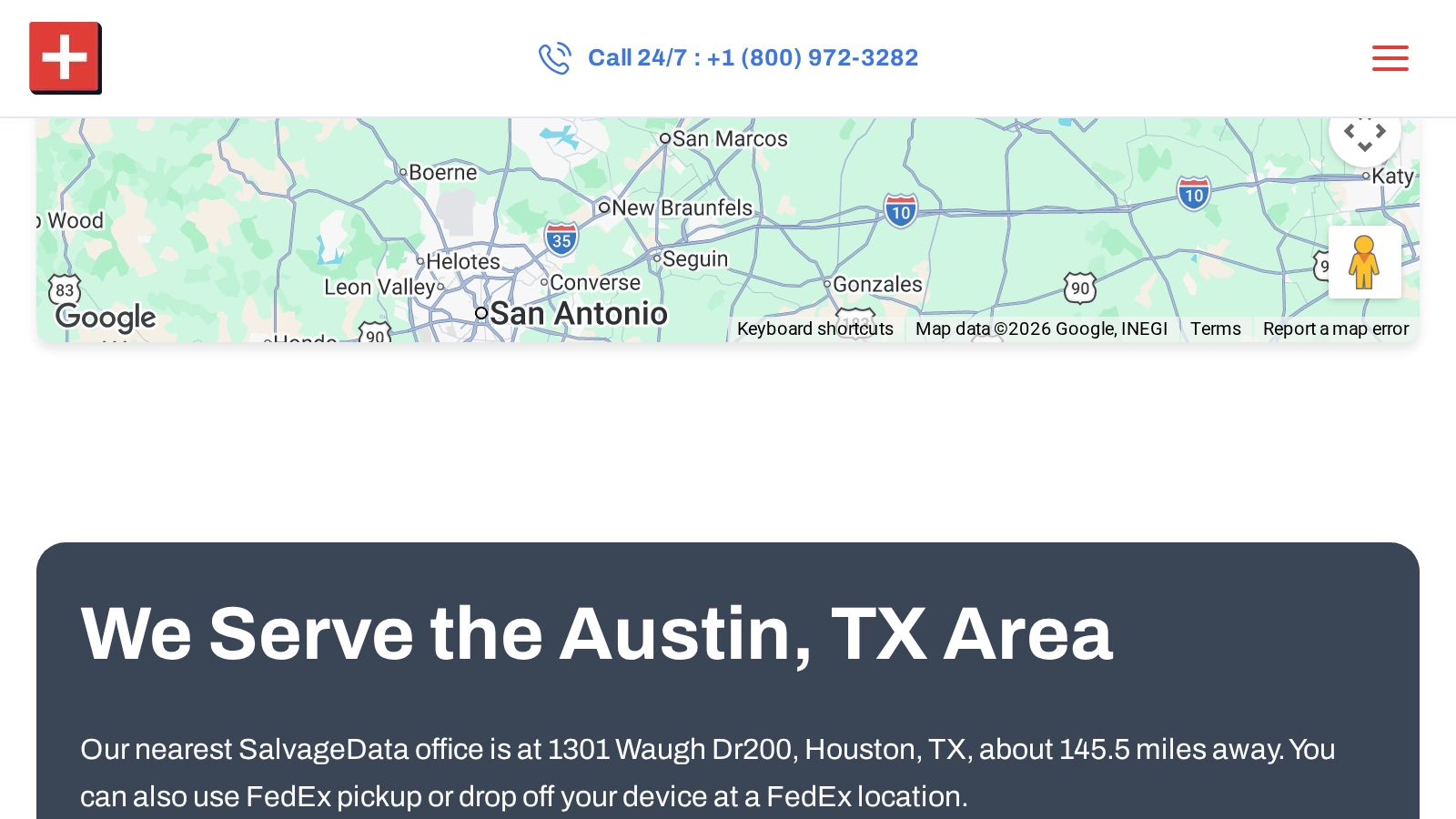
salvagedata.com Austin page, captured September 6, 2026. Internet Archive copy of August 28, 2026 ↗
Separately, investigator Kay Dean published August 2026 records concerning Google, Facebook, & Yelp reviews of SalvageData listings, with her stated conclusions & a statement of what those records do not show: Kay Dean's SalvageData findings.
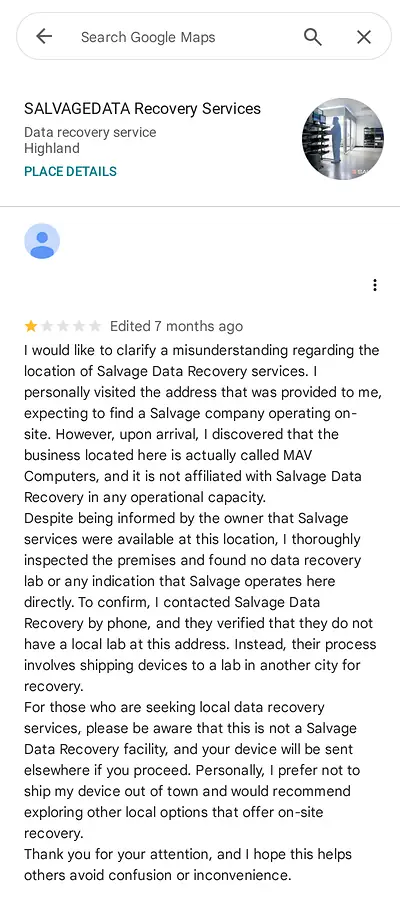
N Lamar Blvd listing. Reviewer found MAV Computers at the address. Read on Google ↗
Secure Data Recovery Services, University of Texas at Austin
A second reviewer brought a server to the Secure Data Recovery listing near the UT Austin campus. The address led to the UT Campus Computer Store. In the reviewer's words, there were "no local data recovery services" there and "They ship it over to another place." The one-star review is reproduced below.
The Google Maps listing displays the company's own name and branding. A customer searching "data recovery Austin" on Google Maps sees "Secure Data Recovery Services" with a map pin, a phone number, and business hours, yet nothing in the listing makes it clear that the address is a campus computer store with no recovery capability.
Secure Data Recovery's locations page, read on July 26, 2026, states: "We have over 150 locations and partners nationwide." The same page describes that network as "hundreds of drop-off locations, certified partner sites, and dedicated recovery labs across the country". Both passages are preserved in the Internet Archive copy of July 27, 2026 ↗. The company draws the distinction itself. A drop-off location is not a certified partner site, and neither one is a dedicated lab with a clean bench, PC-3000 or equivalent imaging hardware, a donor drive inventory, and micro-soldering stations. The listing at the UT campus store carries the same company name as the labs.
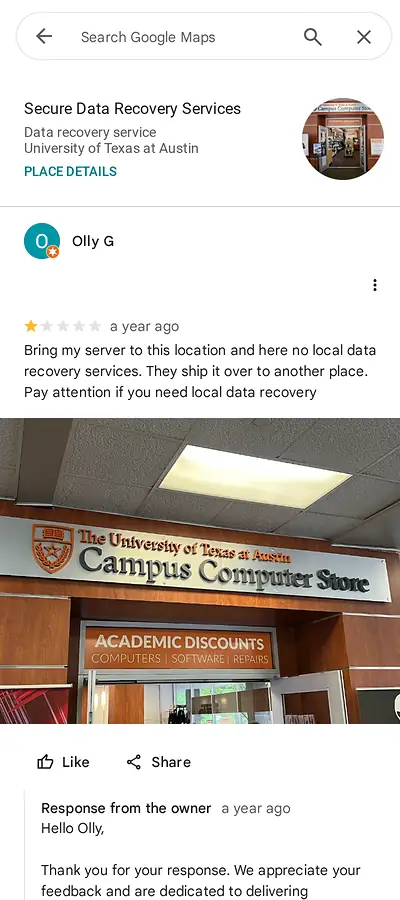
UT Austin listing. Reviewer brought a server and found the Campus Computer Store. Read on Google ↗
WeRecoverData, 111 Congress Avenue, Austin TX
WeRecoverData advertises a data recovery presence in Austin and markets more than 50 locations nationwide. On July 12, 2026, we sent one of our own employees, Chris, to the downtown Austin address WeRecoverData advertises at 111 Congress Avenue, during business hours, to ask for WeRecoverData in person. We filmed the visit and published the footage below.
The address is a Spaces coworking building. Chris was directed to Room 500 on the fifth floor, where the footage shows Spaces branding and a Spaces reception. The person he spoke with there worked for Spaces, the coworking operator, not for WeRecoverData. The footage shows no WeRecoverData signage or staff at the address, and a shared coworking reception rather than a data recovery lab.
WeRecoverData's own page for that address describes what happens to a device left there. Read on September 5, 2026, the page still advertises "111 Congress Ave, Suite 500, Austin, Texas, 78704, US" with Monday to Friday hours of 09:00 to 17:00, and under the heading "Local intake to certified lab" it says:
Your device is logged in at our Austin office, then transported safely to our Austin, Texas recovery laboratory (~9 mi from Austin) — part of the WeRecoverData network trusted by Boeing, NASA JPL, and the U.S. Department of Defense.
The page's text gives no street address for that laboratory. The words "Austin, Texas recovery laboratory" in the sentence above are a link to the company's page for its other Austin address, 9442 N Capital of Texas Hwy, Building 1, Room 516A, and the sentence places that laboratory about nine miles from Austin.
Two more of WeRecoverData's own pages bear on this. Its corrections page, read September 6, 2026 and quoted further down, names "Austin TX" as one of the company's five laboratories. Its page for that other address, read the same day, opens:
Our Austin, Texas location is a staffed WeRecoverData recovery laboratory — devices submitted here are evaluated and recovered on-site in a controlled cleanroom environment, not forwarded to a third party.
We have not been inside that building and make no claim about what is in it.
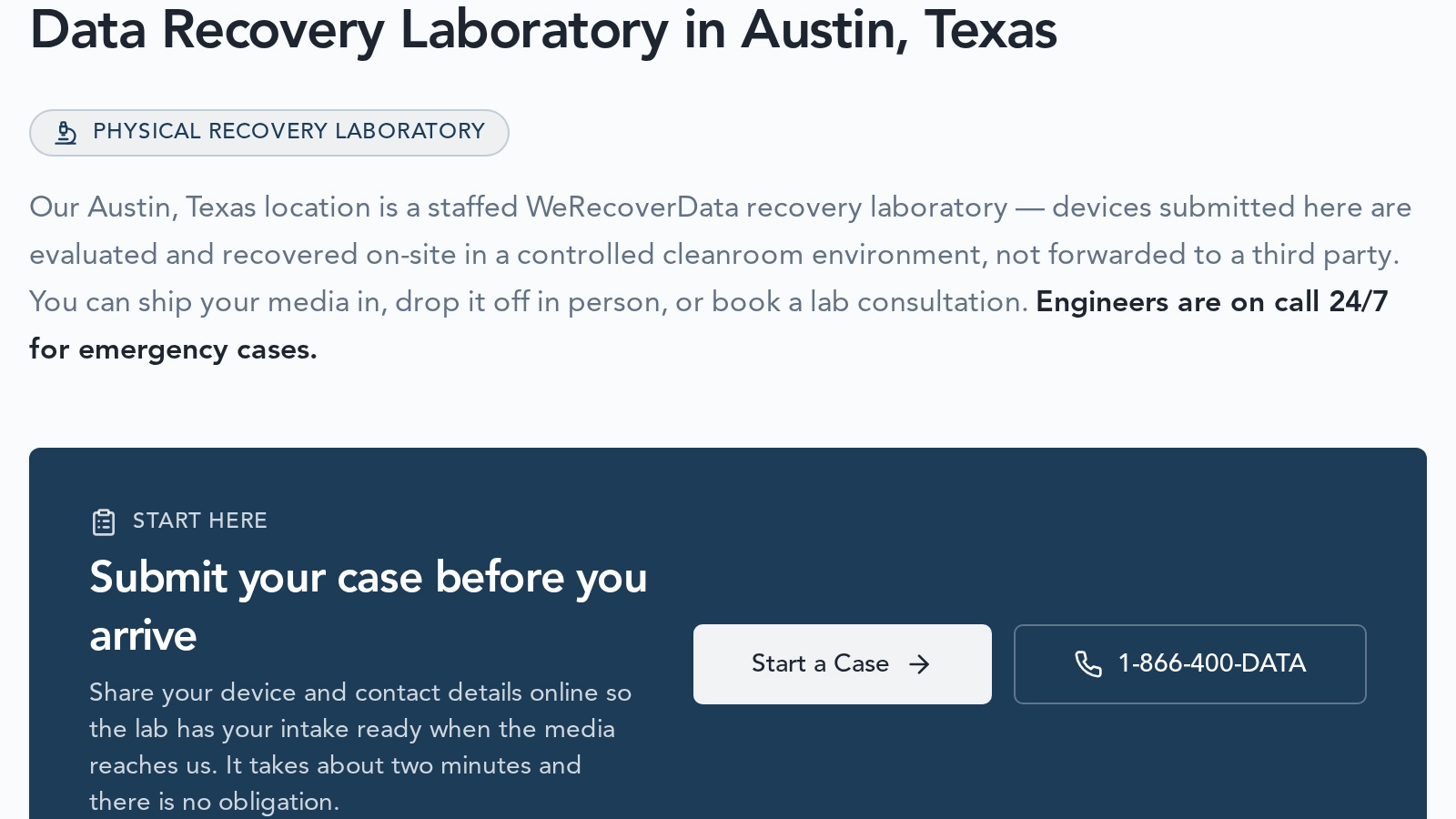
werecoverdata.com/service-locations/us/texas/austin-arboretum, captured September 6, 2026. No Internet Archive copy is available, for the reason given in the caption below.
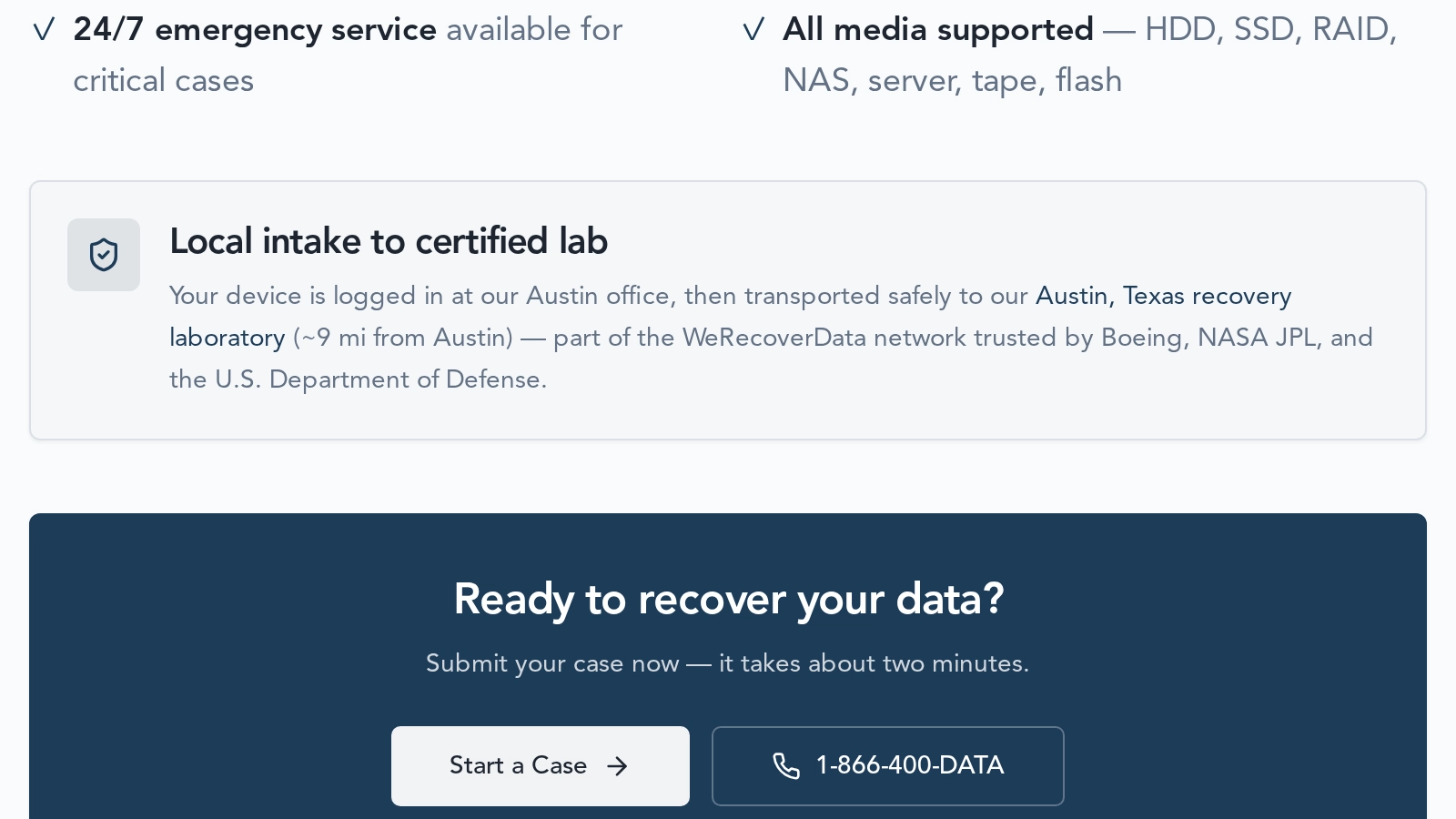
werecoverdata.com/service-locations/us/texas/austin, captured September 6, 2026. No Internet Archive copy is available: on September 6, 2026 the Wayback availability API returned no snapshots for werecoverdata.com or for this page, a request to web.archive.org for an earlier capture of this page returned a 403 response, and the site's robots.txt gives the Internet Archive crawlers ia_archiver and archive.org_bot a Disallow of the whole site.
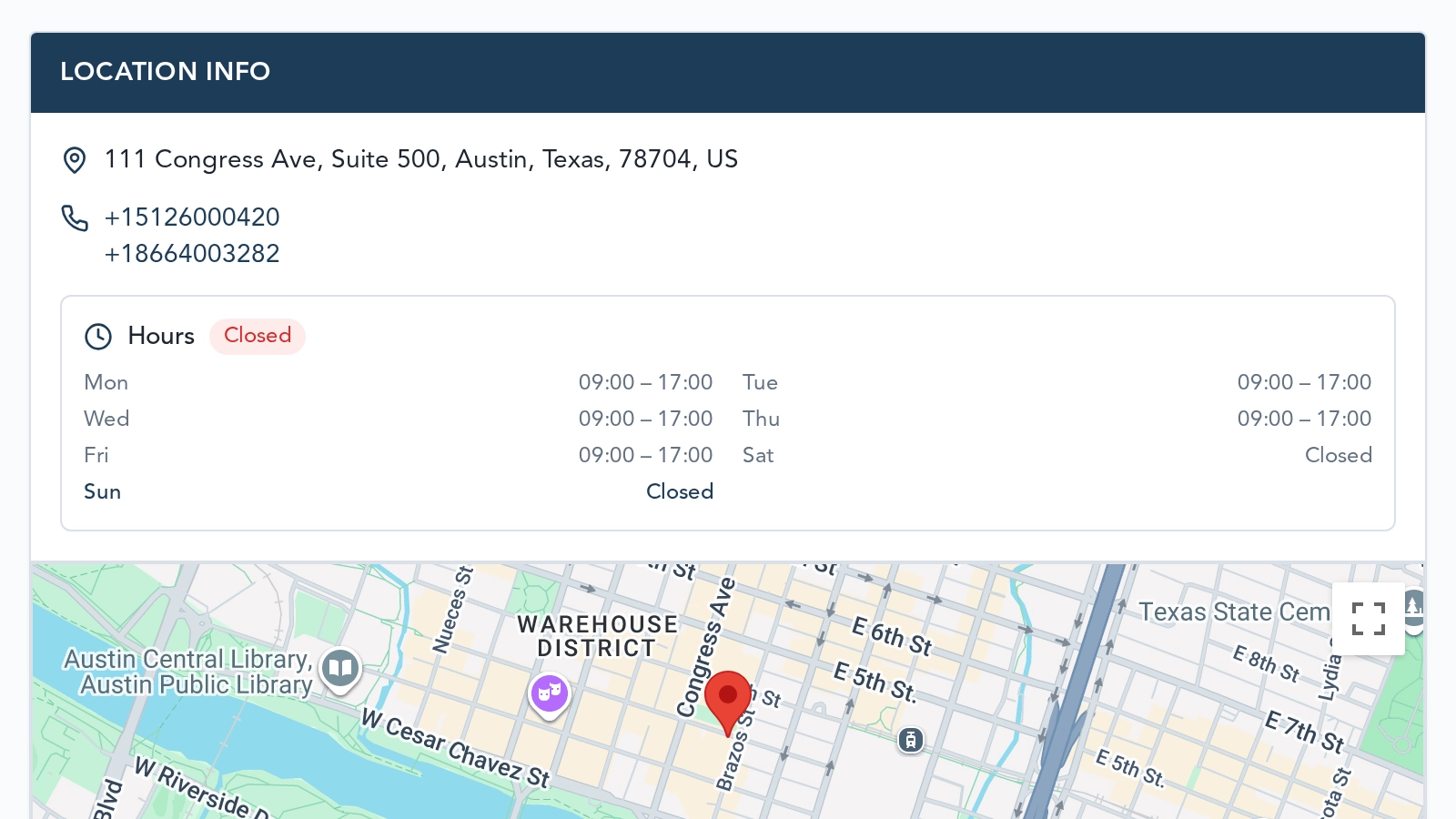
The same page's address and hours panel, captured September 6, 2026.
Google's published rule for this arrangement, quoted above and read on September 5, 2026, is: "Businesses can't list an office at a co-working space unless that office maintains clear signage, receives customers at the location during business hours, and is staffed during business hours by your business staff." The footage documents who was present at the advertised Austin address when a member of the public walked in and asked for WeRecoverData. For the full documentation of WeRecoverData's advertised locations, pricing, and terms of service, see our analysis of WeRecoverData. Separately, investigator Kay Dean has published records from 2019 and 2020 concerning review activity on some WeRecoverData listings, with her stated conclusions and a statement of what those records do and do not show: Kay Dean's records on WeRecoverData listings.
For additional Austin-specific context, see our Austin data recovery page.
Where Is WeRecoverData Located?
At least 24 of the 46 US city pages WeRecoverData advertised in July 2026 describe their location with the same sentence: each says "our laboratory specializes in non-destructive data recovery." We read all 46 city pages on July 26, 2026 and kept copies. A survey of every US location advertised on the company's website, maintained by Louis Rossmann on his consumerrights.wiki userspace page with each row of its table linked to its sources, pairs 45 of those 46 addresses with a company that markets office space at that same address.
WeRecoverData's site now carries a correction about the laboratory language on its city pages. Its "Transparency and corrections" page, which carries the line "Last reviewed 2026-08-06" and which we read on September 6, 2026, lists this as the second of five published corrections:
What we published: City pages used laboratory language for locations that are not laboratories.
We operate exactly 5 full-service recovery laboratories. Every other listed location is now labelled a service area or drop-off point.
The laboratories are New York NY, Pasadena CA, Aventura (Miami) FL, Austin TX, and Toronto ON. Media received at any other listed location is routed to one of those five for the actual recovery work. The word laboratory is now reserved in templates and structured data for those five sites only, and the locations map distinguishes them from service areas.
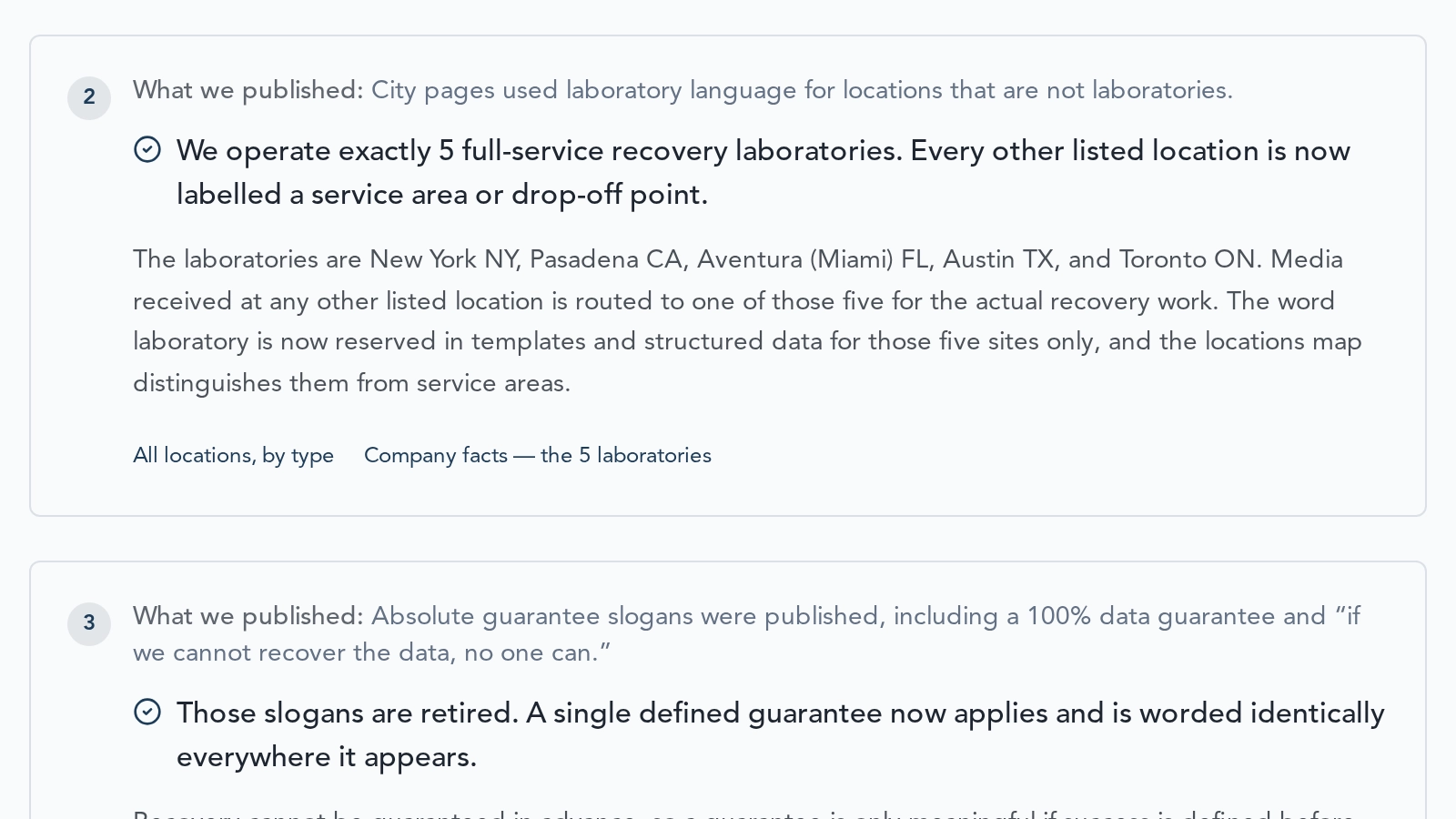
werecoverdata.com/company/transparency, captured September 6, 2026. No Internet Archive copy is available; the site's robots.txt disallows the Internet Archive crawlers, as described in the Austin section above.
WeRecoverData's "Data recovery myths and corrections" page, read the same day, lists as its eleventh item the myth "Data recovery companies operate a laboratory in every city they list." Its correction reads:
Most listed city locations across the industry — including ours — are service areas, not laboratories.
WeRecoverData operates exactly 5 full-service recovery laboratories: New York NY, Pasadena CA, Aventura (Miami) FL, Austin TX, and Toronto ON. The 50+ other listed locations are service areas and drop-off points that route media to one of those laboratories. Any claim that we run dozens of laboratories is inaccurate.
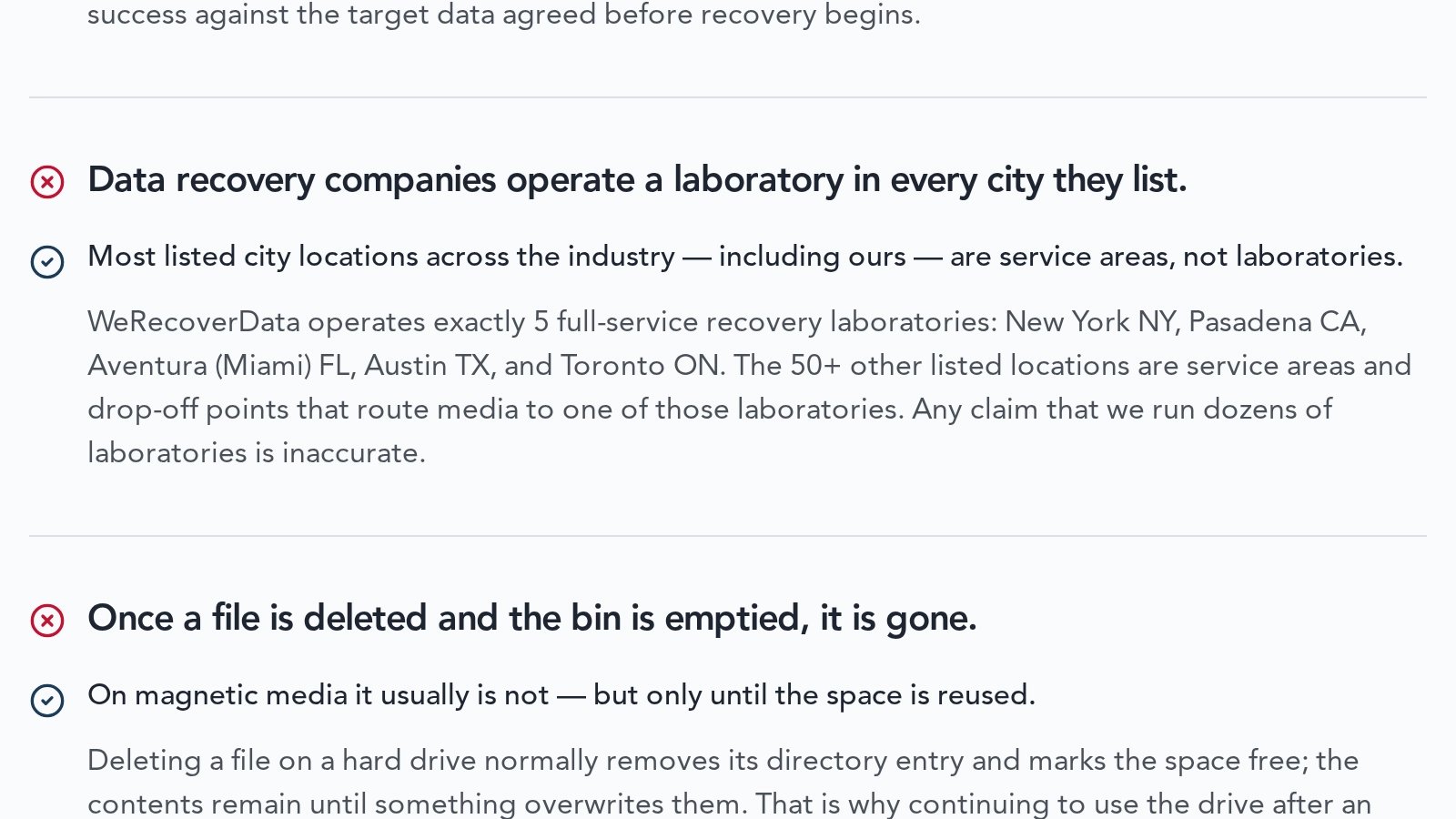
werecoverdata.com/resources/myths-and-corrections, captured September 6, 2026. No Internet Archive copy is available, for the reason given in the Austin section above.
Locations are one of the subjects WeRecoverData's counsel wrote to us about. The demand letter dated June 19, 2026 asked us to remove the page titled "Is WeRecoverData Safe?" and to stop republishing what it called false or misleading factual statements about WeRecoverData's services, pricing practices, locations, facilities, personnel, technical capabilities, credentials, customer relationships, and business practices, and it stated that "WRD anticipates litigation". We declined on June 26, 2026 and asked WeRecoverData to identify any specific statement it contends is false. On July 24, 2026, replying to a July 13, 2026 correction request from us, its counsel wrote that "WRD is not presently pursuing litigation against you concerning the publications at issue", that WeRecoverData is "not asking you to remove the webpage or videos", and that "WRD led with legal correspondence. WRD recognizes that this was the wrong first approach and that it could reasonably have appeared to be an effort to suppress criticism rather than answer it." As of July 26, 2026, the June 19 demands had not been withdrawn in writing. The transparency page quoted above carries the line "Last reviewed 2026-08-06" and states: "It is not a response to any third party, and it does not characterise anyone else's reporting." Every letter in the exchange, both sides, is published in full at WeRecoverData's advertised US locations, a page Louis Rossmann maintains in his userspace on consumerrights.wiki, which did not write, review, or endorse it.
The transparency page tabulates the network as five full-service recovery laboratories and "50+" locations of the type it calls "Service area / drop-off point", which it defines as "A listed city or region where we accept media and serve clients, but which is not a laboratory." Its locations page, read the same day, is headed "Our Global Drop-off Locations". Those are the company's own labels. Of the 46 US addresses in the July 2026 survey, WeRecoverData's corrections page names four cities among its five laboratories: New York, Pasadena, Aventura (Miami), and Austin. Every other listed location, in its words, is a service area or drop-off point.
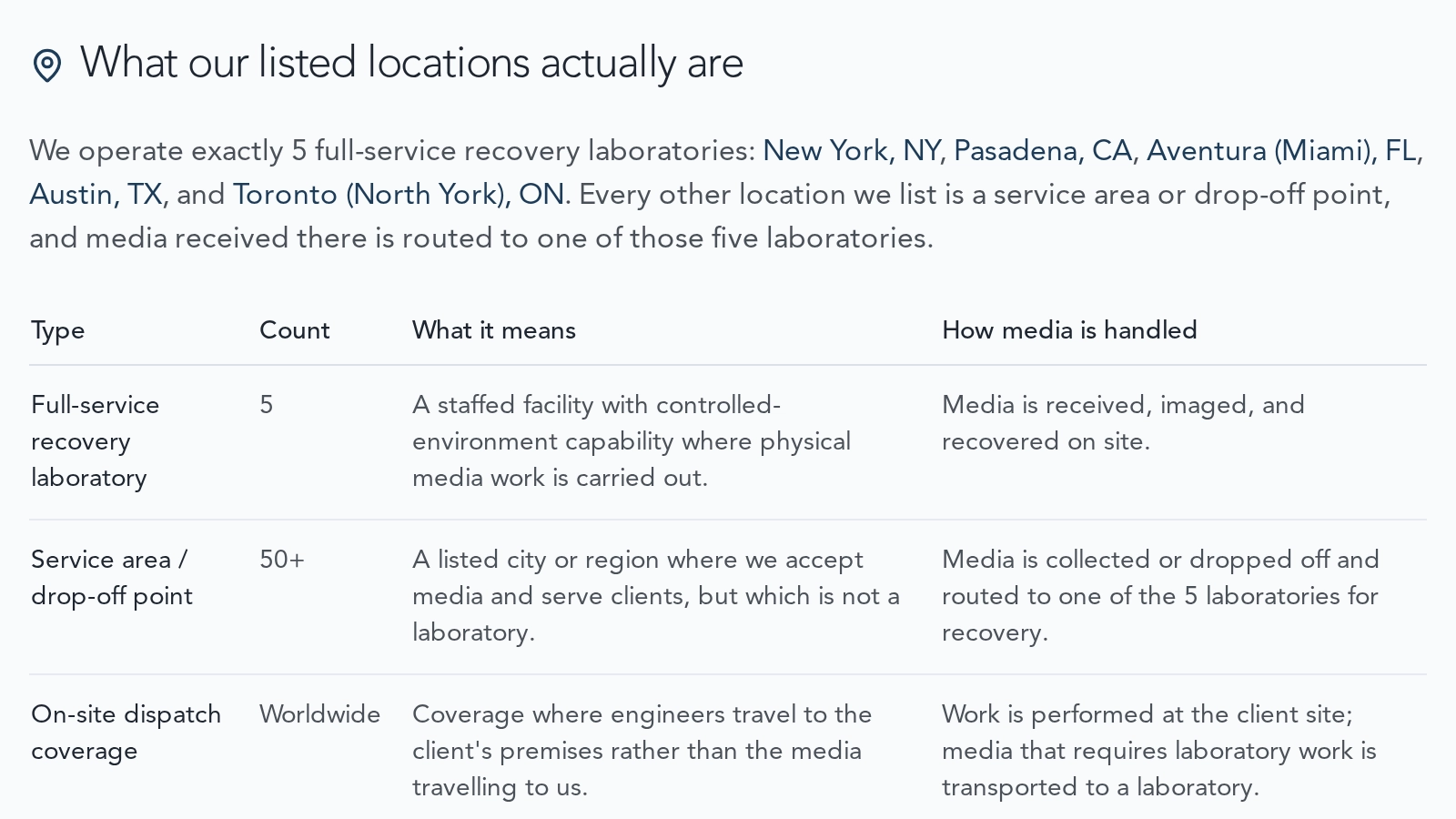
werecoverdata.com/company/transparency, the location-type table, captured September 6, 2026.
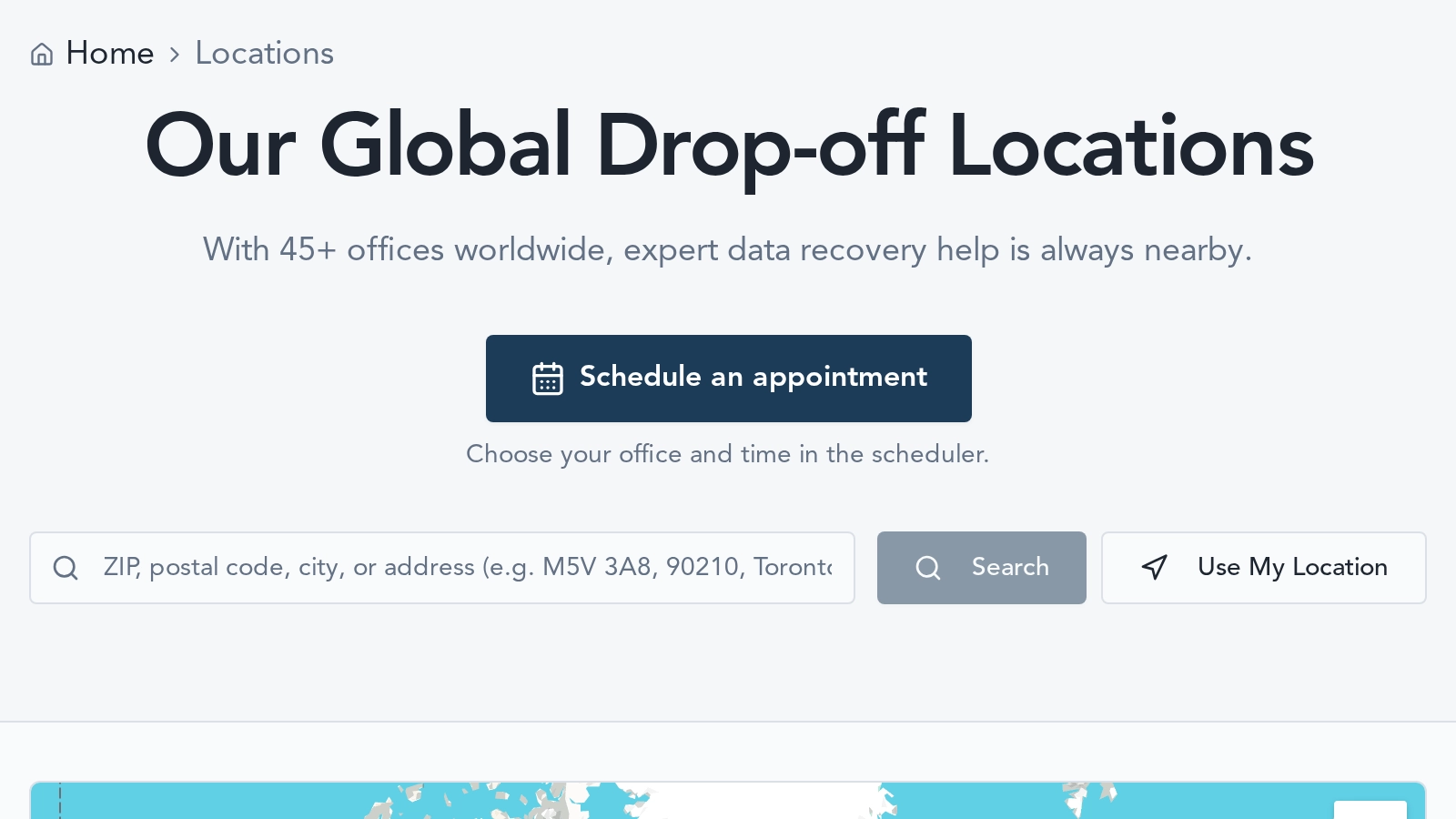
The heading and the 45+ offices line at the top of werecoverdata.com/locations, captured September 6, 2026.
A July 2026 survey recorded 46 advertised US locations on werecoverdata.com, each with its own city page. When we opened all 46 city pages on July 26, 2026, every one was live, and 45 of the 46 listed the same phone number, 212-594-5946. The one address the survey pairs with no outside office-space listing is the New York address, and the survey gives that address the benefit of the doubt as the company's own facility.
For the other 45 addresses, the survey links the page of the company that markets space at each one. The table below counts those pairings by operator. The survey's own table links, for each row, WeRecoverData's city page and the Google Maps listing, and, where one was identified, the listing of the company that markets space at the address, so you can open any city and compare.
| Who markets space at the advertised address | Advertised US addresses |
|---|---|
| Regus (some rows link a CoworkingCafe, LiquidSpace, or OfficeSpace listing showing Regus space at the address) | 32 |
| Premier Workspaces | 3 |
| Davinci Virtual | 3 |
| Intelligent Office | 2 |
| Spaces | 2 |
| District Offices | 1 |
| OneBiz Center | 1 |
| Pasadena Business Park (an ordinary multi-tenant office building; the survey does not call it a virtual office) | 1 |
| No outside office-space listing (New York) | 1 |
Counts from the advertised-locations table on the survey page ↗, as fetched July 26, 2026. The operator listings are the operators' own pages or commercial listing services showing the operator's space; werecoverdata.com pages and the map links were re-opened by us on July 26, 2026. What any listing shows can change; each row of the survey is dated and screenshotted where it matters.
Two numbers describe two different measurements. The March 2026 investigation documented on our analysis of WeRecoverData covered 22 addresses across the US and Canada. The July 2026 survey covers the 46 US locations the website advertised that month, one row per city page. Same company, two dates, two scopes.
Where Did WeRecoverData's Google Maps Listings Point on July 26, 2026?
On July 26, 2026, Louis Rossmann, who maintains the survey, opened all 46 Google Maps links in its table, one per advertised US location, and recorded where each one settled. Thirty settled in their advertised cities. Fifteen settled on one identical point, 46.423669, -129.9427086, which Google Maps draws in the North Pacific Ocean off the Washington coast. Each of those fifteen listings displayed a business name, a website, and a phone number, but no street address. One more, the Commerce, California link, opened with no listing shown. The survey records an ordinary street address on WeRecoverData's own city page for each of those sixteen locations the same day. The screenshots and the per-row record are in the survey's map-link section ↗.
Late the same evening, Central Time, we re-opened all 46 links ourselves, by following each short link and reading the coordinates in the destination URL Google returned. By then, every one of them resolved to coordinates in or next to its advertised city. A Google Maps listing can change at any time, which is why every observation above carries its date and why the survey keeps screenshots.
Neither the survey nor this page draws a conclusion about why fifteen listings pointed at one spot in the Pacific Ocean on July 26, 2026, and neither attributes the state of any listing to anyone: what a Maps listing displays at a given moment depends on listing data and on Google's systems, and an outside viewer cannot tell which. Where each link settled that day is recorded, dated, and checkable, and that is all this page states.
Who Has Filmed Visits to WeRecoverData's Advertised Addresses?
Eight videos, covering seven of the advertised cities, are linked below. Two are ours or published by us and are labeled so; the rest were posted by other channels, and each is labeled by who posted it. Open any of them and watch.
| City | Filmed / posted by | Posted | Watch |
|---|---|---|---|
| Austin | Chris, a Rossmann Repair Group employee (our footage, embedded above) | July 12, 2026 | Embedded above; file history ↗ |
| Salt Lake City | Filmed by a viewer; published on Louis Rossmann's YouTube channel (@rossmanngroup) | July 15, 2026 | Watch ↗ |
| Denver | Posted by the YouTube channel Guard13007 | July 13, 2026 | Watch ↗ |
| Minneapolis | Posted by the YouTube channel CollectionMaster (the visit is part of a longer video; the link starts at the visit) | July 15, 2026 | Watch ↗ |
| Houston (address on the Google listing) | Posted by the YouTube channel MON5TERMATT | July 18, 2026 | Watch ↗ |
| Houston (address on WeRecoverData's Houston page) | Posted by the YouTube channel MON5TERMATT | July 18, 2026 | Watch ↗ |
| San Francisco | Posted by the YouTube channel Arika Yumemiya | July 22, 2026 | Watch ↗ |
| Memphis | A video attached to the Apple Maps listing for the Memphis address; its author and posting date are not established | n/a | Open the Apple Maps listing ↗ |
Attribution states who posted each video, which is what we can verify. We describe none of these videos beyond where they were filmed and who posted them; open any of them and watch. Posting dates are the upload dates the hosting platform displayed on July 26, 2026.
How to Verify Any Data Recovery Lab
Before handing your drive to any company, confirm that recovery work happens at the address you are visiting. These five questions separate a real lab from a shipping depot.
1. What imaging hardware is physically at this address?
A lab performing mechanical recovery needs a PC-3000 system (from ACE Lab), a DeepSpar Disk Imager, or equivalent professional-grade hardware. These are specialized systems that cost tens of thousands of dollars. If the person at the counter cannot name the equipment in the building, the building does not contain it.
2. Can I see the clean bench or cleanroom?
Head swaps and platter work require a controlled environment. A laminar-flow clean bench with HEPA filtration is the minimum. Ask for the particle count specification. Our bench is validated to 0.02 µm particle count. If the facility does not have one, they are not performing mechanical recovery on-site.
3. Will my drive leave this building at any point during the recovery?
This is the question that ends the conversation. A physical lab performs all diagnostic, imaging, and repair work under one roof. If the answer involves shipping your drive to a "main lab" or "processing center," you are at a drop-off counter.
4. Can I speak directly with the technician who will work on my drive?
A physical lab connects you to the engineer handling your case. A drop-off counter connects you to a receptionist or a national call center. The person who discusses your SMART data and failure symptoms should be the same person who opens the enclosure.
5. Check the address on Google Street View before you go.
Look at the building. If the Street View image shows a UPS Store, a shared office lobby, a university bookstore, or a computer repair shop with a different name on the sign, the listing does not match the location.
What Can You See From the Lobby?
Every row below can be settled at the counter, by looking or by asking one question. Run it on any data recovery company, and run it on us: walk into 2410 San Antonio Street during business hours and check the same rows, or watch the lab walkthrough video first and see whether the room matches when you get there.
| What to look at | What a working lab shows you | What a drop-off point shows you |
|---|---|---|
| Signage at the suite door | The company name is on the door or the wall, permanently fixed, not a paper sign or a slot in a directory strip. | The door carries the building operator's brand, or a tenant strip listing dozens of names, or nothing. |
| Who greets you | Someone who works for the company, who can talk about your drive before you hand it over. | A shared receptionist or a retail clerk who takes the device and writes a ticket. Ask one question about the drive and note whether anyone at the counter can answer it. |
| Imaging hardware in the room | A PC-3000, a DeepSpar Disk Imager, or equivalent, plugged in and visible. | A desk, a monitor, a card reader, a printer. |
| A clean bench | A laminar-flow clean bench, and a filter rating the technician can state when you ask for it. | No bench. A head swap needs one. |
| Drives in progress | Other people's drives on the bench, in the middle of work. | No drives at all, or a shipping box by the door. |
| What happens next to your drive | It stays in the building. You can be told which bench it goes to. | It is packed for a courier. Ask where it is going and how long the leg takes. |
| Who answers the phone number on the listing | The lab, during the hours the listing publishes. | A national number. Ask the person who answers whether they are standing in the room where your drive will be opened. |
None of these rows is proof on its own. A real lab can have a quiet bench on a Tuesday, and a company can have a genuine private office inside a building that also rents virtual addresses to other tenants. Read them together, and ask the question in the last row out loud before you let go of the drive.
How Do You Check Where a Data Recovery Company Actually Is?
You do not need to trust this page, or any company's marketing. The check has four steps:
- Open the company's own website page for your city and note the street address it lists.
- Search that street address on the web and see who markets office space at it. Coworking and virtual-office operators list their addresses publicly.
- Open the company's Google Maps listing for that city. Look at where the pin lands and whether the listing shows a street address at all.
- If you visit, note who is actually at the address during business hours: staff of the company, or staff of the building.
This method works on any data recovery company, including us. Rossmann Repair Group has one address, 2410 San Antonio Street, Austin, TX, and mail-in work is performed there.
Documented Mailbox Address Formatting Patterns
While SalvageData operates as a physical data recovery provider, third-party investigators documented irregularities in how their localized listings are represented online.
The Austin listing at MAV Computers is not an isolated case. Between September 2024 and January 2025, Local Search Forum investigator HikingMike documented a pattern of address formatting and listing volume involving the same company.
Analysis of the Edwardsville Location Documentation
An independent investigation on the Local Search Forum documented a pattern of data recovery listings placed at UPS Store and PO Box addresses, including a listing at 6696 Center Grove Rd #299, Edwardsville, IL 62025. That address is a UPS Store. The "#299" unit number is displayed as if it were a suite; the forum documents these as UPS Store and PO Box style listings. Google's Business Profile guidelines state that "P.O. boxes or mailboxes located at remote locations aren't acceptable." The investigator submitted photographic evidence showing UPS Store signage at these addresses. Google denied multiple edit requests immediately.
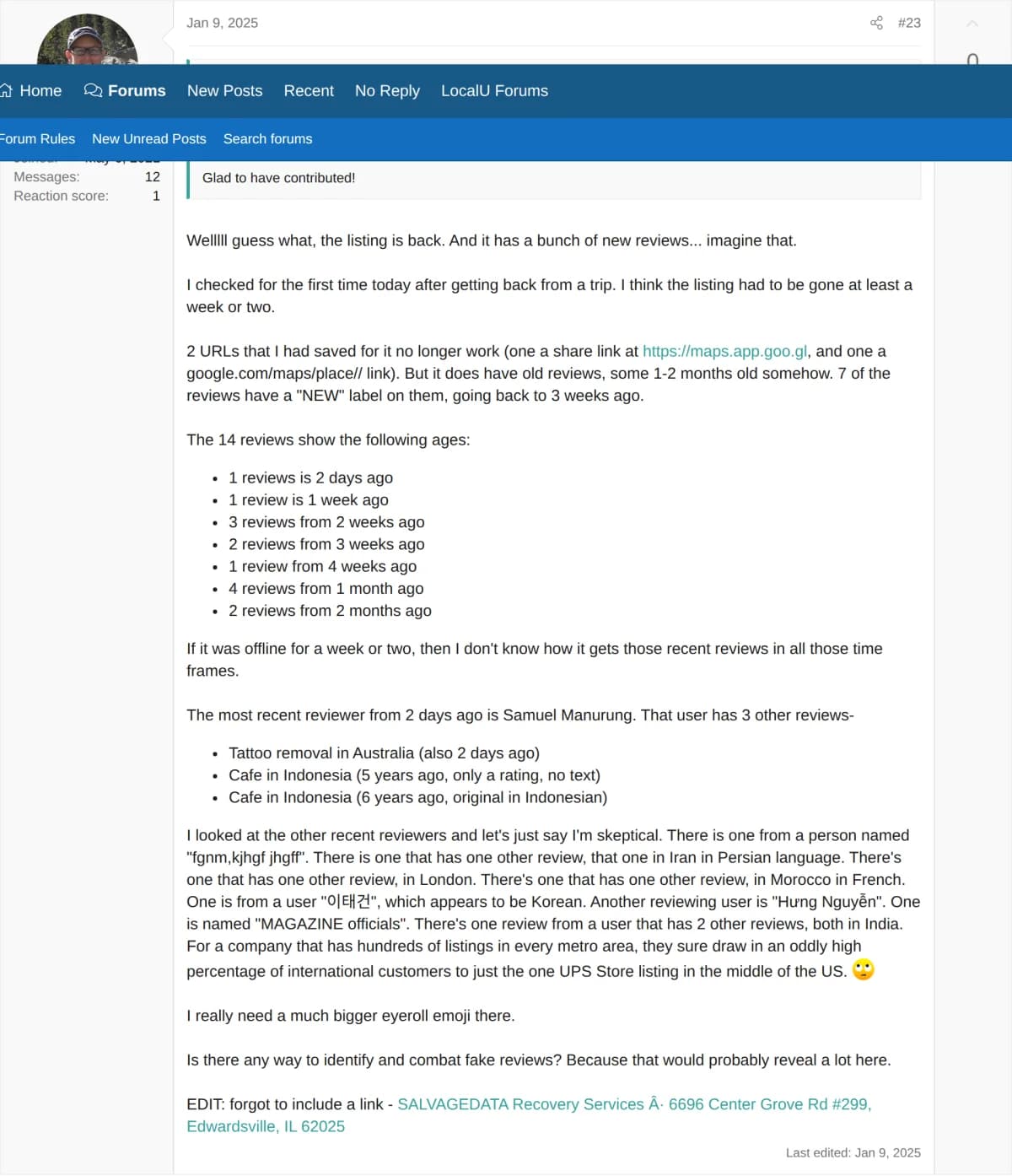
Screenshot from Local Search Forum: SalvageData listing at a UPS Store address in Edwardsville, IL. Source: HikingMike, Local Search Forum, January 2025.
Listing Density in a Single Metro Area
The same investigator compiled a spreadsheet of SalvageData listings in one US metro area and counted approximately 60 separate profiles. According to the investigator's forum posts, these listings were located at computer repair shops and cellphone stores rather than data recovery facilities. The spreadsheet was submitted to Google through the Business Redressal Form. Local search authority Mike Blumenthal escalated the findings directly to Google. After six weeks of communication, Google responded that the listings met current compliance standards.
The Edwardsville listing was briefly removed in late December 2024 after a separate forum member flagged it. By January 9, 2025, the listing had reappeared with 14 reviews from accounts with review histories spanning Indonesia, Iran, Morocco, India, and the United Kingdom, plus reviewer names appearing Korean and Vietnamese. For a detailed breakdown of reviewer profile anomalies and chronological analysis, see the documentation of geographic review irregularities.
The pattern matches what was documented at the Austin location: a commercial address formatted to resemble a physical office, paired with reviewer profiles that do not match the listing's geographic service area. Despite documentation submitted through multiple enforcement channels, automated compliance systems determined the listings met current standards. This highlights a known gap between published business profile guidelines and automated enforcement capabilities, underscoring the value of independent consumer verification.
Why Companies Do This
Google's local search algorithm ranks businesses based on three factors: relevance, prominence, and proximity. For "near me" searches, proximity to you dictates whether you see it in your search results. A legitimate lab in Ohio can't appear in the local results for a searcher in Austin, no matter how good their reputation. The only way to rank locally is to have a local address.
That creates a financial incentive to lease virtual offices and partner with retail stores in every metro area. Each address generates a Google Business Profile, and then appears in that city's local search results. The company captures leads from consumers searching for a local lab. The customer absorbs the hidden costs: shipping risk, longer turnaround, and the loss of direct access to the technician working on their drive.
This is not a fringe tactic used by a single bad actor. Industry professionals have documented it for years. One data recovery engineer in New Jersey wrote that a virtual office address can be rented for roughly a hundred dollars a month, and that a caller should ask a data recovery company whether "they will debug it while you wait and show you their data recovery equipment." The same article recounts a visit to a company in East Rutherford, NJ, where the writer asked to see the back room where the data recovery is done and the person at the desk "refused to bring me there." Datarecovery.com's guide to data recovery scams warns that some companies "operate mailing offices … generally staffed by one person, whose only job is to interact with the customer and mail their device to the actual laboratory"and that hiding this fact is a red flag. The pattern repeats across the industry.
What You Lose When Your Drive Ships
When you hand your drive to a technician in front of his workstation, you get a direct chain of custody. You can ask questions about its failure and get real answers. You can see whether they have the ability to work on your problem. If something goes wrong during recovery, you can talk to the technician who is accountable. When your drive ships through a middleman to another provider, you lose all of that.
Transit Damage
A failed hard drive with degraded read heads is fragile. Vibration during shipping can score the platters or shift heads out of alignment. The drive that arrived at the drop-off point in recoverable condition may not survive a cross-country trip in a FedEx truck.
Diagnostic Delay
A local lab begins evaluation when you walk in the door. A drop-off counter adds packaging time, shipping time, intake processing at the receiving lab, and queue time before a technician opens the box. The clock on your recovery starts days later than it would at a physical lab.
Retrieval Friction
If you disagree with the quoted price and want your drive back, it is now in another state. You wait for return shipping. Some companies charge evaluation fees and shipping fees even when you decline service.
No Direct Technician Access
You speak with a call center or a sales representative. The person who answers your questions about the recovery is not the person performing it. At a physical lab, the technician who evaluates your drive is the same person who images it and executes the repair.
What Our Lab Looks Like
Rossmann Repair Group operates a physical data recovery lab at 2410 San Antonio St in Austin, TX. Every step of the recovery process occurs in this building. When you walk in, the technician who evaluates your drive is the same person who images it, performs the head swap if needed, and returns your data. Your drive does not leave.
You can walk into the lab during business hours and watch. You can read what other walk-in customers experienced on our reviews page. If you are outside the Austin area, our mail-in program ships directly to this lab; there is no intermediary facility.
On-Site Equipment
- PC-3000 Portable III systems from ACE Lab for firmware-level hard drive diagnostics and imaging
- DeepSpar Disk Imagers for sector-by-sector extraction from damaged media
- 0.02 µm ULPA-filtered laminar-flow clean bench
- Donor drive inventory for head stack and PCB replacements
- Micro-soldering stations for board-level component repair on iPhones and MacBooks
Frequently Asked Questions
Do data recovery companies ship your drive to another location?
How can I tell if a data recovery company has a real lab?
Is it safe to ship a failed hard drive?
Why do data recovery companies create fake local listings?
Does Google allow virtual office listings for data recovery?
How do I verify a data recovery company before handing over my drive?
What happens if I want my drive back from a drop-off location?
Where did WeRecoverData's Google Maps listings point on July 26, 2026?
Does SALVAGEDATA have real data recovery labs?
Is Secure Data Recovery a real lab or a drop-off location?
Since 2008
Established
As Featured In
Related services
Related Pages
How we source claims and correct mistakes
Labs we recommend by name
The advertising tax explained
Fact check with sourced evidence
Full HDD recovery overview
Five published pricing tiers
Ship direct to our Austin lab
Nationwide Coverage
Nationwide Mail-In Data Recovery Service
We serve all 50 states with secure mail-in data recovery. Ship your failed drive to our Austin lab and we'll diagnose it within 24-48 hours. All work is performed in-house at our Austin, TX lab. There are no other locations and no outsourcing.
Popular Service Areas
Verify Before You Hand Over Your Drive.
Free evaluation at our Austin lab. Walk in or ship direct. No data, no recovery fee.