
Fake Reviews in Data Recovery
Some data recovery companies create Google Maps listings at addresses that aren't labs. To make those listings rank, third-party brokers inject fake five-star reviews from accounts with no connection to the listed city.
NBC Bay Area, former federal criminal investigator Kay Dean, & independent researchers have documented this pattern at multiple brands. Here's the evidence.
Some data recovery brands run dozens of Google Maps listings at UPS Store counters, residential condos, & apartment units. The listings carry broker-purchased five-star reviews from accounts with no connection to the listed city, & drives dropped off there ship to a central lab in another state. NBC Bay Area, former federal criminal investigator Kay Dean, & Local Search Forum researchers documented the pattern.
Choosing a lab right now? Start with red flags vs. real reviews & the platforms where engineers vet each other.
50 Addresses, Zero Labs
Your drive dies. You search “data recovery near me.” Google shows three businesses. A company with 50+ Map Pack listings & purchased reviews at each will appear before the local shop that owns a PC-3000 & does the work.
50 addresses. 50 sets of fake reviews. That's the formula. A company that wants to appear local in 50 cities without building 50 laboratories needs addresses it doesn't staff & reviews it didn't earn.
Here is what one of those listings looks like from the sidewalk. Google Maps lists this Edwardsville, Illinois address as SALVAGEDATA Recovery Services. The storefront is The UPS Store.
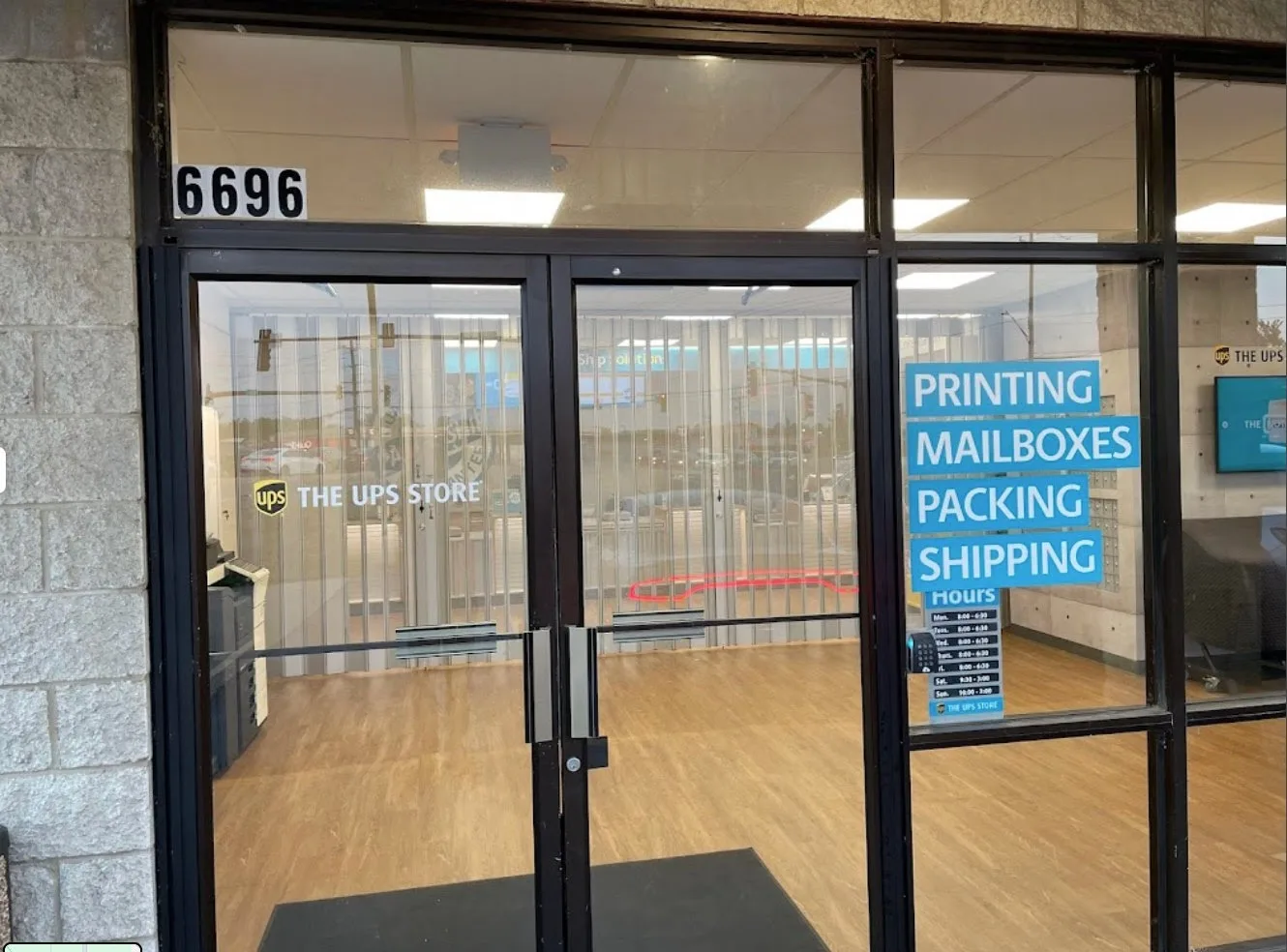
HikingMike stood at that door twice in September 2024 & submitted Google Maps edits marking the listing as nonexistent, attaching photos of the signage, the address number, & the whole building. Google denied both edits immediately. His Local Search Forum investigation found 60 listings for the same company in a single metro area. The reporting timeline documents the four months of rejected reports that followed.
How Deceptive Google Maps Listings Work
- 01
Register addresses.
Rent virtual mailboxes, partner with unrelated retail shops, or use residential apartments. We traced one data recovery brand operating 118 online listings back to a single laboratory in Ohio. The listed addresses included UPS Store counters, income-restricted apartment units, & residential condominiums. - 02
Create localized landing pages.
Generate a template service page for each city, swapping only the city name. One network's Miami landing page carries a leftover template artifact; the Miami address walkthrough below documents it. - 03
Fill the review deficit.
An unstaffed mail-forwarding counter doesn't generate organic five-star reviews about “friendly on-site engineers.” To make these phantom locations rank on Google Maps, companies use third-party review brokers to inject inorganic reviews. - 04
Capture the lead.
When a panicked consumer calls the local number, the call routes to a centralized intake center. The consumer is instructed to ship their drive across the country. The “local lab” never touches it.
| Characteristic | Real Laboratory | Phantom Location |
|---|---|---|
| Physical space | Equipped lab with clean bench, PC-3000 hardware, & engineers | UPS Store counter, virtual office, or residential address |
| Staff | Technicians performing recoveries on-site | No staff; mail-forwarding only |
| Review generation | Organic reviews from customers who visited | Inorganic reviews from accounts with no geographic connection |
| Number of locations | 1 to 3 actual labs | 50 to 120+ Google Maps listings |
What does a phantom location look like in practice? We checked the addresses.
Condos, UPS Stores & Apartments
- Austin, TX7801 N Lamar Blvd - retail electronics shop
Among hundreds of five-star reviews across these listings, a Google Local Guide went to the Austin, TX listing at 7801 N Lamar Blvd & documented what they found. The address is MAV Computers, a retail electronics shop. No PC-3000. No clean bench. No imaging hardware. The reviewer called the company & was told drives are shipped to a lab in another city.
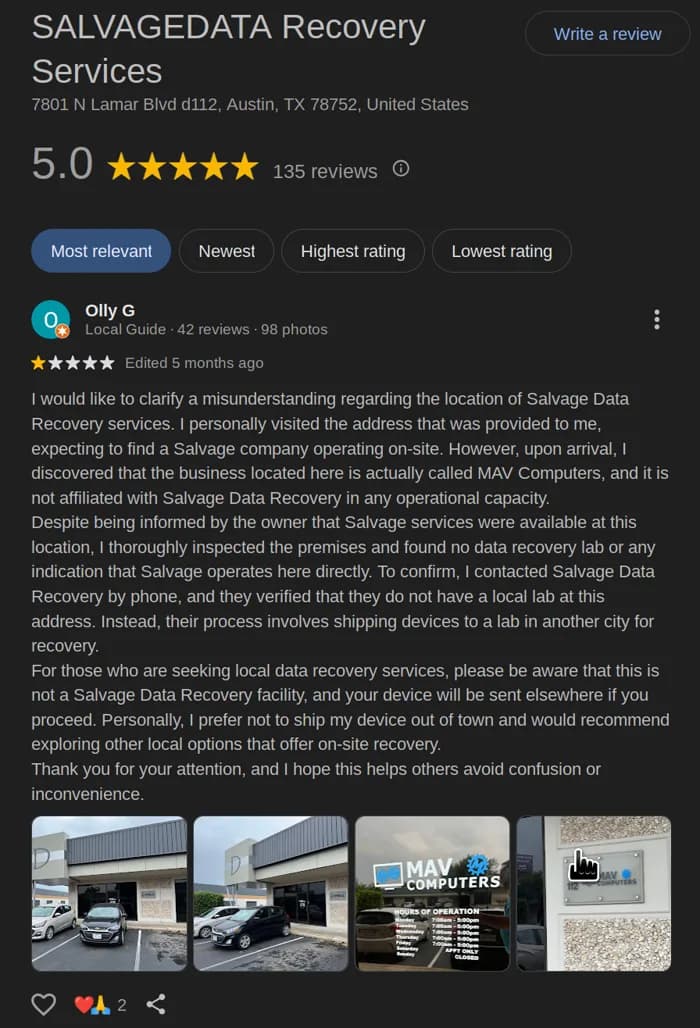
N Lamar Blvd listing. Reviewer found MAV Computers at the address. Click to read the full review on Google. - Miami, FL215 30th St #5 - 471 sq ft residential condo
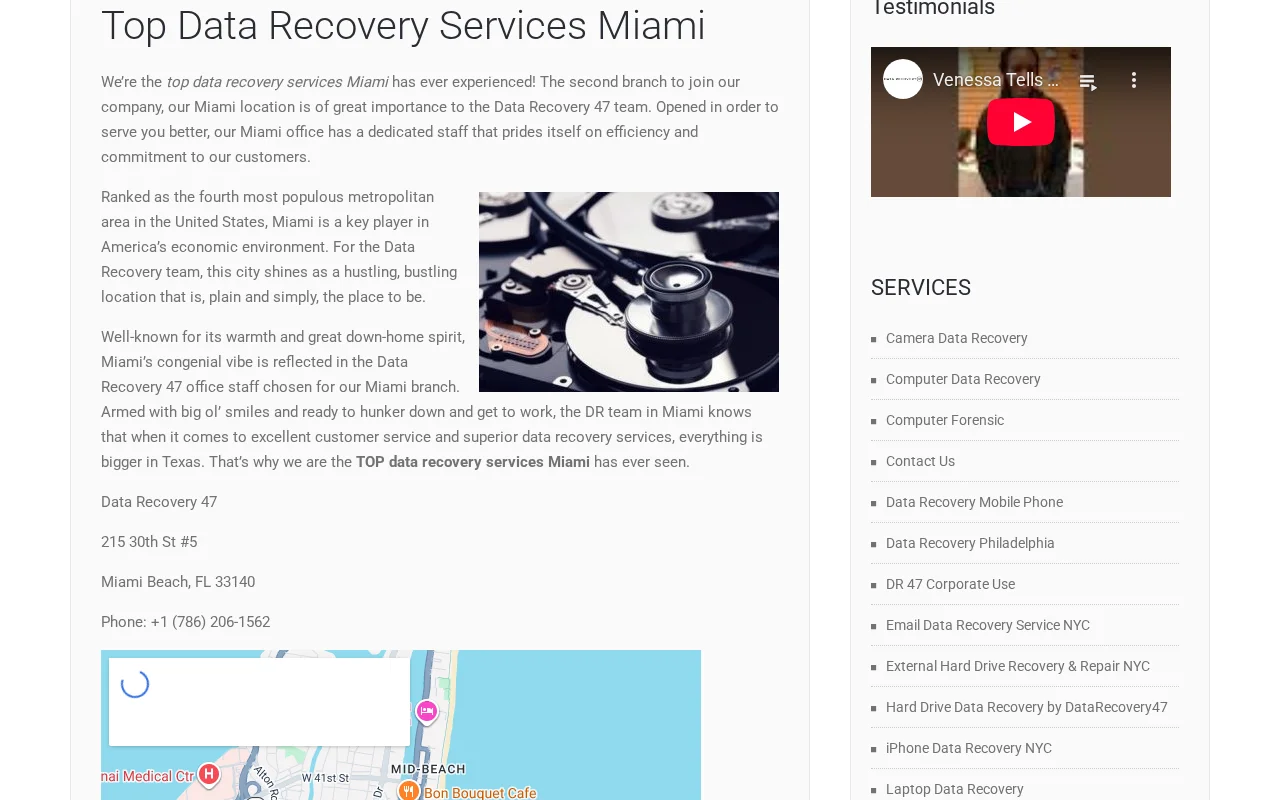
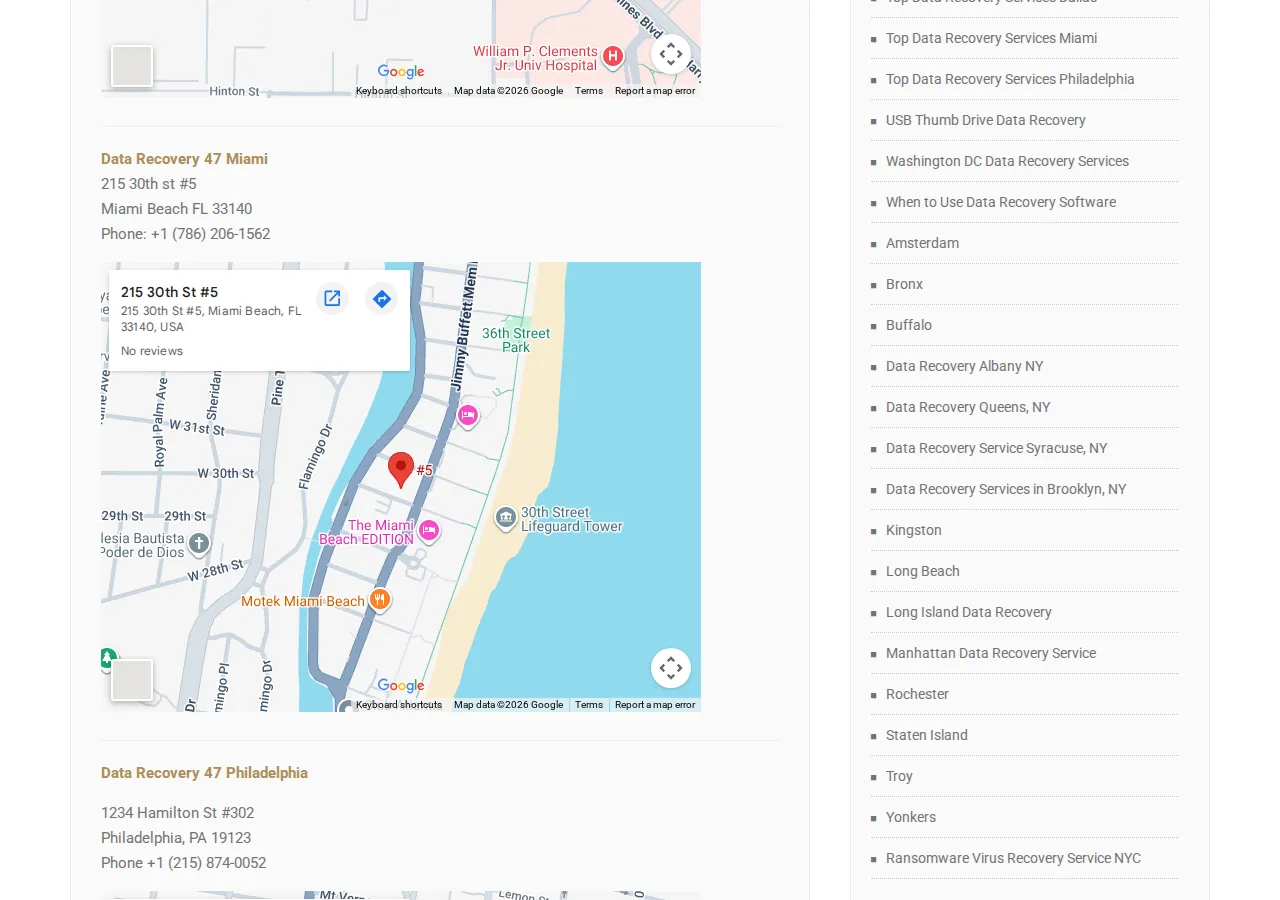
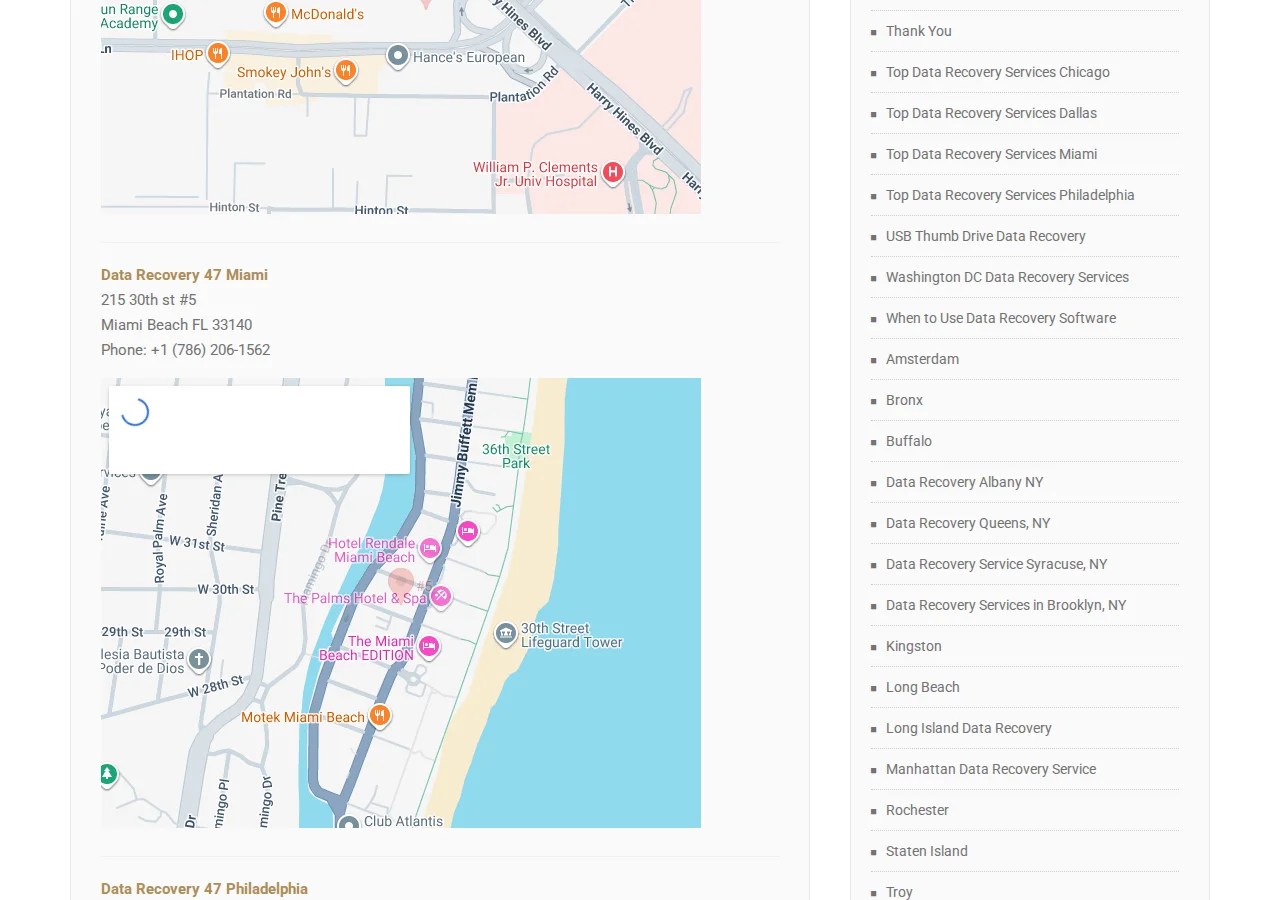
A “Miami branch” at 215 30th St #5, Miami Beach, FL: a 471-square-foot, one-bedroom residential condominium built in 1935. The Miami landing page for this address contains the phrase “everything is bigger in Texas,” left over from a cloned Texas template.
The Miami page still says 'everything is bigger in Texas,' revealing the template was cloned from a different city.
Data Recovery 47 (Miami landing page)
“the DR team in Miami knows that when it comes to excellent customer service and superior data recovery services, everything is bigger in Texas. That's why we are the TOP data recovery services Miami has ever seen.”
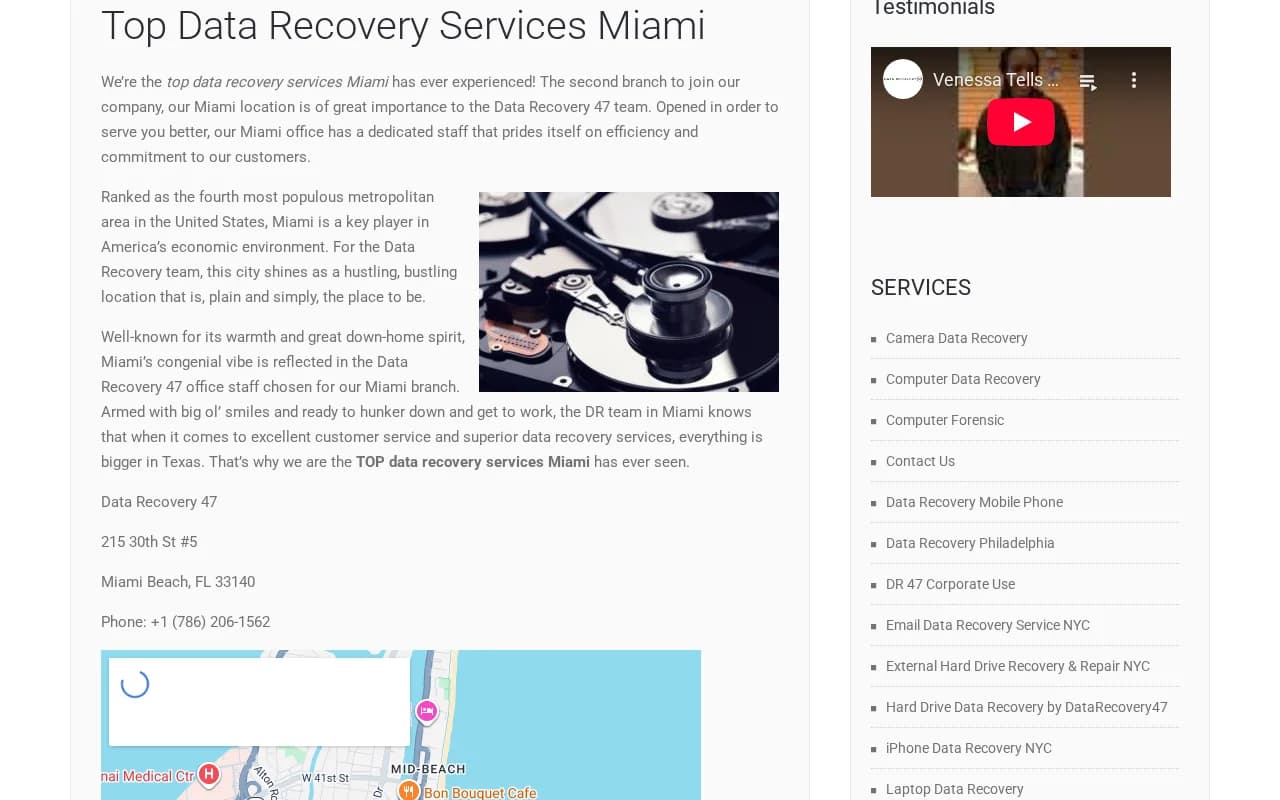
Source: datarecovery47.com/miami-data-recovery-services/index.htmlWayback Machine archive (Captured 2026-03-26) DR47's Miami listing points to a 471 sq ft residential condo.
Data Recovery 47 (Miami listing)
“Data Recovery 47 Miami: 215 30th st #5, Miami Beach FL 33140.”
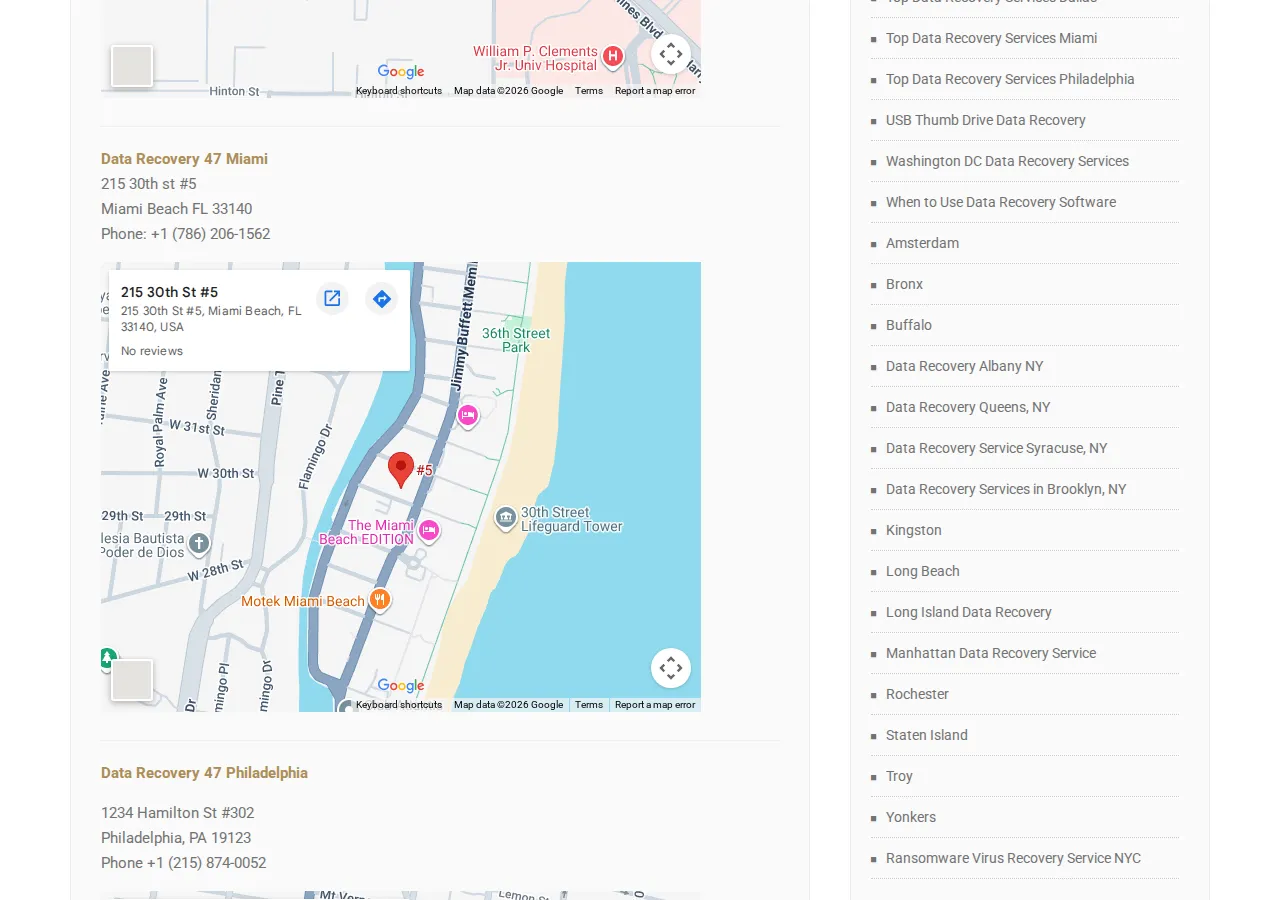
Source: datarecovery47.com/locations/Wayback Machine archive (Captured 2026-03-25) - Dallas, TX1853 W Mockingbird Ln #1201 - income-restricted apartment
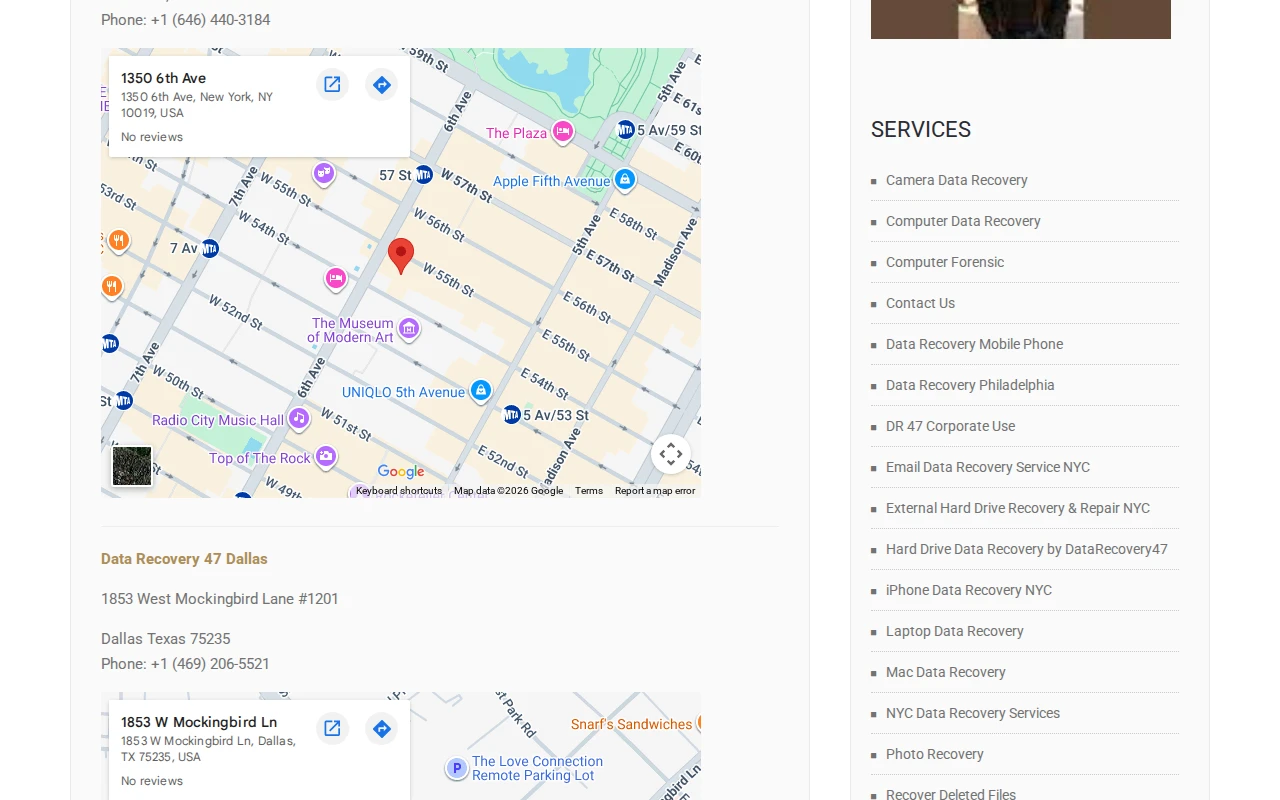
Dallas. “Suite 1201” at 1853 West Mockingbird Lane #1201turns out to be Providence Mockingbird Apartments, an affordable apartment community where income limits apply, with a pool, playground, & fitness center. It's an apartment unit.
The Dallas 'suite' is an apartment unit in an income-restricted housing complex.
Data Recovery 47 (Dallas listing)
“Data Recovery 47 Dallas: 1853 West Mockingbird Lane #1201, Dallas Texas 75235.”
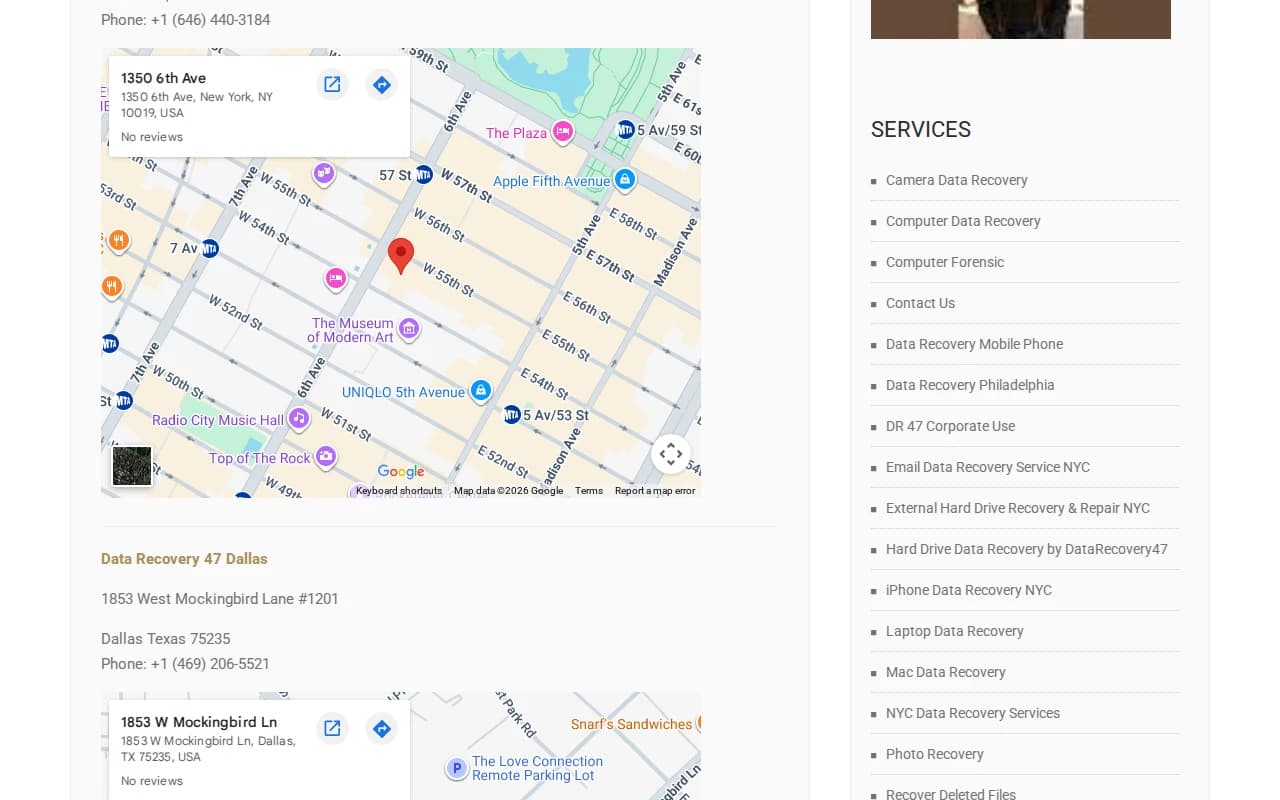
Source: datarecovery47.com/locations/Wayback Machine archive (Captured 2026-03-25) - Philadelphia, PA1234 Hamilton St #302 - residential loft
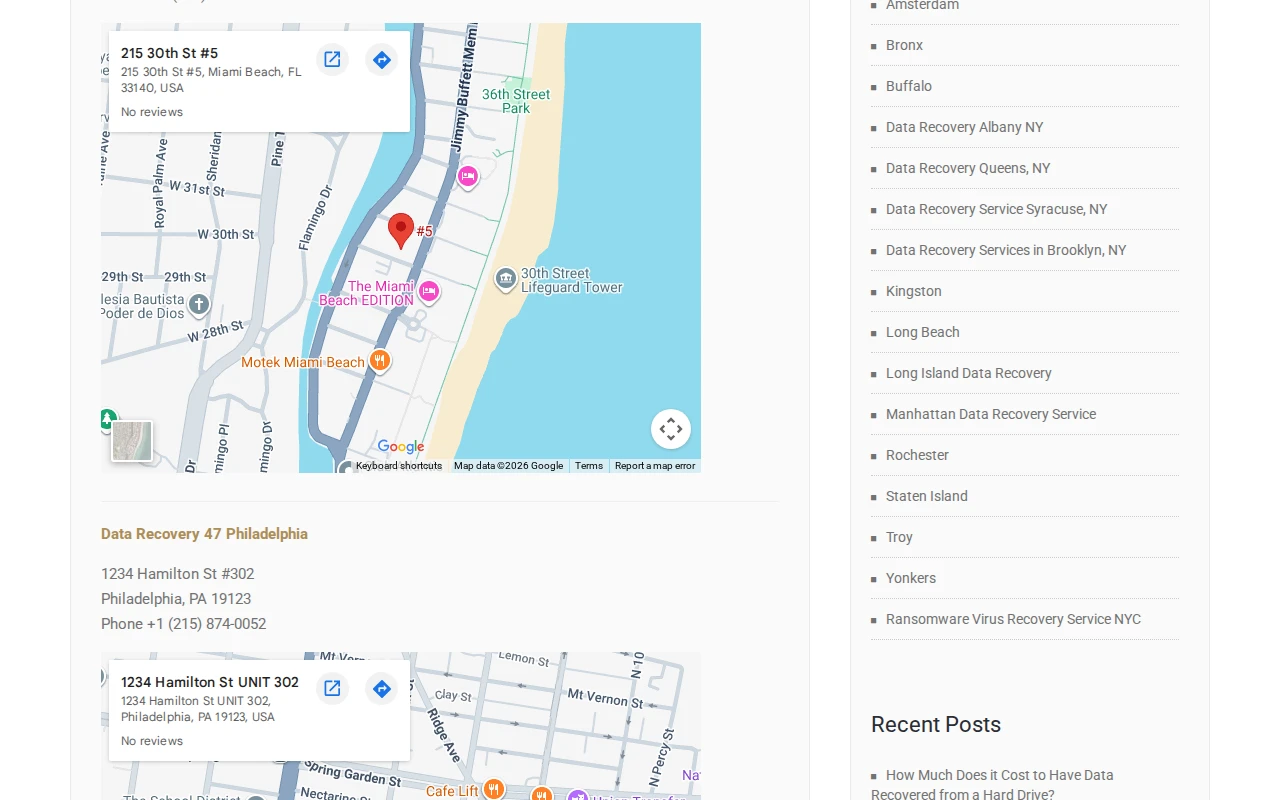
A “Philadelphia branch” at 1234 Hamilton St #302: a residential condominium in a converted 1937 industrial building with keyfob entry & no commercial lobby.
The Philadelphia address is a residential loft in a converted industrial building.
Data Recovery 47 (Philadelphia listing)
“Data Recovery 47 Philadelphia: 1234 Hamilton St #302, Philadelphia, PA 19123.”
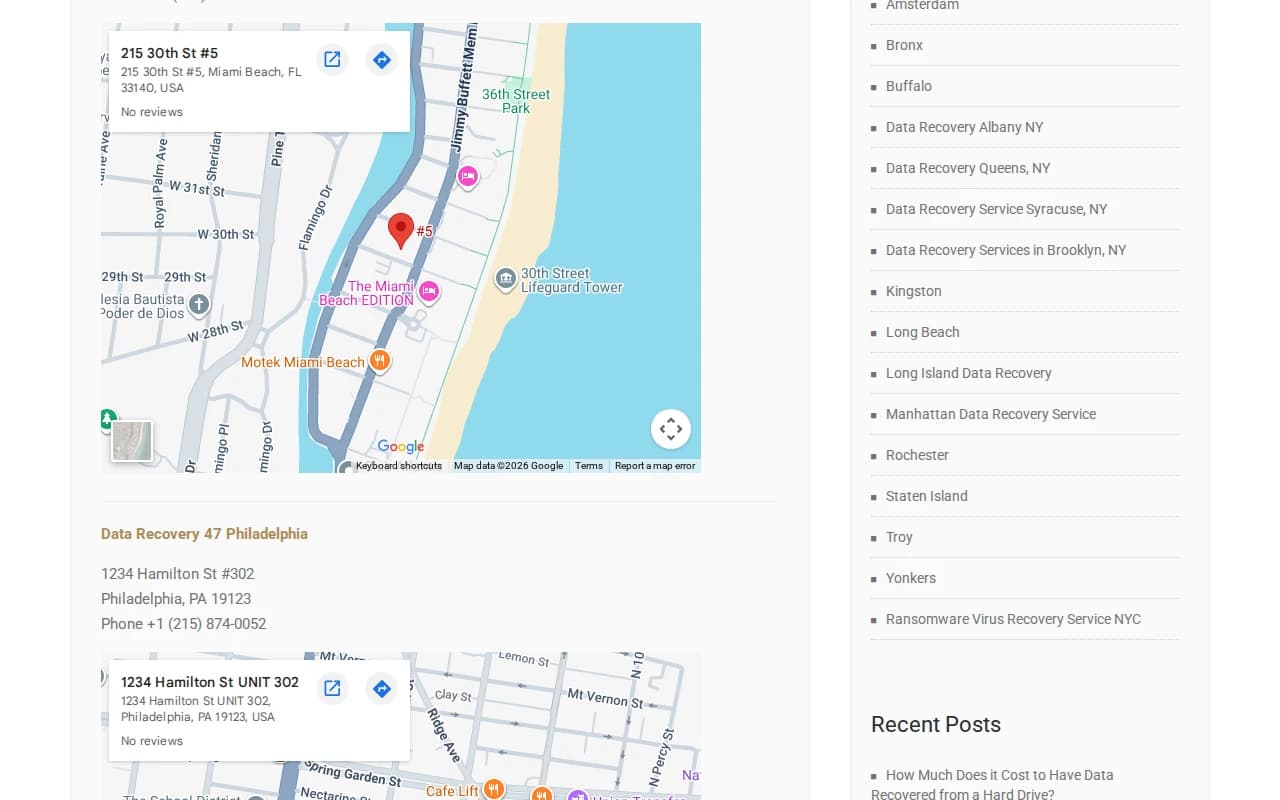
Source: datarecovery47.com/locations/Wayback Machine archive (Captured 2026-03-25)
View 2 more directory verifications from the companies' own location pages
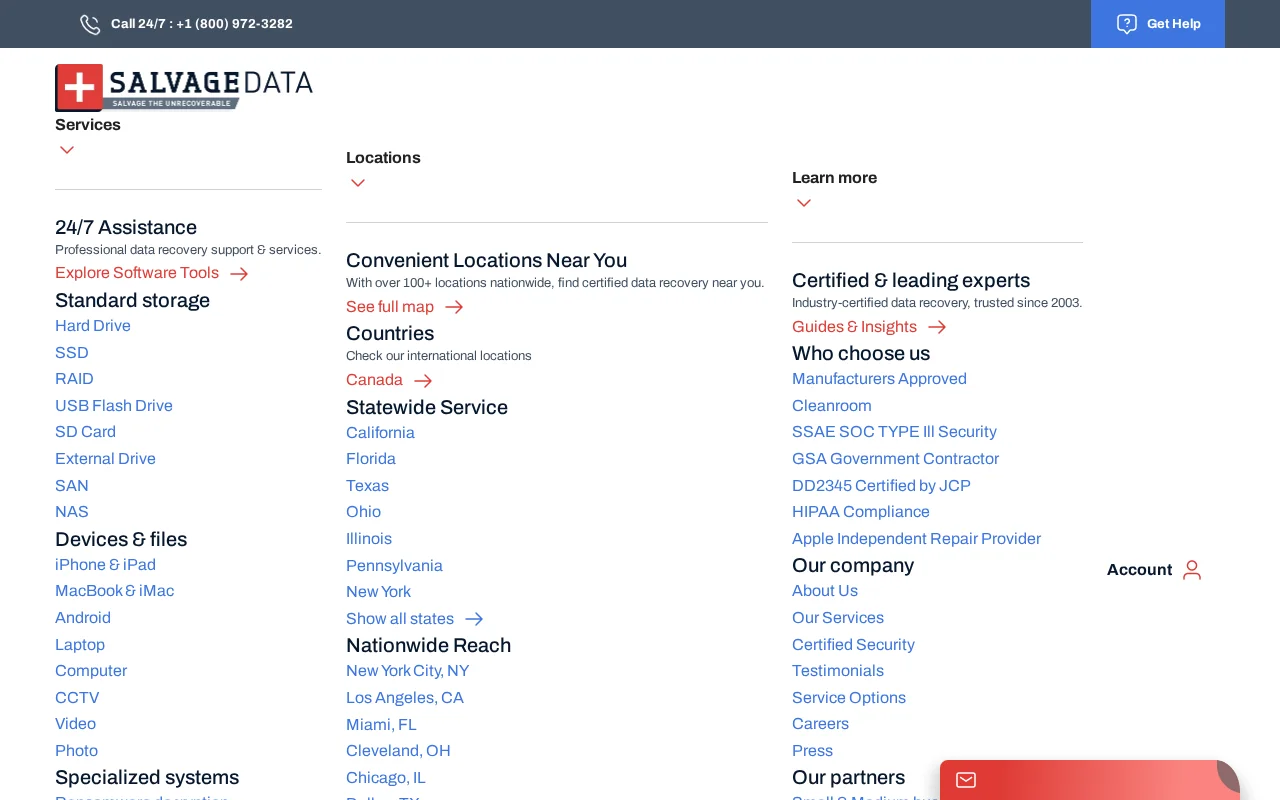
SalvageData advertises 100+ locations across North America on its locations page.
SalvageData Recovery Services (locations page)
“Nationwide Reach: over 100 locations across North America.”
DR47's locations directory lists Miami, Dallas, & Philadelphia addresses that correspond to residential properties.
Data Recovery 47 (copyright footer reads: Data Recovery 47, a SalvageData Recovery company)
“Data Recovery 47 Miami: 215 30th st #5, Miami Beach FL 33140. Data Recovery 47 Dallas: 1853 West Mockingbird Lane #1201, Dallas Texas 75235. Data Recovery 47 Philadelphia: 1234 Hamilton St #302, Philadelphia, PA 19123.”
Phantom addresses are the infrastructure. The five-star ratings that make them rank come from broker-run account networks. The sections that follow document who verified this, the networks themselves, & the brokers who operate them.
Kay Dean's Investigative Record
Most of the third-party evidence on this page traces to one investigator.

Kay Dean
Former Special Agent, U.S. Department of Education Office of Inspector General. Founder of Fake Review Watch.
Dean has documented tens of thousands of purchased reviews across Google, Yelp, & Facebook, publishing over 100 video case studies on her Fake Review Watch YouTube channel. In February 2024 she presented at an FTC hearing on the Consumer Reviews and Testimonials Rule.
The New York Attorney General used her research in an enforcement action that secured $100,000 from a Manhattan doctor who manipulated online reviews. The October 2023 press release thanks her by name for assisting with the investigation.
Her work reaches directly into data recovery: the NBC Bay Area investigation of DriveSavers, covered later on this page, started with review duplication she identified & brought to the station.
Press record
- SFGate: “This Bay Area woman is on a crusade to prove Yelp reviews can't be trusted,” June 2023
- NBC Bay Area: “The Latest Frontier for Fake Reviews: 5-Star Copycats,” October 2023
Also covered by CBC News, The Washington Post, Vice News, & NPR's Reveal.
Dean's work also reaches the company this site has covered before. In July 2026 she provided us with 2019 and 2020 captures from Facebook review-exchange groups, review pages, & Yelp's consumer-alerts history involving WeRecoverData listings, together with her stated conclusions. We have published her records, her conclusions in her own words, & a plain statement of what the records do and do not show: Kay Dean's WeRecoverData findings.
What Did Fake Review Watch's Video Show About WeRecoverData?
On July 30, 2026, Dean published an 11 minute 38 second video, “Fake Review Trades for WeRecoverData,” presenting captures from her 2019 work on Facebook review-exchange groups. It is worth watching for the mechanism alone, because it shows a review trade being assembled step by step. Each of the six episodes shows two five-star reviews posted the same day in opposite directions: one from an account bearing the name Joshua Gulmatico to another business, and one to a WeRecoverData listing from an account Dean links to that business. In four of the six she also displays a Facebook review-exchange post and its reply. In several episodes the Yelp and Google review texts she displays are word-for-word identical.
“Fake Review Trades for WeRecoverData,” Kay Dean, Fake Review Watch, published July 30, 2026. Watch on YouTube.
Segment starts: 0:40, how the exchange groups operate; 1:59, Dean's count of the trades she documented in 2019 and her tracking sheet, where she says she documented “over two dozen review trades on behalf of We Recover Data in 2019”; 2:31, a Los Angeles-area recording studio; 3:49, a medical spa in Temecula, California; 5:16, a restaurant in San Francisco; 6:19, a lounge in the Miami area; 7:14, a contractor in Encino, California; 8:11, a landscaping business in Rochester Hills, Michigan; 9:13, a LinkedIn profile before and after; 9:55, Yelp's 2020 suspicious activity alert & the Center for Investigative Reporting's Reveal program. Dean names the other businesses in the video; we describe them by type & location because they are not the subject of this page.
Her conclusions in the video are hers & she states them as conclusions. At 9:13 she says: “Those are just a few of the fake review trades I concluded Joshua Gulmatico made on behalf of We Recover Data back in 2019.” The video does not establish that WeRecoverData directed, solicited, paid for, or knew about any review exchange, and nothing on this page asserts that it does. The links between accounts & named people are Dean's conclusions from the material she assembled. The captures are from 2019 & 2020 and say nothing about WeRecoverData's reviews today. Fake Review Watch is responsible for the content of its video; we publish it as her work. Nothing in this section states that current management authorized, knew of, or directed anything shown. The underlying captures and what they do and do not establish are on our page publishing her records, alongside our page on WeRecoverData.
Has WeRecoverData responded to this page?
WeRecoverData's counsel sent us a demand letter dated June 19, 2026 over material on this website. We did not take anything down; we published the whole exchange instead. On July 24, 2026, WeRecoverData's counsel wrote that WeRecoverData is "not presently pursuing litigation against [us] concerning the publications at issue" and is "not asking you to remove the webpage or videos"; as of July 26, 2026, the June 19 demands had not been withdrawn in writing, and no lawsuit had been filed. The full record, both sides, is at WeRecoverData's advertised US locations, a page Louis Rossmann maintains in his userspace on consumerrights.wiki, which did not write, review, or endorse it.
What Did Fake Review Watch's Video Show About SalvageData?
On August 26, 2026, Dean published “Fake Reviews for SALVAGEDATA,” following her WeRecoverData and DriveSavers videos. She shows Google accounts that five-starred SalvageData locations and, within hours or days, five-starred astrologers and a Warsaw car dealer thousands of miles away; her spreadsheet counts 87 such accounts in two weeks. On Facebook, 92 five-star reviews arrived in June and July 2024 and none since. On Yelp, 73 reviews hit 61 SalvageData listings in ten weeks of 2025. Her closing line at 15:44: “Fake reviews in my opinion strewn across Google, Facebook, and Yelp.” The captures, addresses, and her full conclusions are on Kay Dean's SalvageData findings.
“Fake Reviews for SALVAGEDATA,” Kay Dean, Fake Review Watch, published August 26, 2026. Watch on YouTube.
One Network Across 5 Industries
This isn't isolated. Kay Dean tracked 148 Google accounts that posted five-star reviews for 14 businesses across five unrelated industries. Data recovery, personal injury law, spray foam insulation, moving companies, & a hospice provider in Texas. Same accounts. Same compressed timeframes.
Third-party review brokers don't serve a single client. They manage portfolios of aged review platform accounts & deploy them across whatever businesses are paying that week. In October 2021, the FTC sent penalty offense notices to over 700 companies across industries for endorsement violations, confirming the cross-sector scope of this practice.
148 Profiles on a Single Spreadsheet
Kay Dean, Fake Review Watch. Spreadsheet analysis begins at 3:00.
In a 2024 analysis, Dean compiled a spreadsheet mapping 148 Google profiles against 14 businesses: five Manhattan financial companies (Standard Capital, Retail Funding, Credit Capital, Madison Funding Partners, & Clear), International Van Lines, Fair Price Movers, spray foam insulation contractors, car accident lawyer Daniel Kim, SalvageData Recovery Services, & Homage Hospice in McKinney, Texas.
The overlap funnel:
- The first 27 profiles on the spreadsheet reviewed both a Manhattan financial company & International Van Lines.
- Fifteen of those 27 also reviewed a spray foam insulation business.
- Seven of those 15 also reviewed SalvageData.
Dean's spreadsheet maps 148 profiles against 14 businesses across 5 industries.
Kay Dean, FakeReviewWatch (148-profile cross-industry network analysis)
“There are 148 Google profiles across the top of this spreadsheet. Down the left side are 14 businesses who received positive reviews from these profiles.”
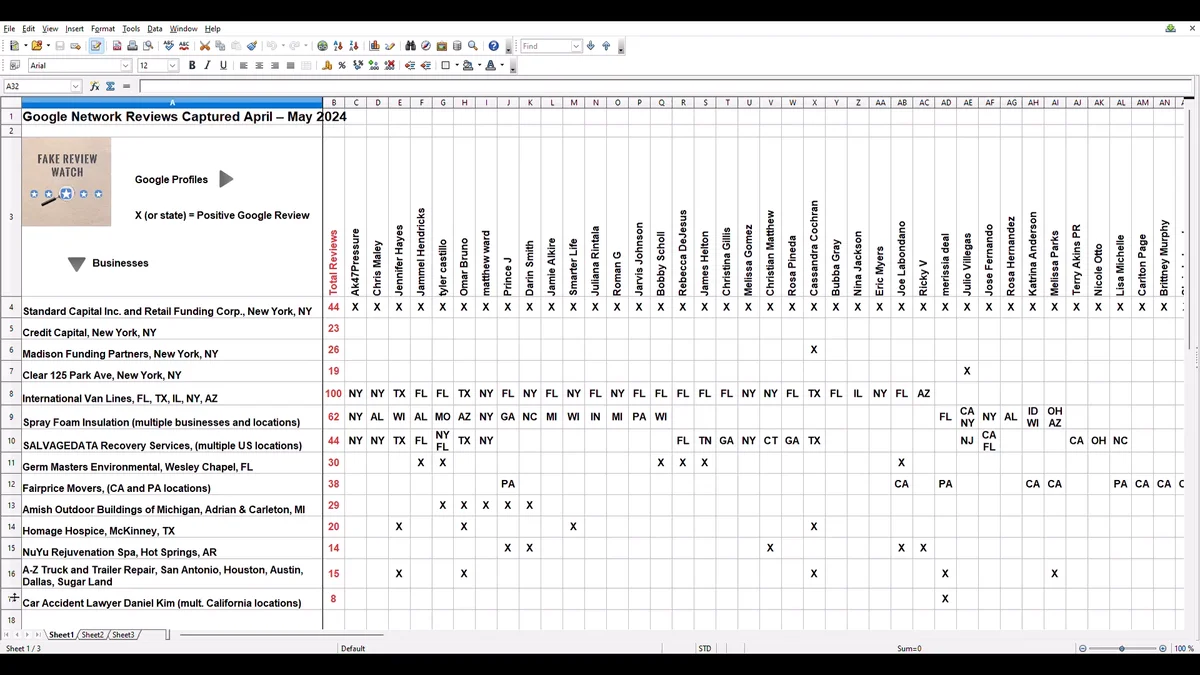
“I took a sampling of his reviewers and looked for other businesses they had reviewed. I saw some literally unbelievable patterns indicating the work of a fake review network.”
“58 of these reviewers of California lawyer Daniel Kim's various Google pages have also reviewed one or more spray foam insulation businesses across the country.”
“Then, note as we scroll to the right that many Kim reviewers are also reviewing Salvage Data Recovery Services, with offices around the nation.”
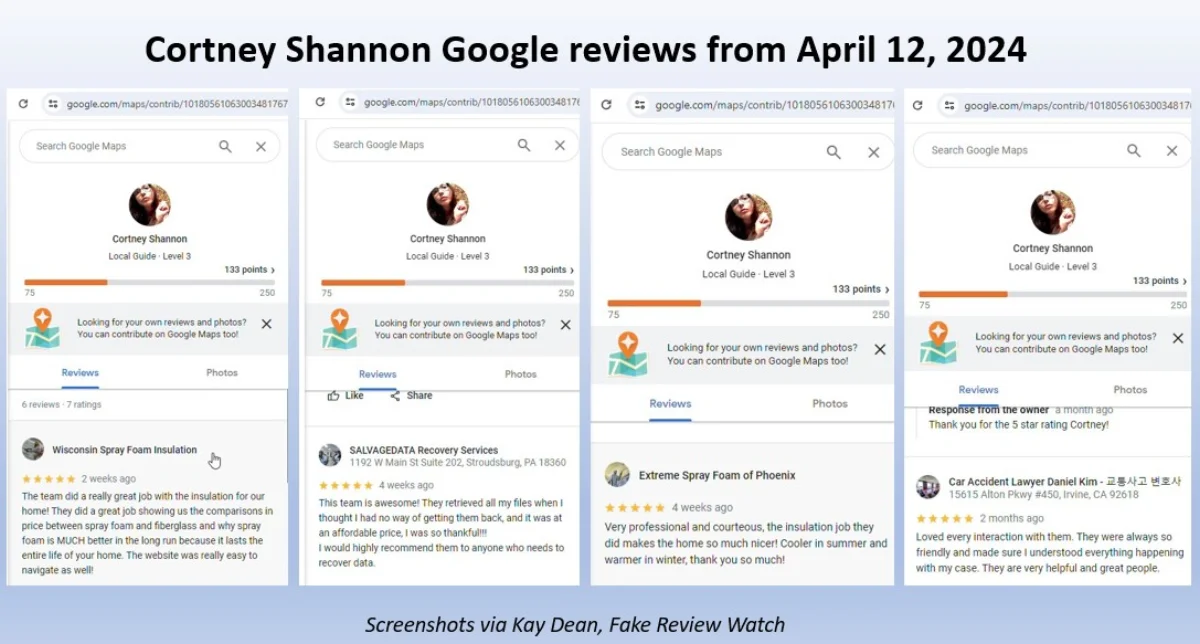
“Let's look at the reviews by Courtney Shannon, for example. Just two weeks ago, she reviewed a Wisconsin spray foam insulation company. Four weeks ago, she reviewed Salvage Data in Pennsylvania. Four weeks ago, she also reviewed a spray foam place in Arizona. And two months ago, she reviewed car accident lawyer Daniel Kim in California.”
“In my opinion, this is clearly the work of one or more online marketers with a network of fake Google profiles.”
That's one profile: the “Cortney Shannon” account was a Local Guide, Level 3, & its four five-star reviews landed the same day, April 12, 2024, across three industries & three states.
Cortney Shannon posted five-star reviews for a spray foam company, SalvageData, another spray foam company, & a lawyer on the same day.
Cortney Shannon cross-industry review pattern (Fake Review Watch)
“A Google profile named 'Cortney Shannon' (Local Guide, Level 3) posted five-star reviews for a spray foam company in Wisconsin, SALVAGEDATA Recovery Services, a spray foam company in Phoenix, and car accident lawyer Daniel Kim, all on April 12, 2024.”
Seen SalvageData in your search results for data recovery? Color me surprised.
For address verification & listing density analysis of SalvageData's local search presence, see the independent evaluation of SalvageData's operations.
Dean returned to SalvageData in August 2026 with a video on its Google, Facebook, & Yelp reviews; those later captures & her stated conclusions are published on Kay Dean's SalvageData findings.
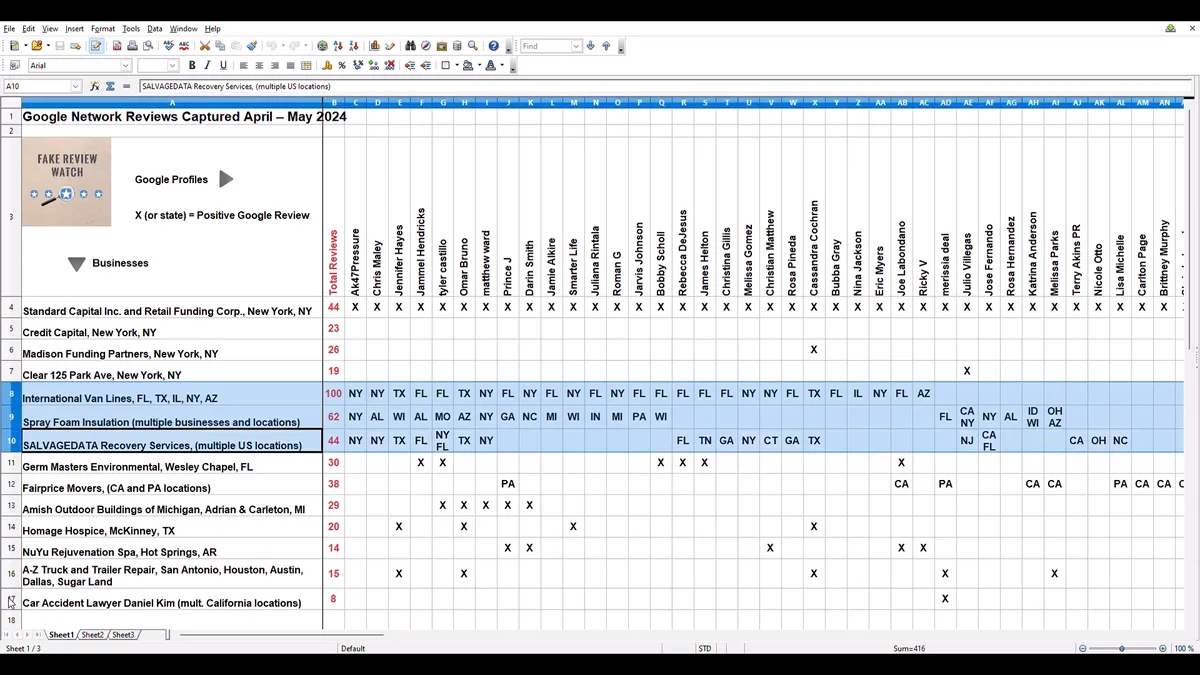
SalvageData appears on the same cross-industry spreadsheet alongside financial companies, movers, & hospice providers.
Kay Dean, FakeReviewWatch (SalvageData row on cross-industry spreadsheet)
“SalvageData Recovery Services appears as one of the 14 businesses on the cross-industry spreadsheet, with reviews from the same network of profiles that reviewed financial companies, moving companies, and spray foam contractors.”
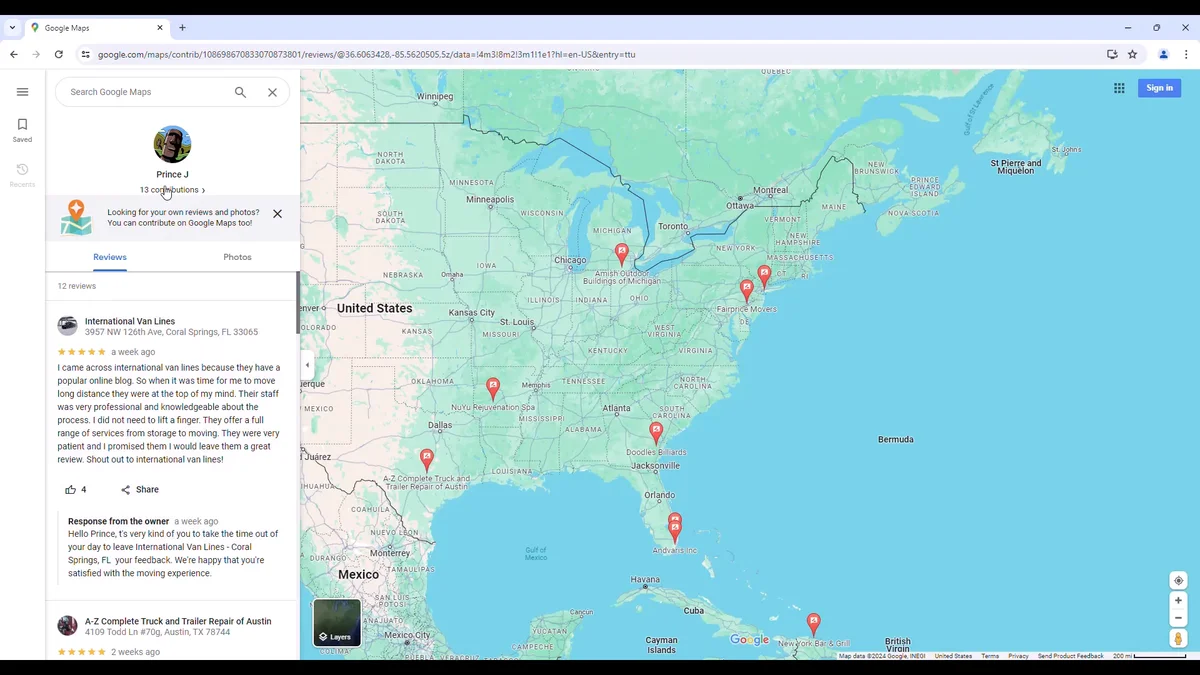
Individual profiles make the pattern visible. Dean documented a profile named “Prince J” with 12 Google reviews posted within a single month: International Van Lines in Florida, a trailer repair shop in Austin, a spa in Hot Springs, Arkansas, Amish Outdoor Buildings in Michigan, a spray foam insulation business in Alabama, Retail Funding in New York, & Fair Price Movers in Philadelphia. Every business Prince J reviewed appears on the cross-industry spreadsheet.
Seven states in four weeks. That would require purchasing a shed, getting a small business loan, insulating a house, moving cross-country, repairing a trailer, visiting a spa, & hiring a moving company.
Prince J reviewed businesses in 7 states within 4 weeks; every business appears on the cross-industry spreadsheet.
Kay Dean, FakeReviewWatch (Prince J impossible review timeline)
“Prince J reviewed International Van Lines in Florida, a trailer repair shop in Austin, a spa in Hot Springs Arkansas, Amish outdoor buildings in Michigan, spray foam insulation in Alabama, Retail Funding in New York, and Fair Price Movers in Philadelphia. All within a single month.”
Fake Hospice Reviews from the Same Accounts
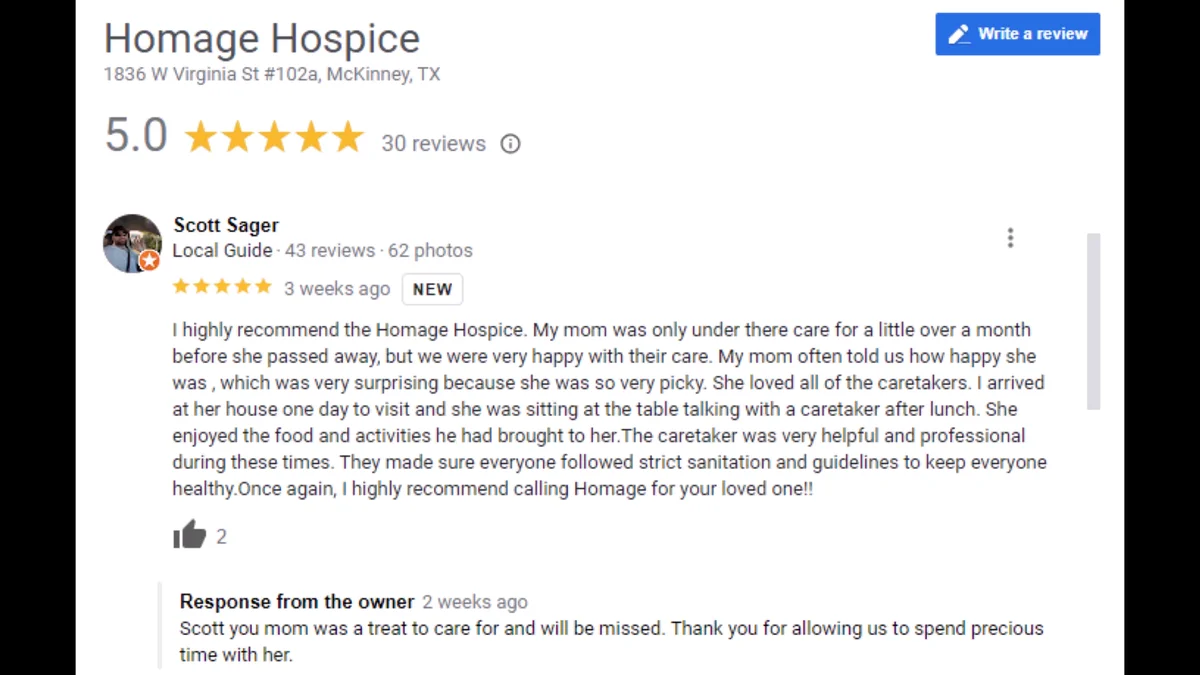
Dean's analysis of a profile named “Scott Sager” follows the same pattern. Sager, listed as a Google Local Guide with 43 reviews, posted a five-star review of the New York financial company Clear. Within the same month, he reviewed International Van Lines in Houston, a spray foam insulation business in Wisconsin, & a truck repair shop in Houston. He also posted a detailed five-star review of Homage Hospice in McKinney, Texas, describing the care his mother received. The business owner replied: “Scott['s] mom was a treat to care for and will be missed.”
The overlap funnel:
- Six of the 19 Clear Financial reviewers on Dean's spreadsheet also reviewed Amish Outdoor Buildings in Michigan.
- Twelve of those 19 also reviewed International Van Lines.
- Eight reviewed a spray foam business.
The same names, reviewing the same unrelated businesses, within the same compressed timeframes.
Scott Sager reviewed a hospice, a financial company, a spray foam business, & a truck repair shop in the same month.
Kay Dean, FakeReviewWatch (Scott Sager hospice and cross-industry review pattern)
“Scott Sager posted a five-star review of Homage Hospice in McKinney, TX with a detailed story about his mother. The business owner replied: 'Scott's mom was a treat to care for and will be missed.' Sager also reviewed a financial company in New York, a spray foam business in Wisconsin, and a truck repair shop in Houston within the same month.”
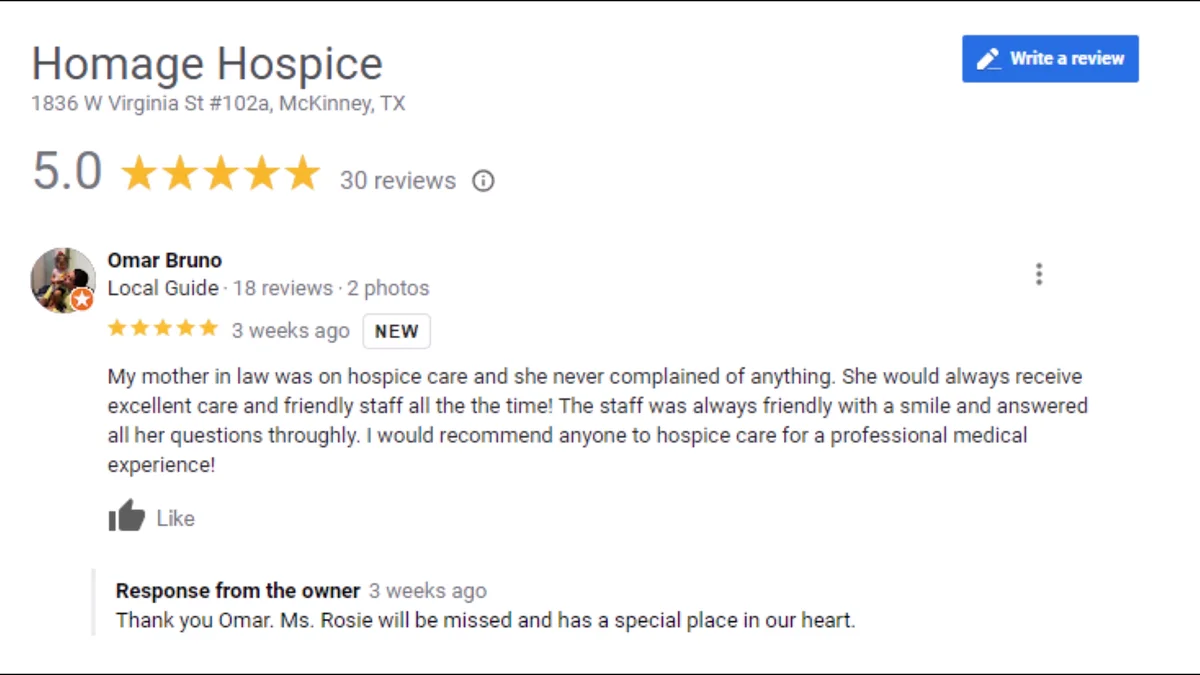
Twenty profiles on Dean's spreadsheet reviewed Homage Hospice with stories about family members receiving end-of-life care. Omar Bruno posted a five-star review describing the care his mother received & drew a personal reply from the business owner. According to Dean's analysis, Bruno reviewed seven of the 14 businesses on the spreadsheet.
Consumers choosing end-of-life care for a parent read these reviews & trust them.
A hospice is where families send loved ones to die with dignity. If the profiles posting those reviews are the same profiles reviewing spray foam contractors & moving companies across seven states in a single month, those consumers are making one of the most consequential decisions of their lives based on fabricated experiences.
Omar Bruno reviewed the hospice & 7 of the 14 businesses on the spreadsheet.
Kay Dean, FakeReviewWatch (Omar Bruno hospice and cross-industry review pattern)
“Omar Bruno posted a five-star review of Homage Hospice praising the care his mother received. The business owner replied: 'Thank you Omar. Ms. Rosie will be missed and has a special place in our heart.' Bruno reviewed seven of the 14 businesses on the cross-industry spreadsheet.”
The spreadsheet maps who posts the reviews. NBC Bay Area caught the same tactic from a different angle: identical review text recycled across Google & Yelp under different names.
NBC Catches Copied Reviews at DriveSavers
In October 2023, NBC Bay Area reported that DriveSavers, a data recovery company in Novato, California, had copycat five-star reviews on Yelp. Former federal investigator Kay Dean pitched the story to the station after identifying reviews copied word-for-word from Google & reposted on Yelp under different profile names.
NBC Bay Area confirmed five-star reviews were being duplicated across Google & Yelp under different names.
NBC Bay Area / DriveSavers investigation
“Somebody took those reviews, and we suspect paid other people to post them word for word.”
DriveSavers told NBC it had nothing to do with the duplicate reviews & suspected a competitor was responsible. Yelp said it had no evidence a competitor posted the duplicates.
NBC's team found ten copycats on the DriveSavers page and flagged them to Yelp, which removed all ten plus 100 more. Yelp put a “Suspicious Review Activity Alert” on the page, then took it down. Yelp said it lifts an alert if it finds the offending behavior has stopped after 90 days.
Same Text, Different Names, Two Platforms
Dean's independent analysis went deeper than NBC's. She identified 28 suspicious DriveSavers reviewers on Yelp, all of which Yelp had recommended as trustworthy. Of those 28 profiles: 24 also reviewed a garage door or rolling gate business in the East or Midwest, 17 reviewed a locksmith, & 23 were plagiarizing TripAdvisor restaurant & hotel reviews to pad their profiles.
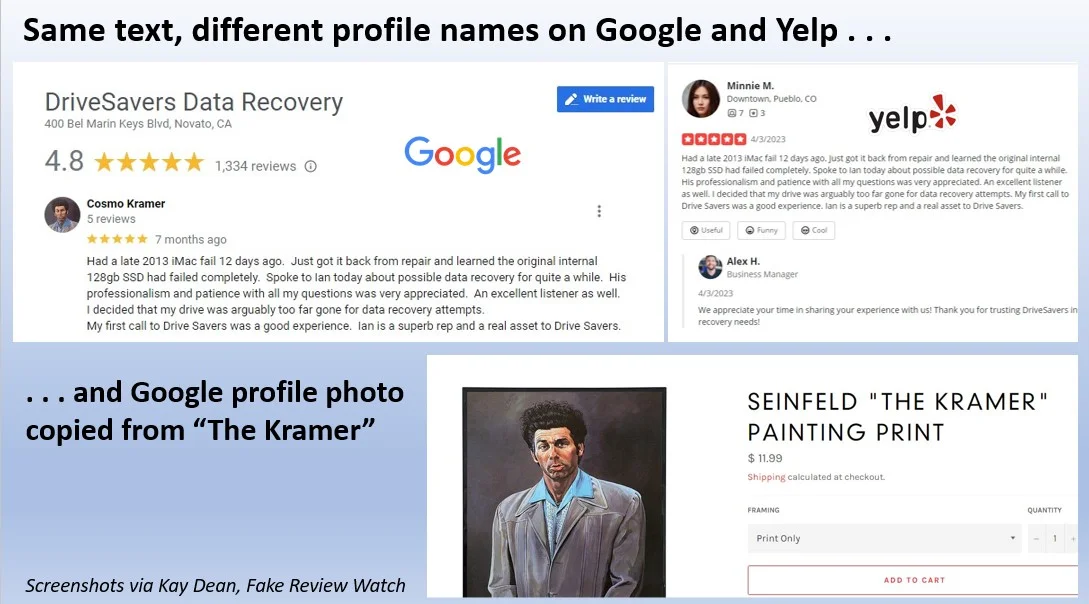
She also found a dozen Yelp reviews for DriveSavers that had first appeared on Google under different profile names. Same text, recycled across platforms under different accounts. One review about a failed iMac had been posted on Google six months earlier by a profile named “Cosmo Kramer” (the fictional Seinfeld character), then appeared on Yelp months later under a different name.
One duplicate could be coincidence. A dozen, posted under randomized names on different platforms, is consistent with a review broker recycling scripts across whatever accounts are available. The Cosmo Kramer name just made it easy to spot.
The same review text appeared on Google under 'Cosmo Kramer' & months later on Yelp under a different name.
Kay Dean, FakeReviewWatch (DriveSavers cross-platform review duplication)
“The Cosmo Kramer example was just one of multiple instances of the same reviews showing up on both Google and Yelp under totally different names for DriveSavers.”
DriveSavers doesn't publish its recovery pricing. The DriveSavers legitimacy analysis looks at what it charges, and the DriveSavers alternatives comparison covers lower-cost options.
Sealed helium drives are on their own price list, $200–$5,000+. When a head swap or platter repair opens one, we refill it with helium. That adds $400–$800, and the donor has to be an exact match. Helium drive prices
Dean ran the same profile-tracing method against SalvageData. She identifies 10 Google profiles that reviewed car accident lawyer Daniel Kim, a spray foam business, & SalvageData, and attributes the pattern to one or more online marketers running a network of fake Google profiles.
Kay Dean, Fake Review Watch. SalvageData segment begins at 10:48.
The DriveSavers case showed reviews being copied across platforms. The cross-industry spreadsheet documented above showed the same broker accounts serving 14 businesses across five industries. The next question is who operates these account networks.
How the Broker Model Works
- 01
Account aging.
Brokers cultivate hundreds or perhaps thousands of fake accounts over years. Dean has found Yelp profiles posting benign reviews for random cafes & restaurants (often plagiarized from TripAdvisor) to build a trust score that fools Yelp's recommendation software. Her DriveSavers investigation (covered in the NBC Bay Area section) caught this tactic in action: the same Yelp profiles posting DriveSavers reviews were also padding their accounts with plagiarized TripAdvisor restaurant reviews. - 02
Cross-pollination.
When clients pay, the broker activates aged accounts that then post five-star reviews for them. There may be many clients across different areas of the country. This is how 93 happy reviewers of the same Las Vegas pool builder turn out to be customers of garage door repair businesses throughout the East Coast & Midwest. Dean documented this pattern in her video Rigging the Deck: Fake Reviews for Vegas Contractor. - 03
Profile locking.
After deployment, brokers instruct workers to lock their Google profiles (hiding review history from public view). This prevents investigators from clicking a reviewer's name & seeing their cross-industry activity. Over 100 locked profiles were documented on one attorney's listings alone. - 04
Velocity scripting.
To mimic organic growth, brokers use automated scripts to drip-feed reviews over days or weeks. In Dean's investigation of California car accident attorney Daniel Kim, she found that 28 different business listings affiliated with Kim each received exactly one five-star review on the same day, rolling in sequentially.
Identified Review Brokers
Dean's Fake Review Watch has identified multiple fake review brokers, foreign & domestic, who also pay real people to post fake reviews. One is Vu Nguyen, operator of California digital marketing firm Infinity Insights, who recruited college-age students via Facebook to post fake reviews for clients across multiple industries, including construction companies & law firms. Dean documented Nguyen's operation in her video Infinity Insights Digital Marketing's Fake Yelp Review Network.
Another broker Dean exposed is Michael Monahan, administrator of Cash4Reviews.com, which advertised “Get Paid to Write Reviews and Make Money Online!” Monahan paid $4 to $8 per review & had clients across the country, including a children's charity &, according to Dean's analysis, SALVAGEDATA. Dean documented Monahan's operation in her video Marketer's Fake Review Operation EXPOSED. He rebranded after becoming aware of Dean's video.
Google Said the Listings Were Fine
While SalvageData operates as a physical data recovery provider, third-party investigators documented irregularities in how their localized listings are represented online. The following section presents those third-party findings.
The FTC recognized purchased reviews as a federal problem. On August 22, 2024, they published a new rule. But what happens when you try to report a listing through Google's own systems? A four-month investigation tested every available enforcement channel. Google said the listings were fine.
Four Months of Rejected Reports
In September 2024, Local Search Forum investigator “HikingMike” opened a thread titled “Google immediately denies edits for UPS Store/PO Box style listings.” The thread documented a SalvageData Recovery Services listing at 6696 Center Grove Rd #299, Edwardsville, IL 62025. That address is a UPS Store. The “#299” is a mailbox number formatted as a suite to mimic a commercial office.
HikingMike submitted edit reports using two separate Local Guide accounts, both with established edit histories. Google denied every edit within minutes. Business Redressal Forms filed in October & November 2024 produced no action. The case was then escalated to the Google Community Forum, where local search authority Mike Blumenthal communicated directly with Google on the investigator's behalf.
Blumenthal recommended compiling evidence of a broader pattern. HikingMike selected a single US metro area & documented approximately 60 SalvageData listings, all located at computer repair shops & cellphone stores rather than data recovery facilities. The spreadsheet was submitted through the Business Redressal Form. Google didn't act on it.
HikingMike found 60 SalvageData listings in one metro area, all at computer shops & cellphone stores.
Local Search Forum investigation (HikingMike, Dec 2024)
“So I picked out one metro area in the US and found 60 listings for this company!!! These were basically all either computer shops or cellphone repair shops, and of course NOT the business in the listing.”
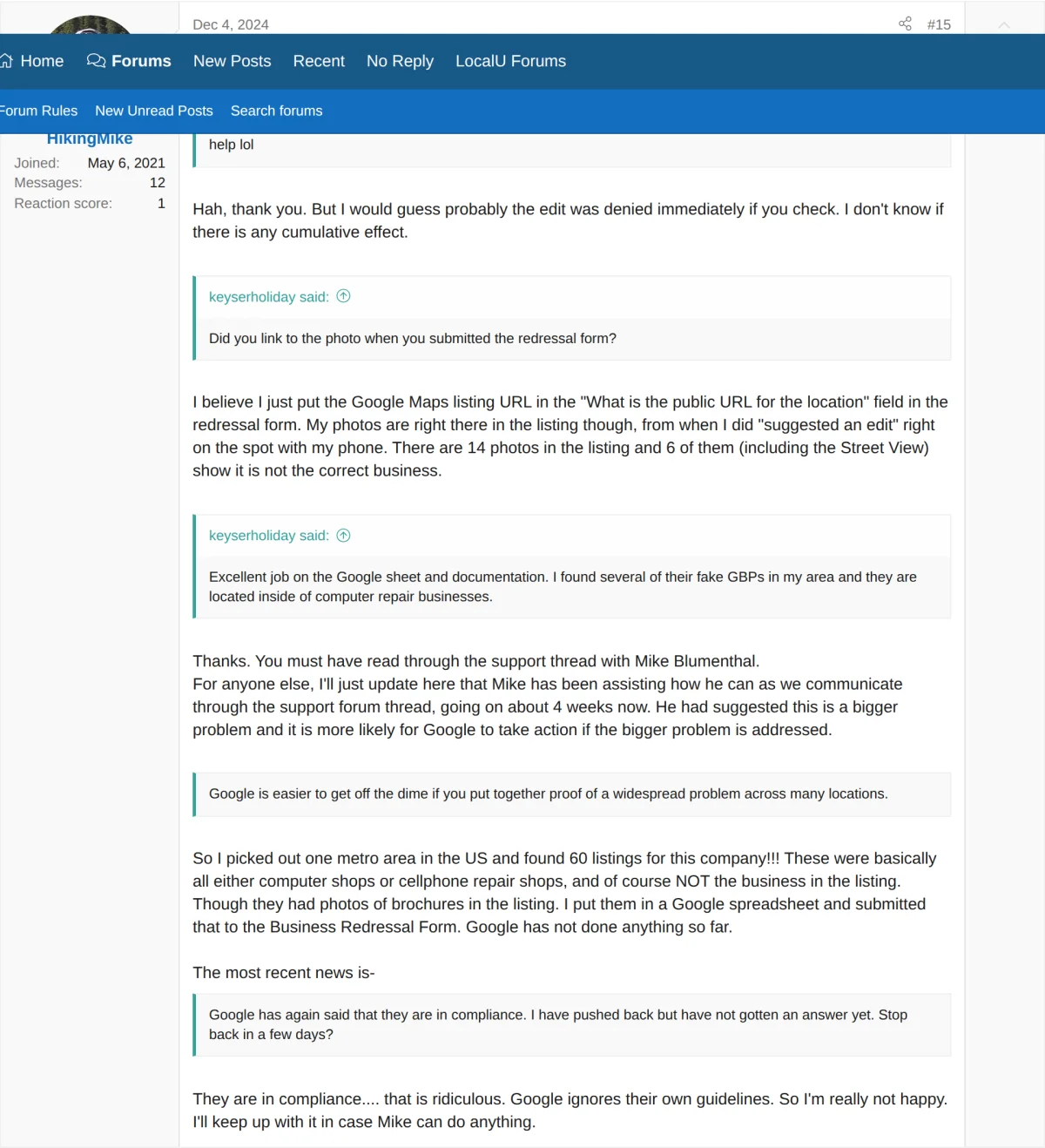
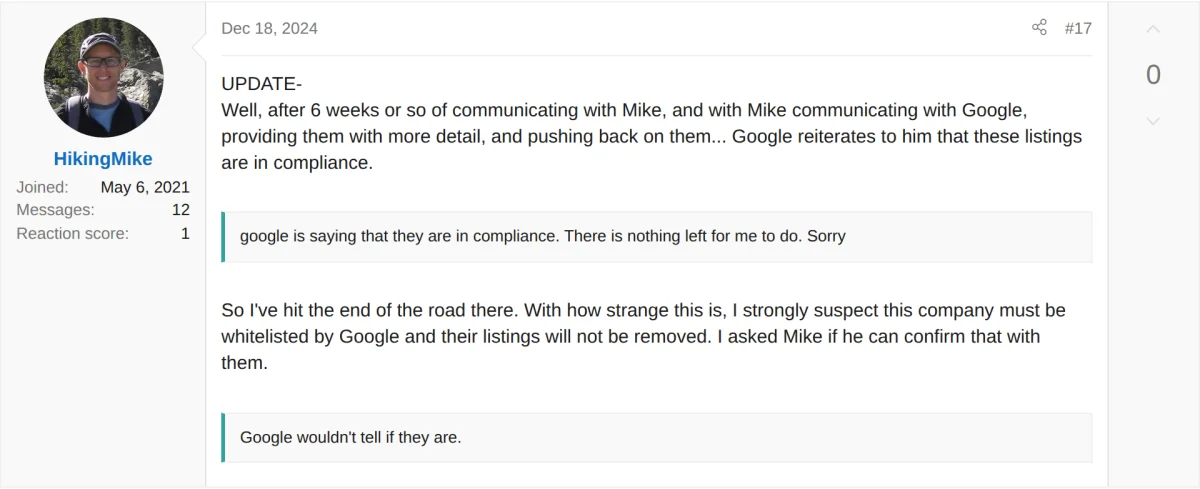
After six weeks of communication through Blumenthal, Google reiterated that the listings were “in compliance.” HikingMike asked whether the company had been whitelisted. Google wouldn't say.
“They are in compliance.... that is ridiculous. Google ignores their own guidelines.”
Mike Blumenthal relayed Google's response: the listings are 'in compliance.' No further action available.
Local Search Forum / Mike Blumenthal escalation (Dec 2024)
“google is saying that they are in compliance. There is nothing left for me to do. Sorry”
In late December 2024, another forum member got the Edwardsville listing removed through a standard edit suggestion. It stayed offline for an estimated one to two weeks.
On January 9, 2025, HikingMike reported that the listing had reappeared. It now carried 14 reviews. Seven displayed a “NEW” label. The review timestamps spanned from 2 days to 2 months prior to the January 9 check.
If the listing was offline for one to two weeks, reviews timestamped during that offline period couldn't have been left by consumers who found the business through Google Maps. A removed listing isn't visible to searchers. Reviews dated during the suspension window indicate they were either queued while the listing was invisible or injected through automated means targeting the listing's Place ID.
Geographic Distribution of Reviewer Profiles
HikingMike audited all 14 reviewer profiles. The geographic distribution is inconsistent with a domestic data recovery drop-off location in suburban Illinois.
| Reviewer | Other Review Locations | Language / Origin |
|---|---|---|
| Samuel Manurung | Tattoo removal in Australia (same day), two cafes in Indonesia (5 & 6 years prior) | Indonesian |
| “fgnm,kjhgf jhgff” | None | Keyboard-generated characters |
| (unnamed) | One review in Iran | Persian |
| (unnamed) | One review in London | English |
| (unnamed) | One review in Morocco | French |
| “이태건” | None | Korean |
| “Hưng Nguyễn” | None | Vietnamese |
| “MAGAZINE officials” | None | Non-personal account name |
| (unnamed) | Two reviews in India | Hindi / Indian |
The Samuel Manurung account reviewed the Edwardsville listing & a tattoo removal service in Australia on the same day. Its only prior activity: two cafe reviews in Indonesia, five & six years earlier. One reviewer used keyboard-generated characters as a display name, a pattern consistent with automated account creation.
Reviewer profiles span Indonesia, Iran, Morocco, Korea, Vietnam, & India for a single UPS Store in suburban Illinois.
Local Search Forum investigation (HikingMike, Jan 2025)
“For a company that has hundreds of listings in every metro area, they sure draw in an oddly high percentage of international customers to just the one UPS Store listing in the middle of the US.”
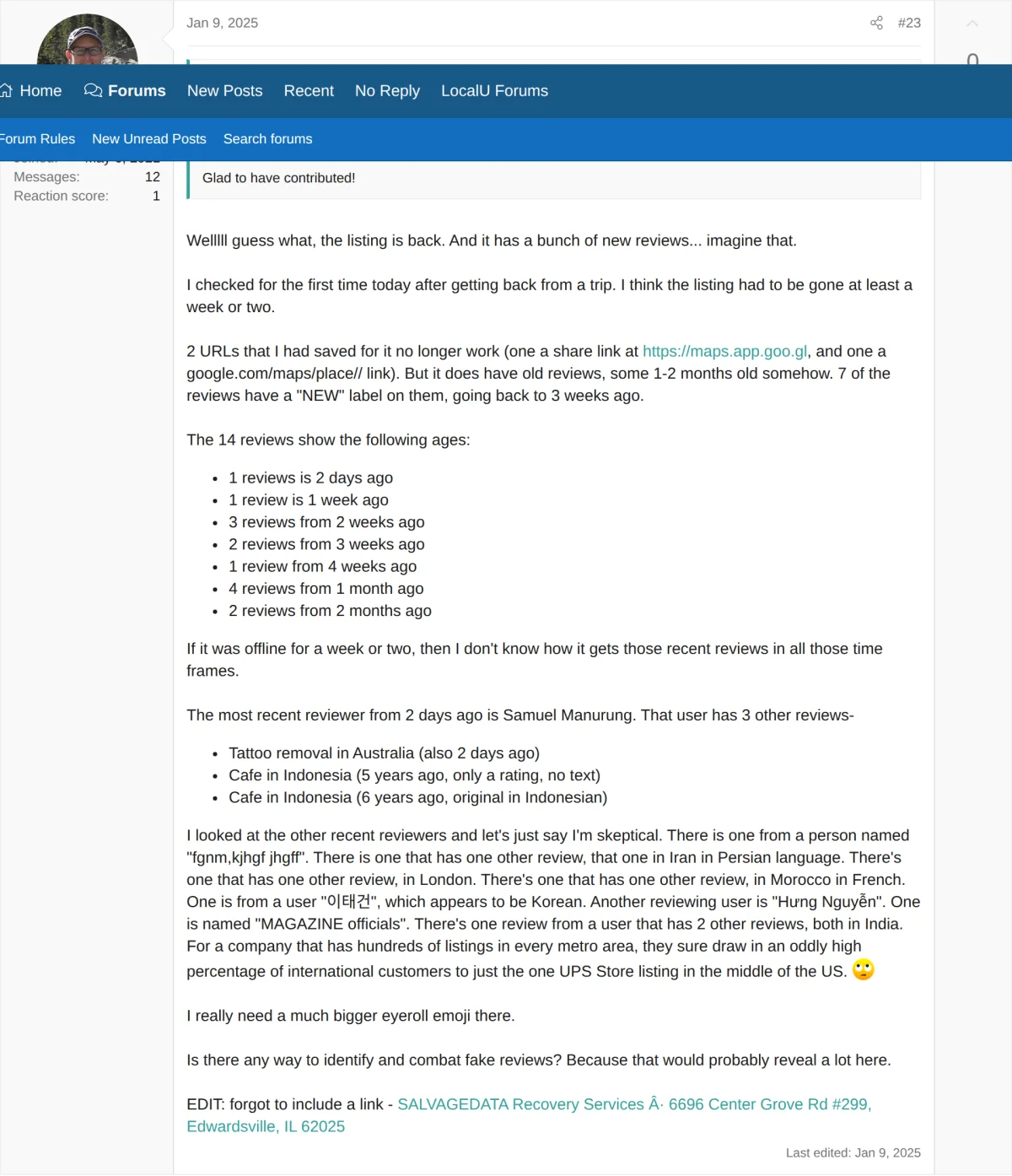
None of these profiles align geographically with the customer base of a suburban Illinois drop-off point. Combined with the chronological impossibilities documented earlier in this timeline, the reviewer data points to accounts sourced from outside the listing's geographic service area.
How to Verify Reviewer Profiles Yourself
The method HikingMike used is available to anyone with a Google account. Click on a reviewer's name in any Google Maps listing to open their public profile. Check where their other reviews were posted. Takes under 30 seconds per profile.
A reviewer who left five-star ratings for a data recovery location in rural Illinois, a tattoo removal clinic in Australia, & two cafes in Indonesia across a six-year span has a review history that doesn't match any plausible customer pattern. This check applies to any business, not just data recovery.
For a broader analysis of SalvageData's local search presence, including address verification & listing density, see the independent evaluation of SalvageData's operations. The address formatting patterns documented here, including mailbox numbers formatted as suites & listings at unrelated retail shops, are part of a broader investigation into phantom data recovery locations.
How to Report a Fake Review to Google
Google documents three separate reporting channels, & each covers a different situation. We fetched all three support pages on August 28, 2026.
- To flag one review, use the per-review flow in Google's Report or Fix Content instructions: open the listing, find the review, & select Report review.
- To report another business's review conduct, use the “Report business conduct” flow described in Report a business on Google Maps, which covers “Reviews posted in exchange for a payment, deal, or discount” and says such reviews are prohibited.
- To report reviews on your own Business Profile, use Google's owner reporting flow or its Reviews Management Tool, which tracks the status of each report.
The Business Redressal Complaint Form is not a review channel. Google scopes it to “misleading information or fraudulent activity on Google Maps related to the name, phone number, or URL of a business” & states that complaints outside that scope will not be reviewed.
Red Flags vs. Real Reviews
Not every five-star review is fake. A review that says “they recovered 1.8 TB from my Seagate Barracuda after a head swap in four days” is harder to fabricate than one that says “great service, fast turnaround, highly recommend.” Single-location labs with reviews naming specific technicians & procedures are generating real feedback.
The red flags are uniformity (all five-star, no variance), geographic impossibility (reviewers from multiple continents for a single location), & volume spikes (dozens of reviews appearing in compressed windows).
How does a location that does not perform data recovery accumulate reviews from customers who describe receiving data recovery?
In January 2025, the UK Competition & Markets Authority secured undertakings from Google to detect and remove fake reviews and to put warning alerts on the profiles of UK businesses that use fake reviews to boost their star ratings.
The best signal remains specificity. Look for technical details, named procedures, & realistic timelines. Related: common data recovery misinformation, why data recovery costs vary, is WeRecoverData safe?.
Where Engineers Vet Each Other
Google removes policy-violating reviews continuously; no platform is immune. According to Dean, detecting coordinated fake reviews requires cross-referencing reviewer profiles across businesses & platforms, which a consumer reading reviews in isolation cannot do.
Google and Yelp have the data and the engineering resources to do this cross-referencing at scale, but their algorithms keep missing patterns that Dean tracks by hand in a spreadsheet.
- Google Maps reviews
- They're easy to game. Anyone can create a listing and buy reviews from offshore farms.
- Trustpilot
- It's also vulnerable to solicitation campaigns.
- Better Business Bureau (BBB) complaints
- The BBB complaints page shows the actual text of consumer disputes & the company's response. When a company has thousands of five-star Google reviews but a trail of BBB complaints about pricing escalation & drives held until fees are paid, the BBB complaints are closer to reality.
- Reddit: r/datarecovery & r/AskADataRecoveryPro
- These communities are moderated by working data recovery engineers who evaluate companies based on technical capability, not star ratings. Astroturfing attempts are identified & called out.
Labs vetted by working engineers are listed on our honest data recovery companies page, with side-by-side pricing on comparing data recovery services.
We are a data recovery lab ourselves, so this page documents review practices in an industry we compete in. That is a reason to open the captures & the linked sources rather than take our word for anything; the labs we recommend pay us nothing to be listed.
What Penalties Does the FTC Review Rule Carry?
Each violation of the FTC's August 2024 rule (16 CFR Part 465) carries a civil penalty of up to $53,088. Buying reviews through a marketing agency doesn't protect a business that knew or should have known the reviews were fake.
FTC Rule: 16 CFR Part 465
Published in the Federal Register (89 FR 68034) on August 22, 2024, effective October 21, 2024. The rule bans:
- Creating, buying, or selling reviews from people who didn't use the product or service
- AI-generated reviews
- Paying for reviews conditioned on a specific sentiment (positive or negative)
- Company employees posting reviews without disclosure
- Suppressing negative reviews through threats or intimidation
Fines & Enforcement Actions
- On December 22, 2025, FTC staff sent letters to 10 companies warning them of potential violations of the rule.
- The New York Attorney General reached agreements with 19 companies caught writing fake online reviews. The companies paid over $350,000 in fines.
Under Section 43(a) of the Lanham Act, competitors harmed by fake reviews can sue for false advertising & unfair competition.
Frequently Asked Questions
How do I know if a data recovery lab is real?
Are five-star Google reviews for data recovery companies trustworthy?
What is a phantom lab in data recovery?
What did NBC News find about fake reviews in data recovery?
How does the FTC define fake reviews?
Data Recovery Standards & Verification
Our Austin lab operates on a transparency-first model. We use industry-standard recovery tools, including PC-3000 and DeepSpar, combined with strict environmental controls to maintain drive integrity. This approach allows us to serve clients nationwide with consistent technical standards.
Localized Clean Zone
Open-drive work is performed in a 0.02 micron ULPA-filtered laminar clean bench.
Transparent History
Serving clients nationwide via mail-in service since 2008. Our lead engineer holds PC-3000 and HEX Akademia certifications for hard drive firmware repair and mechanical recovery.
Media Coverage
Our repair work has been covered by The Wall Street Journal and Business Insider, with CBC News reporting on our pricing transparency. Louis Rossmann has testified in Right to Repair hearings in multiple states and founded the Repair Preservation Group.
Aligned Incentives
Our "No Data, No Charge" policy means we assume the risk of the recovery attempt, not the client.
Technical Oversight
Louis Rossmann
Our engineers review all lab protocols to maintain technical accuracy and honest service. Since 2008, his focus has been on clear technical communication and accurate diagnostics rather than sales-driven explanations.
We believe in showing the bench rather than just describing it. Open-drive work runs on a 0.02 micron ULPA-filtered laminar clean bench, and we filmed it.
See the particle counter test at the benchSince 2008
Established
As Featured In
Need Data Recovery?
Call (512) 212-9111 or ship your device to our Austin lab. No diagnostic fee. No data, no recovery fee.