
Is Fields Data Recovery Safe? Independent Pricing and Custody Analysis
The serious risk reported by Fields Data Recovery customers is a bait-and-switch pricing pattern, not whether the company exists. Reddit, Trustpilot, and the company's own BBB responses describe initial verbal quotes climbing substantially after the drive is in custody, fees retained after no data is returned (including Fields' own written admission of charging $1,094.19 for a failed head swap), and written terms that authorize disposal of an uncollected drive after seven days. The questions worth asking before shipping are about the price, the refund policy if no data is recovered, and where the work will actually be done.
What the Evidence Shows
- Customers report initial quotes that climb after Fields takes custody of the drive.
- Fees totaling $400 to over $1,000 have been retained after no data was returned.
- Fields' written terms cap liability at the fees paid and authorize disposal of uncollected media after 7 days.
- Marketed local offices are described by Fields and by the building operator as virtual addresses, with the recovery work performed elsewhere.
- Rossmann publishes tier pricing, charges no diagnostic fee, and performs all work at one Austin lab.
What Fields Data Recovery Can Plausibly Do
Fields Data Recovery Ltd is a UK private limited company registered in Bridgend, Wales (UK Companies House registration 06695262). The company has been operating under the Fields name for over a decade and maintains active intake operations in the UK and the US.
For straightforward logical recovery work where the drive itself is mechanically healthy, the procedures Fields can perform are the same procedures any competent lab can perform. Imaging a healthy drive sector by sector, running a file-system rebuild against the image, and exporting recovered files to a return disk requires standard recovery software and a clean working copy of the source media. A competent technician with PC-3000-class imaging hardware or a DeepSpar Disk Imager can complete this class of work on most consumer hard drives without opening the drive case.
Similarly, recovering deleted files from an undamaged file system, reconstructing a quick-formatted partition table, or carving files from a logically corrupted volume are procedures that fall within the published capabilities of mainstream recovery software stacks. There is no engineering reason to assume Fields cannot perform this class of work.
The analysis on this page is not a claim that Fields cannot recover data. It documents specific public reports about how Fields prices the work, what happens to fees when the work fails, what the written terms commit the company to, and how the marketed location network maps to the physical recovery facilities where the work is actually performed.
Post-Intake Hard-Drive Quote Increases
Public reports across Reddit, Trustpilot, and Fields' own BBB responses describe a recurring pattern. The customer receives one figure during the sales call, ships the drive, and is then presented with a different, higher figure after the drive is in Fields' custody. A second pattern appears in identified industry-operator commentary: a high initial quote that drops by hundreds or thousands of dollars when the customer pushes back.
The engineering point underneath these reports is the same: a single-drive recovery has a fairly predictable parts and labor cost. A quote that moves on customer pushback, rather than on diagnostic findings, was not anchored in the engineering reality of the recovery. A reputable lab issues one fixed price after diagnostic and honors that price for the duration of the engagement.
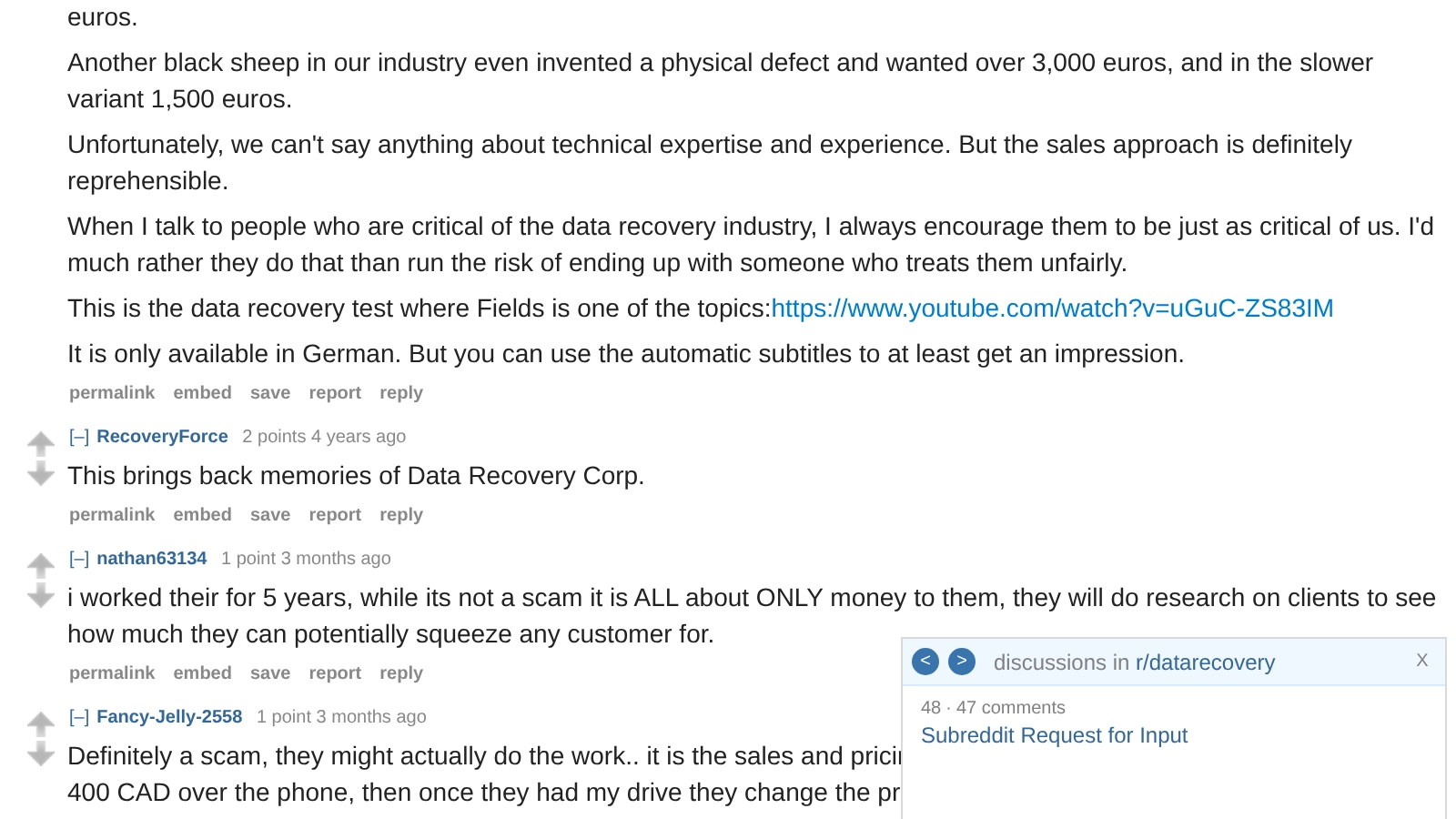
Phone quote of CAD $200-$400 escalating to CAD $1,700 after intake
“Definitely a scam, they might actually do the work.. it is the sales and pricing tactics that are the problem, they promise 2-400 CAD over the phone, then once they had my drive they change the price to 1700”
Consequence: Informed consent is impossible once the drive is in the other party's custody. A consumer who agreed to one price on the phone is presented with a different price after the leverage has shifted.
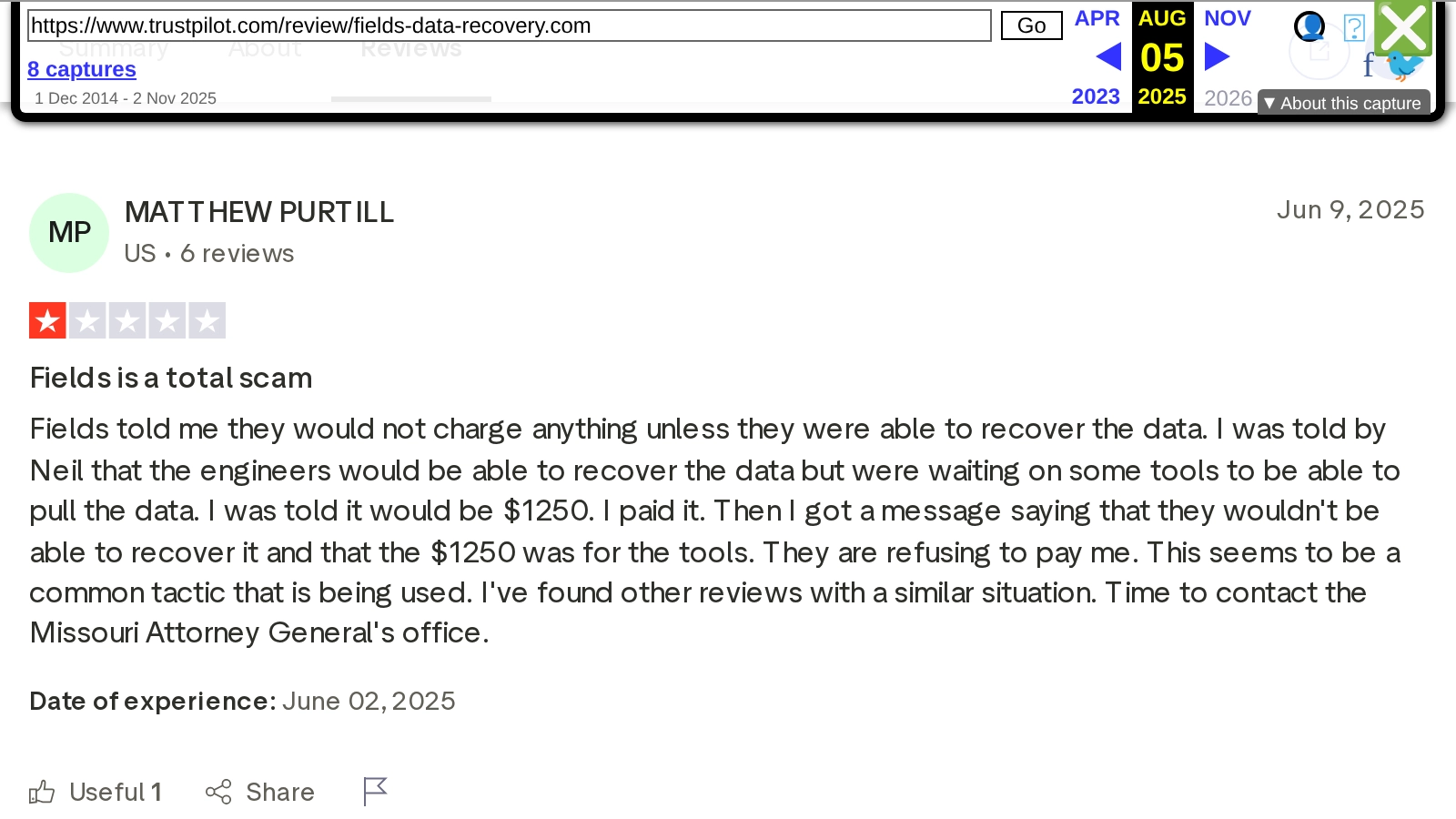
$1,250 paid on verbal no-charge-unless-recovered promise, retained after failed recovery
“Fields told me they would not charge anything unless they were able to recover the data. I was told by Neil that the engineers would be able to recover the data but were waiting on some tools to be able to pull the data. I was told it would be $1250. I paid it. Then I got a message saying that they wouldn't be able to recover it and that the $1250 was for the tools.”
Consequence: Customers may pay for tooling they never agreed to fund, with the redefinition occurring after the money has been collected.
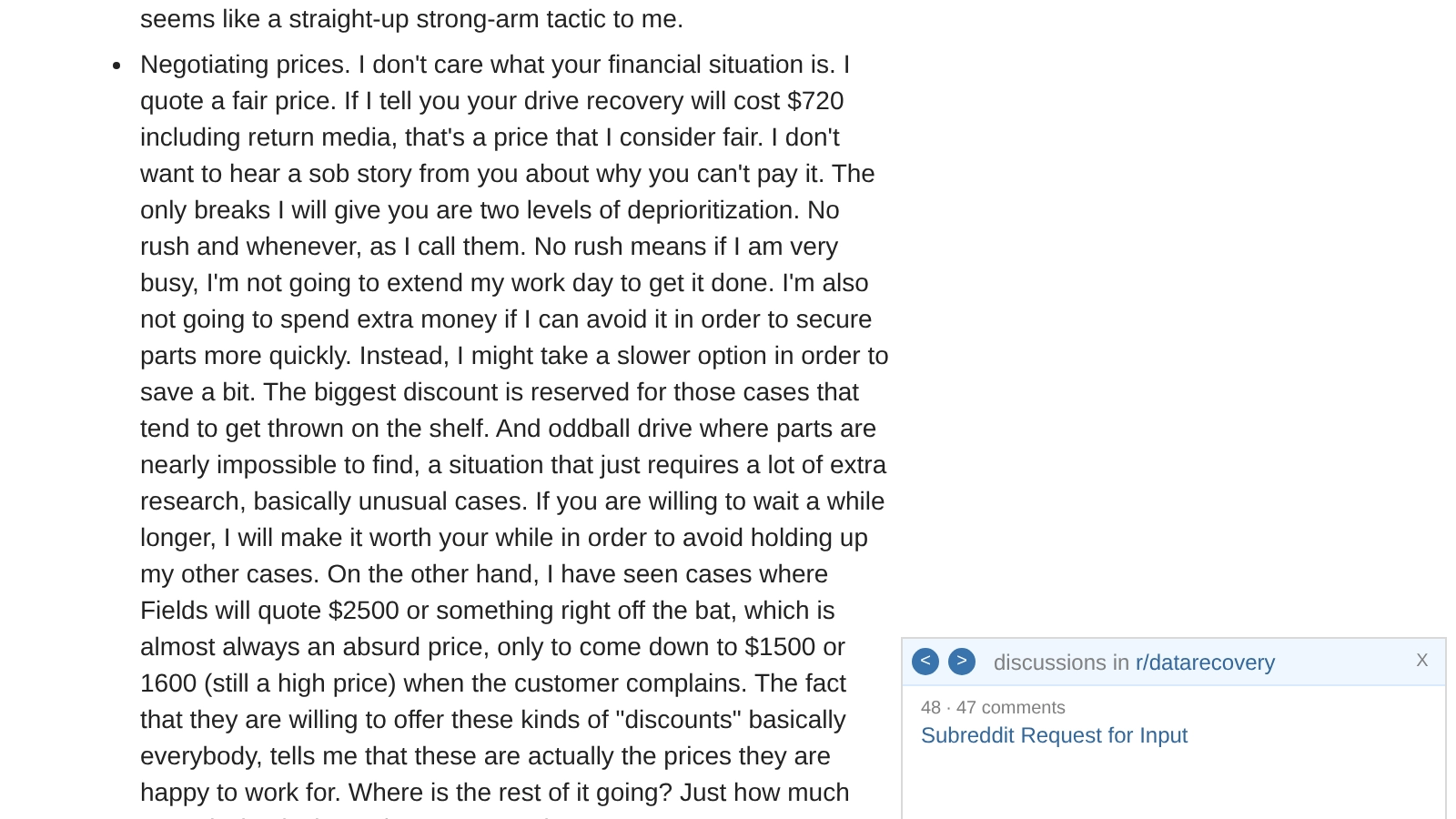
Pattern of high initial quotes dropping when the customer pushes back
“On the other hand, I have seen cases where Fields will quote $2500 or something right off the bat, which is almost always an absurd price, only to come down to $1500 or 1600 (still a high price) when the customer complains. The fact that they are willing to offer these kinds of "discounts" basically everybody, tells me that these are actually the prices they are happy to work for.”
Consequence: Customers who do not negotiate pay materially more than customers who do, for the same physical work on the same media.
Reported practice of pricing after the recovery based on perceived data value
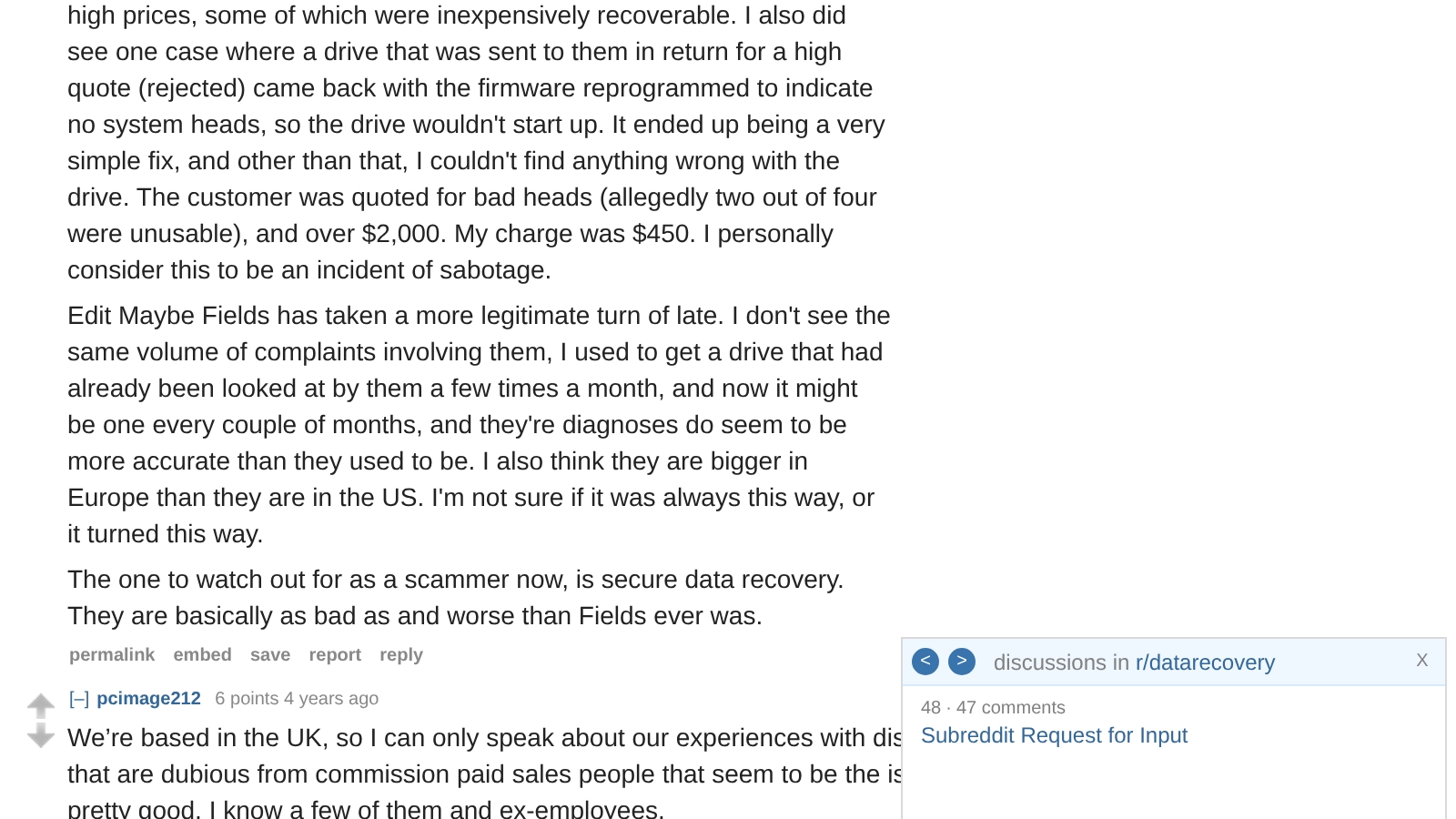
“We're based in the UK, so I can only speak about our experiences with disgruntled clients and it's the sales "techniques" that are dubious from commission paid sales people that seem to be the issue. The guys that do the actual recoveries are pretty good, I know a few of them and ex-employees. I've been told that they do the recovery first and then quote a price, according to what they think the data might be worth.”
Consequence: Customers with personally important data may be quoted higher than customers with less sentimentally valuable data on the same drive type.
Fees Retained After No Recovered Data
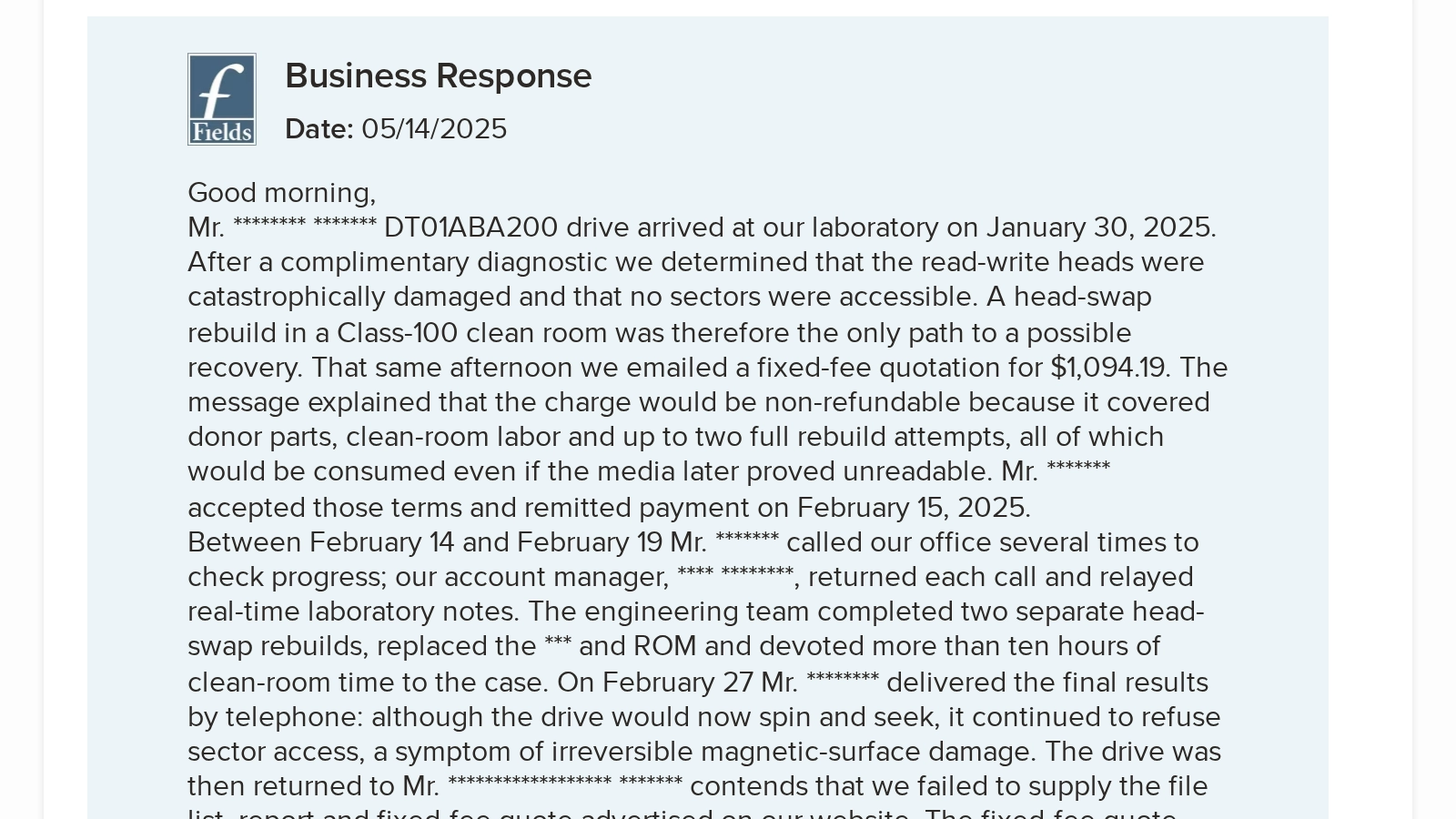
The clearest single piece of evidence on this question is Fields' own written response to BBB complaint 23327268, dated 14 May 2025. In that response Fields describes a $1,094.19 fee that was retained in full after two attempted head-swap rebuilds produced no readable sectors, characterizing the fee as covering donor parts, clean-room labor, and up to two full rebuild attempts. A separate Trustpilot account dated 9 June 2025 describes $1,250 paid on the basis of a phone-stage promise of no charge unless data was recovered, with the fee then retained after the recovery failed and recharacterized as a tooling charge.
A no-data, no-recovery-fee policy is the mechanism that aligns a lab's revenue with the customer's outcome. When the engineering fee is structured to be retained in full regardless of recovery outcome, the financial risk of a failed head swap is shifted onto the consumer.
Fields' own BBB response: $1,094.19 retained after two failed head-swap rebuilds
“The message explained that the charge would be non-refundable because it covered donor parts, clean-room labor and up to two full rebuild attempts, all of which would be consumed even if the media later proved unreadable.”
Consequence: A customer can pay over a thousand dollars and receive no data, with the fee retained under a written policy the customer first encountered after the engagement had already begun.
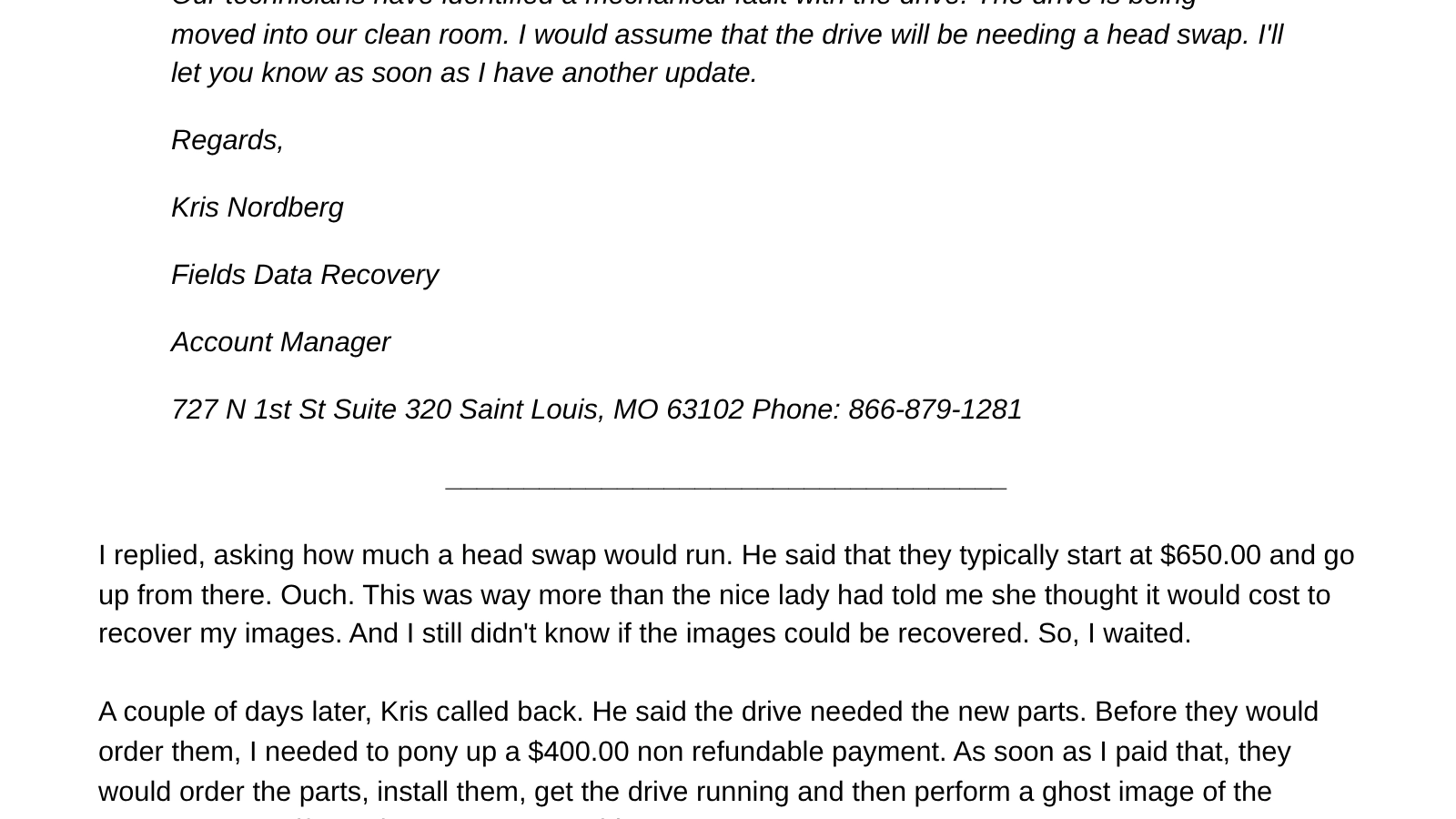
$400 non-refundable payment, no data returned
“Before they would order them, I needed to pony up a $400.00 non refundable payment. As soon as I paid that, they would order the parts, install them, get the drive running and then perform a ghost image of the contents to see if any data was recoverable.”
Consequence: This pattern has been reported across nearly a decade and multiple platforms, with consistent characteristics from one account to the next.
These two accounts are separated by nearly a decade. The 2017 Baselineshots blog account and the 2025 Fields BBB response describe materially the same outcome: a fee paid up front, the recovery does not return data, the fee is retained. A pattern that persists across that span of time is the pattern of the published policy, not a one-off engagement.
Written Terms vs. Sales-Stage Representations
The Fields Data Recovery Terms and Conditions page contains the contractual language the company holds the customer to. Two clauses stand out: a liability cap that limits total damages to the fees paid for the recovery service, and an uncollected-media clause that authorizes disposal of returned drives after a seven-day window.
Verbal sales-stage assurances that data will be recovered, or that fees are conditional on success, cannot be enforced against a written contract that states the opposite. The written document is the document a court reads first. A customer who wants to know what Fields has actually committed to should compare the salesperson's words against the published terms page before any payment is taken.
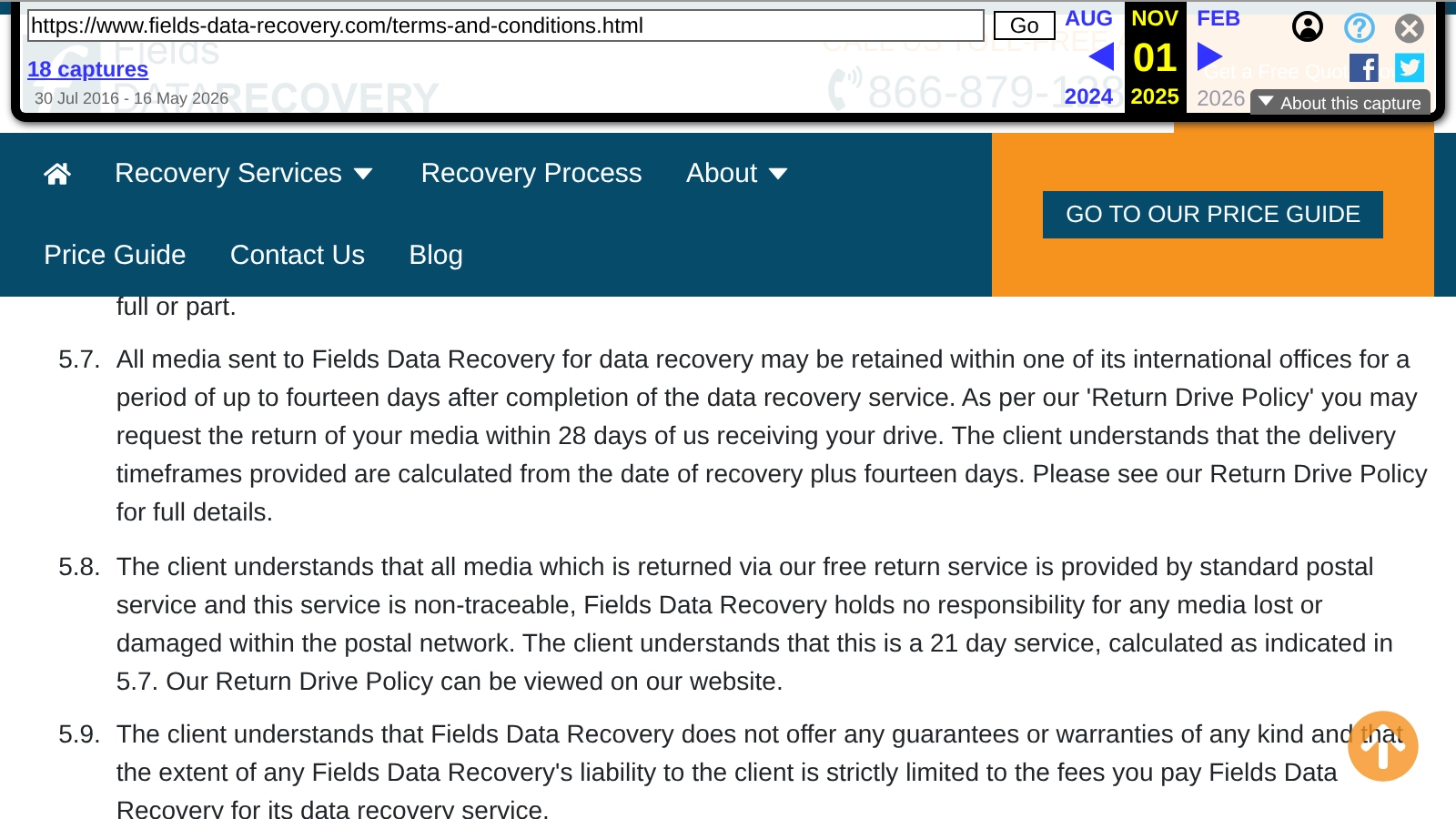
Written contract caps total liability at the fee paid, regardless of data value
“The client understands that Fields Data Recovery does not offer any guarantees or warranties of any kind and that the extent of any Fields Data Recovery's liability to the client is strictly limited to the fees you pay Fields Data Recovery for its data recovery service.”
Consequence: Customers should be able to compare what the salesperson promised verbally against what the published terms commit to in writing before any payment is taken.
7-day disposal window for uncollected returned media
“Uncollected Media If the media is not collected from the postal office or courier and is subsequently returned to our laboratory, we reserve the right to dispose of it after a 7-day period without further notice.”
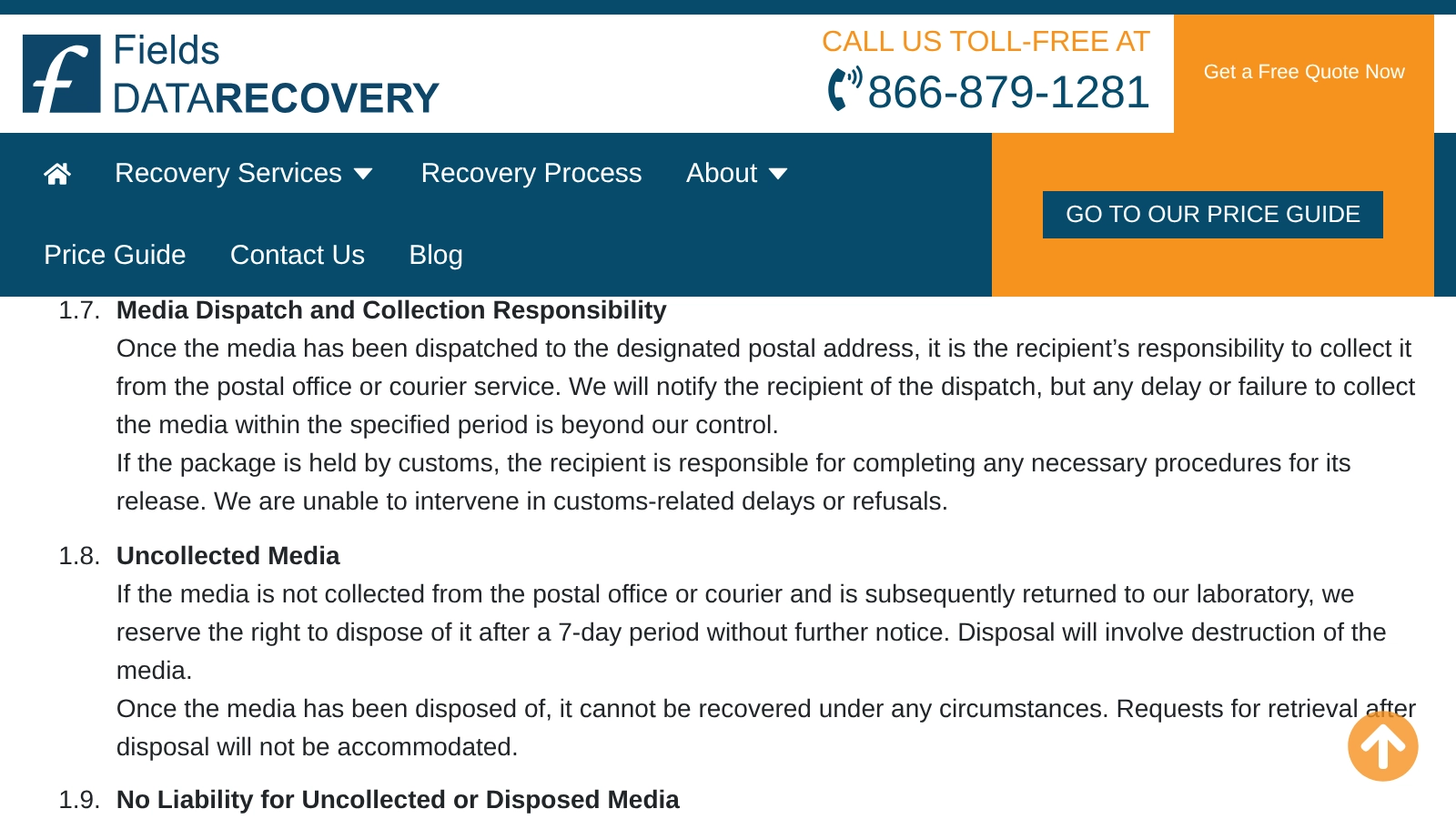
Consequence: A failed delivery during a routine absence can lead to permanent destruction of the original media without further notice to the owner.
Customer Leverage Once Fields Has the Original Drive
Once the original drive is in Fields' physical custody, the consumer's ability to walk away from a renegotiated price is constrained by whatever the consumer's next step is to get the drive back. Fields' own BBB response in complaint 22897653 describes the 12100 Wilshire Boulevard Los Angeles location as "a virtual office we mainly use for customer convenience." The 2021 Guadalupe Street Austin address that appears in Fields' marketing is listed by the building operator (Offices.net) as a coworking and virtual-office center offering virtual office plans starting at $46 per month.
A customer who chose Fields based on a perceived local presence in Los Angeles or Austin is, in practice, shipping the drive out of the local area. A customer who declines the renegotiated quote after intake must still arrange to get the original drive back from wherever it was actually sent, which is not the location the customer dropped it off at.
Fields itself describes the Los Angeles location as a virtual office
“Instead, he chose to drop off the drive at our *********** location, which is a virtual office we mainly use for customer convenience. The staff there shipped his drive using a Fields Data Recovery *** label, but *** has no record of it ever being scanned.”
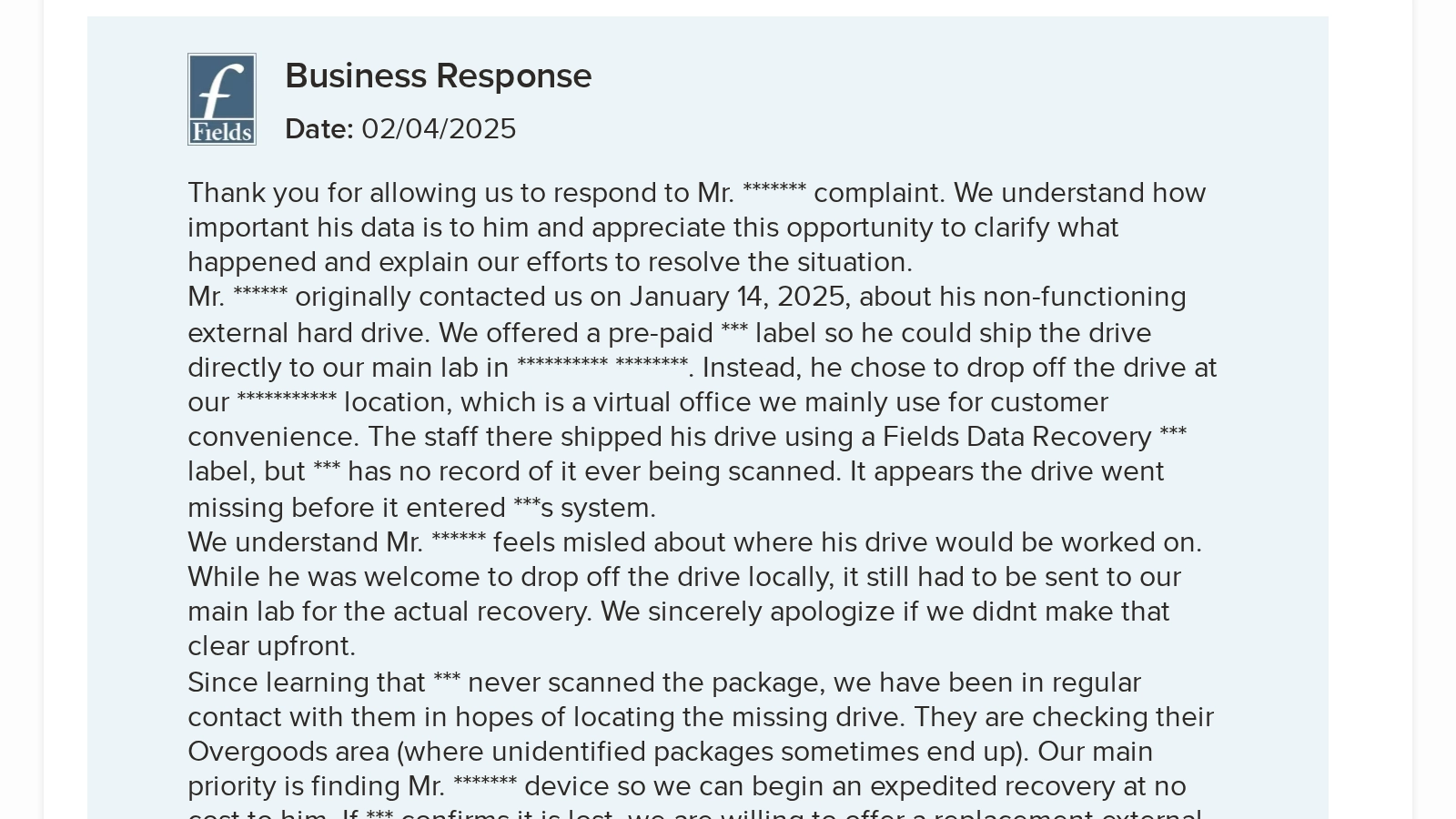
Consequence: When custody is broken at the handoff between the virtual office and the carrier, the consumer has no chain of evidence to demonstrate where the drive was lost.
Drive shipped out of state from the marketed local office without customer authorization
“After being lied to for over two weeks, the receptionist (Jordie) informs me that no work is done at that location and she was instructed to my drive out of state to ******** (w/o my authorization). My drive is now "missing."”
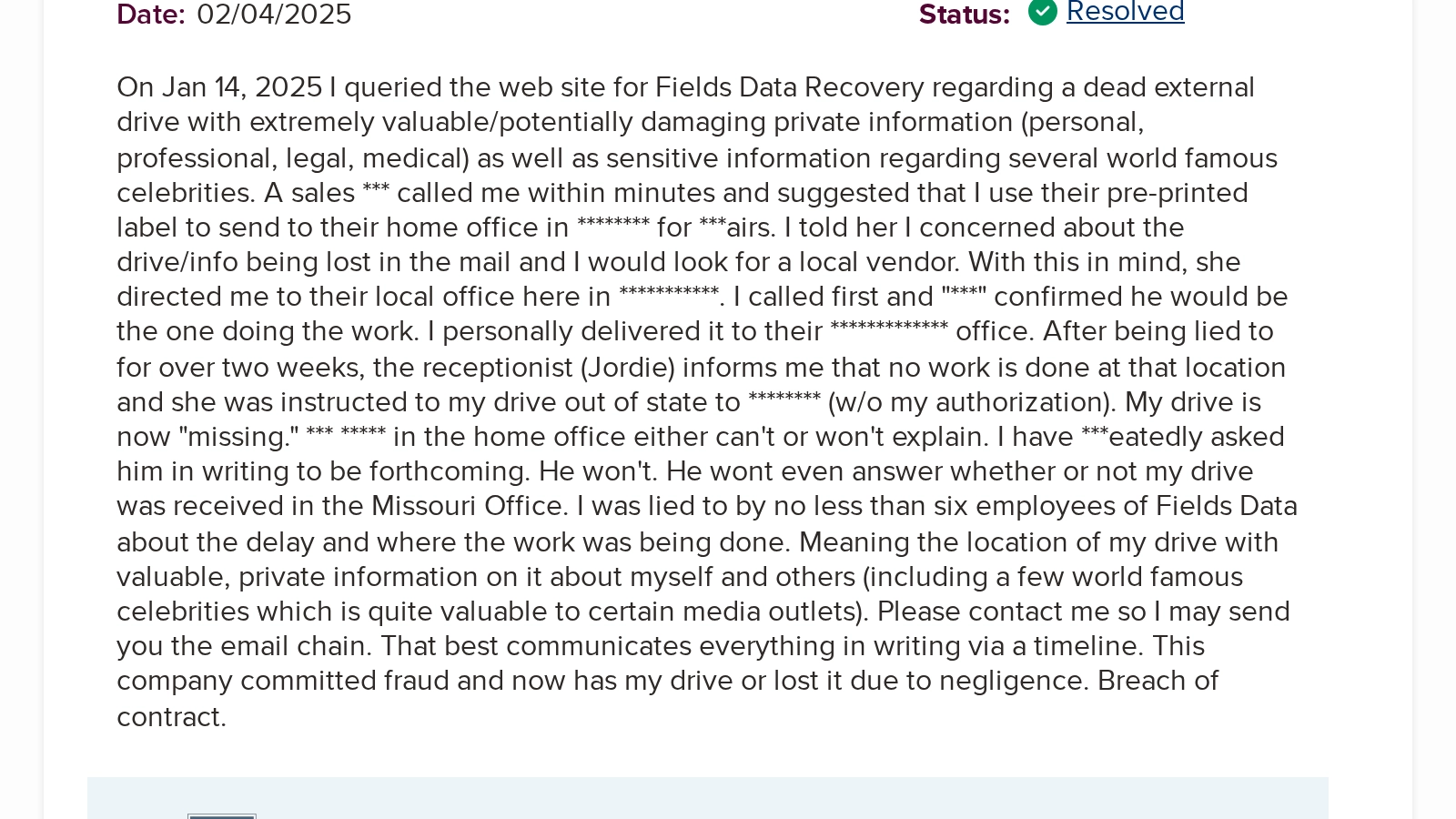
Consequence: The consumer loses the ability to track custody at the very moment the device is most vulnerable, with no on-site lab presence to receive direct handoff.
Austin marketed address is listed by the building operator as a virtual-office center
“Serviced Offices from $425 Coworking spaces from $209 Virtual Office from $46”
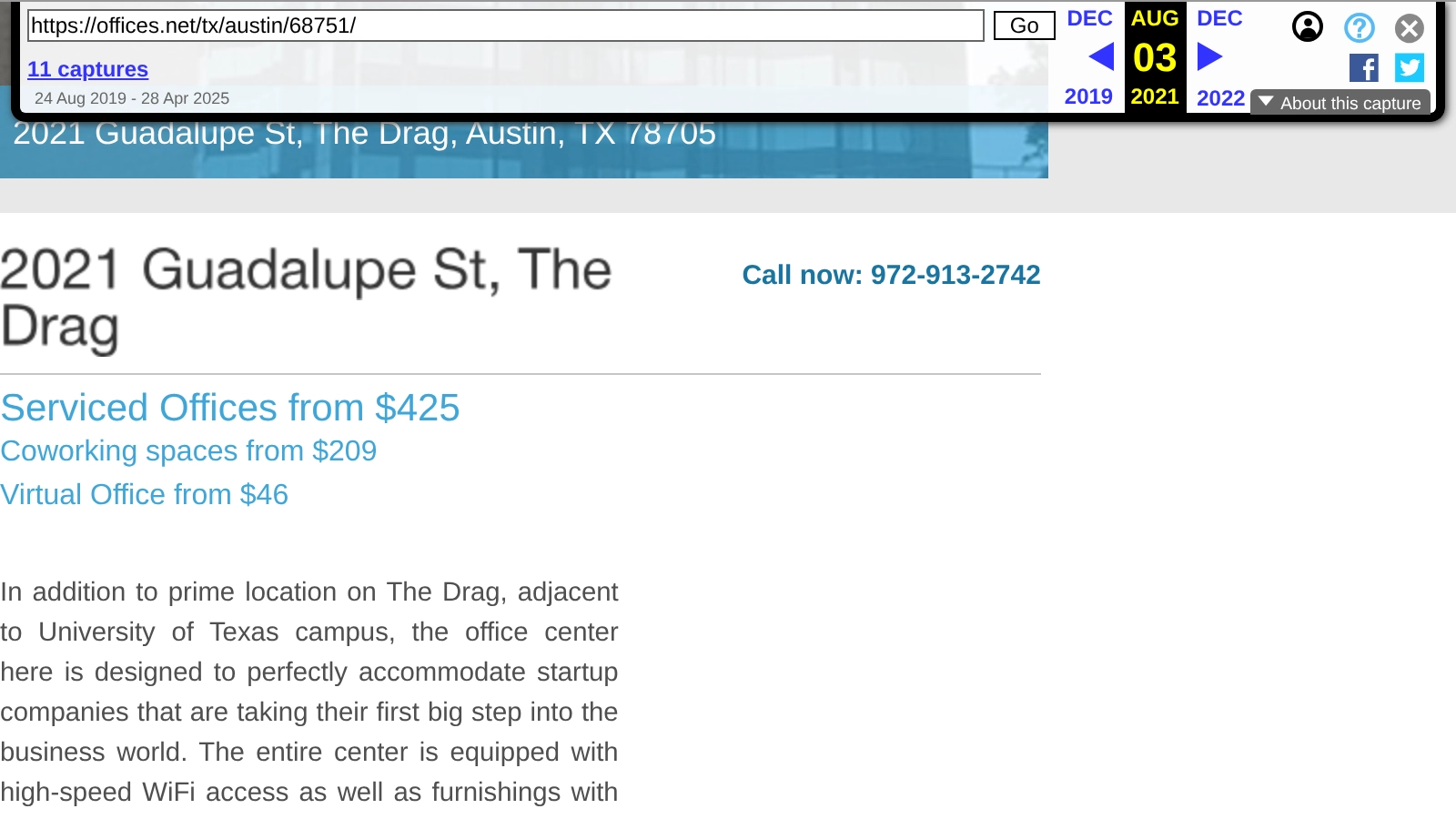
Consequence: Consumers expecting to drop a drive at a local lab arrive at a coworking front desk that is not equipped to perform recovery work.
Industry operator describes the marketed-address pattern across the data recovery sector
“Despite only a handful of actual lab locations, the company uses virtual ("co-working" buildings, mailroom+receptionist addresses, and redirecting mailboxes) to lead potential customers into believing that they have actual facilities all over the world, in their neighborhood.”
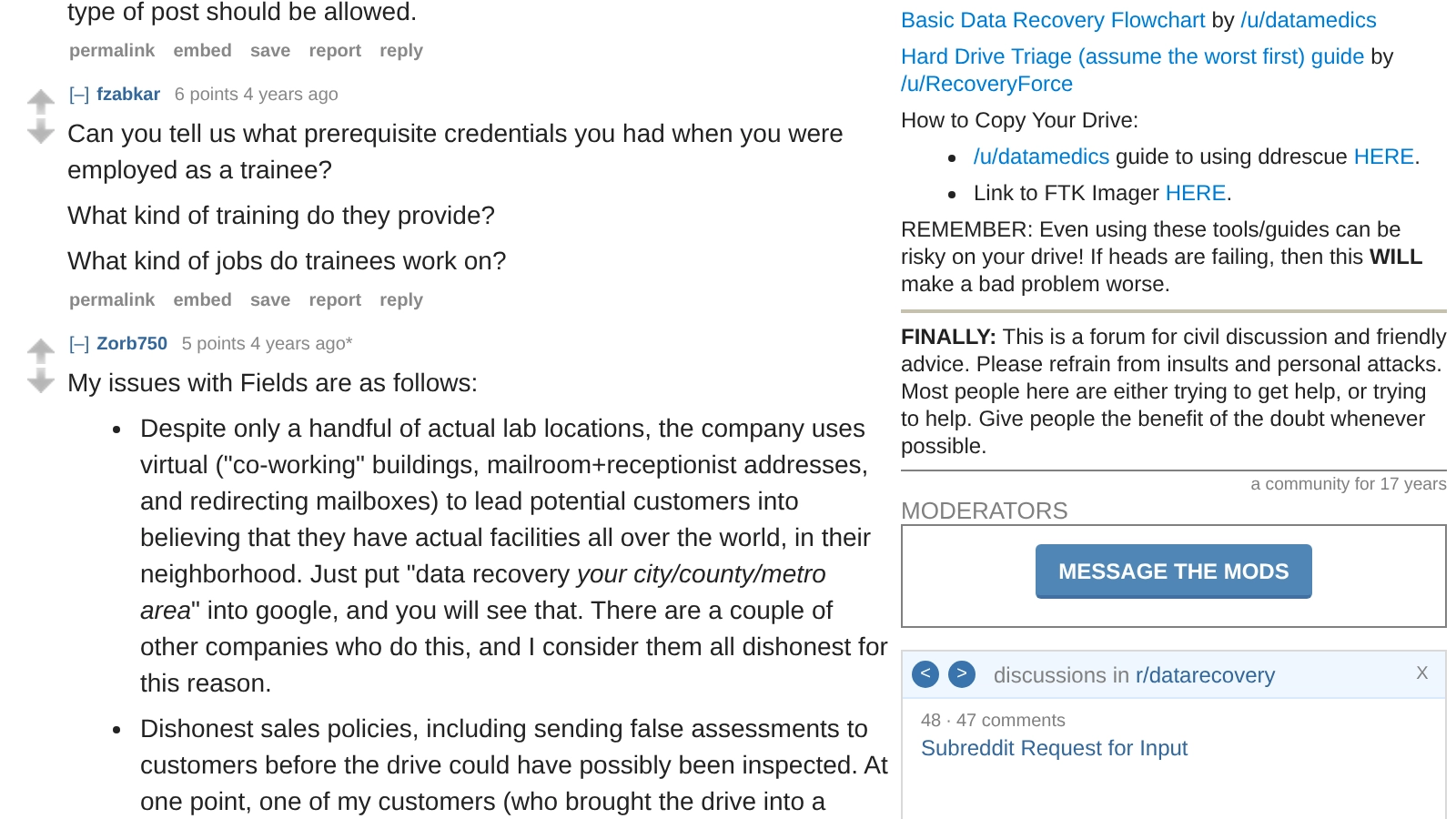
Consequence: A consumer who selects a recovery provider based on a perceived local presence may be selecting a mail forwarder, not a lab.
Chain of custody for sensitive media (medical records, legal evidence, business data) requires direct handoff to trained recovery technicians. A virtual mail-drop staffed by a third-party receptionist breaks the chain at the very first step. The receptionist is employed by the building operator, not by the recovery lab, and has no training in evidence handling.
How Rossmann Differs
Rossmann Repair Group was founded in 2008 and operates one physical lab at 2410 San Antonio Street, Austin, TX 78705. There are no franchises, no satellite offices, no virtual mail-drops, and no outsourcing. All recovery work, including mechanical work, helium drive refill, and platter cleaning, is performed in-house at that address.
| Operational Detail | Pattern reported about Fields | Rossmann Repair Group |
|---|---|---|
| Pricing model | Verbal quotes that customers report changing after intake | 5 published HDD tiers, fixed before shipment |
| Diagnostic fee | Reports of non-refundable up-front fees | No diagnostic fee |
| Outcome when recovery fails | Fees retained per Fields' own BBB response and customer accounts | No data, no recovery fee |
| HDD pricing floor | Not published | From $100 |
| SSD pricing floor | Not published | From $200 |
| Physical labs | Marketed addresses described by Fields and the building operator as virtual offices | 1 lab, 2410 San Antonio Street, Austin, TX 78705 |
| Equipment named | Not published | PC-3000 Portable III, PC-3000 Express, PC-3000 SSD, DeepSpar Disk Imager, 0.02µm ULPA-filtered clean bench |
| Founded | UK Companies House 06695262 | 2008 |
For context on the broader UK corporate footprint of the Fields Group: Wales Online reported in January 2020 that Bridgend County Borough Council disclosed more than 800 trading-standards complaints against businesses in the Fields Group, with the Council's Freedom of Information response recording 829 complaints, 64 service requests, and 20 enforcement visits between January 2008 and February 2017 against the group (archived Wales Online report). A sister company in the Fields Group, Action Direct UK Ltd, sharing the same Bridgend registered address, was the subject of UK Ministry of Justice action in 2011 restricting it from taking new claims-management clients (archived Wales Online report). The BBB profile for Fields Data Recovery (profile ID 0734-310322677) records 17 complaints in the trailing three years (archived BBB profile).
For a broader look at how labs that publish fixed tier pricing compare to quote-based providers, see our writeup on honest data recovery companies.
Frequently Asked Questions
The questions below address the points consumers most often raise when researching Fields Data Recovery: whether the company is real, what recovery costs, what happens when no data is recovered, what the contract actually commits Fields to, what the marketed offices are, and what the BBB record looks like.
Is Fields Data Recovery legitimate?
How much does Fields Data Recovery charge?
Will Fields Data Recovery refund me if no data is recovered?
What happens if I decline a Fields quote after they have my drive?
Are Fields Data Recovery's local offices real recovery labs?
What is the Fields Data Recovery BBB rating?
What should I ask Fields before shipping my drive?
How does Rossmann compare?
Is Fields Data Recovery legitimate?
How much does Fields Data Recovery charge?
Will Fields Data Recovery refund me if no data is recovered?
What happens if I decline a Fields quote after they have my drive?
Are Fields Data Recovery's local offices real recovery labs?
What is the Fields Data Recovery BBB rating?
What should I ask Fields before shipping my drive?
How does Rossmann compare?
Data Recovery Standards & Verification
Our Austin lab operates on a transparency-first model. We use industry-standard recovery tools, including PC-3000 and DeepSpar, combined with strict environmental controls to maintain drive integrity. This approach allows us to serve clients nationwide with consistent technical standards.
Localized Clean Zone
Open-drive work is performed in a 0.02 micron ULPA-filtered laminar clean bench.
Transparent History
Serving clients nationwide via mail-in service since 2008. Our lead engineer holds PC-3000 and HEX Akademia certifications for hard drive firmware repair and mechanical recovery.
Media Coverage
Our repair work has been covered by The Wall Street Journal and Business Insider, with CBC News reporting on our pricing transparency. Louis Rossmann has testified in Right to Repair hearings in multiple states and founded the Repair Preservation Group.
Aligned Incentives
Our "No Data, No Charge" policy means we assume the risk of the recovery attempt, not the client.
Technical Oversight
Louis Rossmann
Our engineers review all lab protocols to maintain technical accuracy and honest service. Since 2008, his focus has been on clear technical communication and accurate diagnostics rather than sales-driven explanations.
We believe in showing the bench rather than just describing it. Open-drive work runs on a 0.02 micron ULPA-filtered laminar clean bench, and we filmed it.
See the particle counter test at the benchNeed Professional Data Recovery?
Free evaluation. No diagnostic fees. No data, no recovery fee. HDD recovery from $100. SSD recovery from $200.
Since 2008
Established
As Featured In
Related services