A solid-state drive is sealed silicon. It has no platters, no read/write heads, no spindle, and no exposed magnetic surface, so airborne particles have nothing inside to land on. A cleanroom controls dust in the air; on an SSD, NVMe drive, USB stick, or SD card, there is no open recording surface for that dust to threaten. The real work happens at a soldering bench, not behind an airlock.
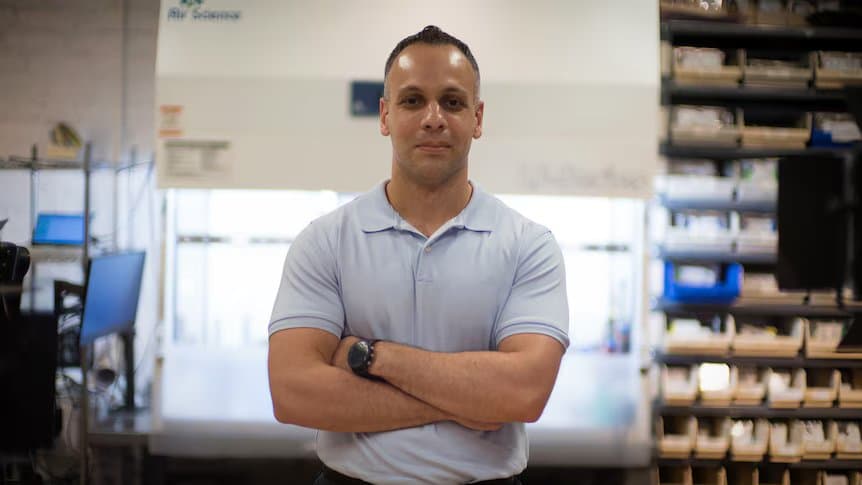
Large recovery operations lead with photos of technicians in bunny suits, airlocks, & ISO Class 5 chambers, & many carry that same cleanroom framing straight onto their SSD, NVMe, & flash pages. The pitch is simple: any storage device has to be opened under particle control or the data is at risk.
For a mechanical hard drive with exposed platters, particle control is real. A single speck landing between a flying head & a spinning platter causes a head crash. Move that same claim onto a sealed SSD & it describes a hazard that does not exist.
A cleanroom exists to keep particles off an exposed surface during the minutes it sits open. On a hard drive, the head flies a few nanometers above the platter, so a particle larger than that gap is a crash. An SSD has none of that geometry.
The NAND flash & the controller are packaged chips soldered to a circuit board. Prying open the plastic or aluminum shell exposes a green PCB, not a magnetic surface. Dust settling on a circuit board does not corrupt stored bits; the charge sits in NAND cells sealed inside epoxy chip packages, where no bench air ever reaches it.
The same is true for USB sticks, SD & microSD cards, & the eMMC or UFS storage inside a phone. Sealed packages, no open recording surface, nothing for filtered air to save.
We do keep a 0.02 micron ULPA-filtered clean bench in the lab. It is for opening hard drives, where a platter is exposed. We do not use it for solid-state recovery, because there is no platter to keep clean.
Solid-state recovery is board-level electrical work & firmware work. The failure mode decides the procedure, & each one happens at a microsoldering station, not under particle control.
| Symptom | What it needs |
|---|---|
| Not detected in BIOS, dead, or shorted | Board-level microsoldering to replace a blown protection diode or a failed voltage regulator on the PCB, with a FLIR thermal camera to localize the short. |
| Detected but wrong capacity or stuck in safe mode | Firmware & translator repair. A PC-3000 SSD talks to the live controller over SATA or NVMe, holds it in diagnostic mode, & rebuilds the flash translation layer. |
| Controller physically dead | Chip-off. The NAND is desoldered with hot air, read on a dedicated NAND reader, & the image is reconstructed in software. |
The tools are a soldering iron & a hot air station, not an airlock. We solder with Hakko FM-2032 irons on FM-203 or FX-951 bases, reflow & remove packages with an Atten 862 hot air rework station, & run BGA work on Zhuo Mao rework stations. A cleanroom adds nothing to any of it.
When the controller is dead, we desolder the NAND package & read the die on a dedicated NAND reader. That raw dump is not files. It is fragmented across dies & planes, XOR-scrambled, & protected by LDPC error correction.
Reconstructing readable data means reversing the specific controller's scrambling, correcting bit errors with soft-decision decoding, & rebuilding the flash translation layer from spare-area metadata on every page. The barrier is that reconstruction, not dust. Many mainstream drives carry no hardware encryption at all, & the scrambling plus error correction are still enough to make a raw dump unreadable without the original controller's logic.
Encryption changes the ending, not the environment. On a drive with hardware AES keyed to the original controller, or an Apple T2 or M-series Secure Enclave, the key stays on the board when the NAND comes off, so chip-off yields ciphertext. The only path is repairing the original board so the controller decrypts its own data; we repair the hardware, we do not crack or work around the encryption.
On a monolithic microSD card or USB drive, the controller & memory share one epoxy package, so nothing can be desoldered separately; the work is abrading the epoxy to reach the factory test pads & bonding micro-probes under a stereomicroscope. Still a soldering-bench job, still no cleanroom.
DriveSavers & Ontrack are real labs with real capabilities. They recover data that plenty of shops can't touch, & the cleanroom on their hard-drive bench is genuine equipment doing genuine work. A solid-state job is simply not the work that bench does.
ISO 14644-1, the cleanroom standard, certifies one thing: the maximum particle count allowed per cubic meter of air. It says nothing about whether a lab can read a Phison controller in diagnostic mode, rebuild a translation layer, or reconstruct a scrambled NAND dump.
A shop can hold a certified cleanroom & never once open it for a solid-state job, because the SSD was never a candidate to go in there. The certificate on the wall measures air, not the skill that recovers your files.
We recover SSDs, NVMe drives, USB flash, & SD cards at a soldering bench in our Austin lab, & there is no cleanroom surcharge because there is no cleanroom in the loop. Every job runs in-house. Single location, no franchises, no outsourcing.
SATA SSD: From $200. Circuit-board repair $450–$600; firmware & translator rebuild $600–$1,200. SSD recovery details.
NVMe SSD: From $200. Firmware & FTL repair $900–$1,200. NVMe recovery details.
USB flash & SD cards: from $200; chip-off $1,200–$1,500. No particle-control surcharge on any of it.
No diagnostic fee. No data, no recovery fee. Founded in 2008.
A donor drive is a matching SSD used for its circuit board. Typical donor cost: $40–$100 for common models, $150–$300 for discontinued or rare controllers. +$100 rush fee to move to the front of the queue.
Since 2008
Established
As Featured In
Related services
SSD recovery from $200. Board-level microsoldering & firmware repair.
M.2 NVMe recovery from $200. Controller & FTL work.
The mechanical-drive case: where a ULPA bench matches cleanroom filtration.
Every data recovery myth debunked with technical evidence.
Call (512) 212-9111 or ship your SSD, flash drive, or SD card to our Austin lab. No diagnostic fee. No data, no recovery fee.