“Had a raid 0 array (windows storage pool) (failed 2tb Seagate, and a working 1tb wd blue) recovered last year, it was much cheaper than the $1500 to $3500 Canadian dollars i was quoted by a Canadian data recovery service. the price while expensive was a comparatively reasonable $900USD (about $1100 CAD at the time). they had very good communication with me about the status of my recovery and were extremely professional. the drive they sent back was Very well packaged. I would 100% have a drive recovered by them again if i ever needed to again.”
Seagate SkyHawk Surveillance Data Recovery
SkyHawk surveillance drives endure 24/7 continuous write workloads that standard desktop HDDs are not designed to handle. When a SkyHawk fails, recovery requires PC-3000 F3 terminal access to bypass the ImagePerfect firmware, donor head matching for write-worn head assemblies, and proprietary NVR filesystem parsing to extract multiplexed video streams. We perform all of this at our Austin, TX lab.
Pricing starts at $600 for firmware-level repairs, $1,200–$1,500 for head swaps. Free evaluation. No data recovered means no charge.

Do NOT Initialize, Format, or Run chkdsk
When you connect a surveillance drive to a Windows PC, Disk Management will show it as "Not Initialized" or "Unallocated." This is normal. Surveillance systems use proprietary filesystems that no PC operating system can read. Clicking "Initialize" or "Format" permanently destroys all recorded footage. Running chkdsk on a physically failing drive will compound mechanical damage. Power the drive off and contact a recovery lab.
Surveillance Workload Characteristics and Drive Wear
A typical desktop HDD spends most of its life idle, with occasional burst read/write activity. A SkyHawk drive operates at a sustained 90% write / 10% read ratio, continuously ingesting multiplexed H.264 or H.265 video streams from dozens of cameras. Seagate engineered the SkyHawk with the ATA-8 Streaming Command Set and their proprietary ImagePerfect firmware to prioritize frame delivery over error correction. This means the drive intentionally skips ECC retries to avoid dropping video frames.
The trade-off: when the drive develops bad sectors in the surveillance zones, the firmware has already been suppressing error reports. By the time the NVR flags a problem, the physical damage is advanced. Standard data recovery software cannot handle these drives because it relies on the OS-level error reporting that ImagePerfect has been silencing.
Standard SkyHawk
Air-filled CMR platters. Rated for 180 TB/year write workload. Supports up to 64 cameras. 1TB to 8TB capacities. Rotational vibration (RV) sensors for multi-bay NVR enclosures.
SkyHawk AI
Designed for AI-enabled NVRs with deep-learning analytics. 550 TB/year write rating. Supports 64 AI streams plus 32 additional streams. High-capacity models (10TB+) are Helium-sealed, changing the physical recovery procedure.
SkyHawk Failure Modes
SkyHawk drives share the Seagate F3 firmware architecture with Barracuda and IronWolf families, but the continuous-write workload creates distinct failure patterns. These are the two categories we see most frequently.
Firmware Corruption and BSY States
The most common SkyHawk failure pattern in our lab. When the NVR loses power during a write operation, the massive volume of data staged in the drive's Media Cache (MC) fails to flush to its final platter locations. This corrupts the F3 translation layer, which maps Logical Block Addresses (LBAs) to Physical Block Addresses (PBAs). The drive enters a BSY (Busy) state and reports 0 GB or 3.86 GB capacity.
Recovery procedure: Connect to the PCB test points via serial adapter, send Ctrl+Z to reach the T> prompt, then use PC-3000's Seagate F3 module to read ROM contents, patch the boot code to unlock terminal access (modern SkyHawk ROMs are locked by default), clear the corrupted Media Cache, and rebuild the translator module. Pricing: $600–$900.
Write Head Degradation from 24/7 Operation
Unlike desktop drives where head crashes are sudden events, surveillance drives suffer gradual magneto-resistive element degradation on the primary write heads (Head 0 and Head 1). After months or years of continuous sequential writing, the head elements weaken progressively. The drive may intermittently drop video channels before fully clicking.
Recovery procedure: Open the drive on our 0.02 µm ULPA-filtered clean bench. Match donor heads by preamp type, head configuration, manufacturing site, and firmware revision. Replace the head stack assembly using a Seagate-specific head comb tool. Image the platters with PC-3000 using selective head imaging to skip damaged surfaces. Pricing: $1,200–$1,500.
PC-3000 F3 Terminal Workflow for SkyHawk Drives
All Seagate SkyHawk drives use the F3 firmware architecture. The F3 terminal is a low-level diagnostic interface accessed via serial connection to test points on the PCB. After sending Ctrl+Z to reach the T> prompt, we can read ROM, PROM, and RAM directly to diagnose firmware corruption, clear BSY states, repair the Media Cache, and rebuild translator tables.
On newer SkyHawk models, ROM access is locked by default. Gaining terminal access requires desoldering the ROM chip, reading its contents via an external programmer, patching the boot code to unlock diagnostic access, and resoldering it back to the PCB. Only then can the firmware modules be repaired via PC-3000 vendor commands.
SkyHawk AI Helium Drives
High-capacity SkyHawk AI drives (10TB to 20TB) are sealed with Helium to reduce aerodynamic drag on the platters, enabling higher platter density and lower operating temperatures. These are not standard breather-filter drives. The sealed Helium environment is critical to platter stability.
Physical recovery on a Helium SkyHawk AI requires specialized atmospheric handling during the head swap process. If a Helium drive is opened in standard atmospheric conditions, the heavier nitrogen and oxygen molecules create severe turbulence between the platters, causing immediate head crash upon power-up. Our lab performs Helium drive work using controlled-atmosphere techniques on our 0.02 µm ULPA-filtered clean bench.
If your NVR uses SkyHawk AI drives in a multi-drive configuration, do not attempt to rebuild a degraded RAID or spanned volume. The parity recalculation process will overwrite original video data blocks on the surviving drives. Remove all drives from the NVR enclosure, label their slot positions, and send the complete set for recovery.
Proprietary NVR Filesystems
Even after a successful physical repair and sector-by-sector clone, the video data on a SkyHawk surveillance drive is stored in a proprietary filesystem that no standard OS can read. The file system format is determined by the NVR/DVR manufacturer, not by Seagate. Different brands use different proprietary formats:
| NVR Brand | Filesystem | Key Challenge |
|---|---|---|
| Hikvision | Custom block allocator with HIKBTREE index | Index corruption after power loss breaks timestamp mapping |
| Dahua | DHFS (proprietary) | Multiplexed stream interleaving requires frame-level carving |
| Swann / Lorex | WFS or ext-based variants | Circular recording overwrites oldest blocks; no file boundary markers |
| Hanwha / NightOwl | Vendor-specific proprietary | Requires raw H.264/H.265 NAL start code scanning for recovery |
After physical drive repair and cloning, we identify the NVR manufacturer's filesystem by scanning for known signatures, then parse the proprietary index structures to map timestamps to video data blocks. If the index is corrupted beyond repair, we fall back to sequential H.264/H.265 frame carving, which recovers all surviving video but loses timestamp associations. Footage is delivered in standard MP4 format.
SkyHawk Recovery Pricing
Surveillance drive recovery follows our standard HDD pricing tiers. The physical drive repair cost depends on failure type. Proprietary filesystem parsing and video extraction are included in the quoted price.
| Service Tier | Price | Description |
|---|---|---|
| Simple CopyLow complexity | $100 | Your drive works, you just need the data moved off it Functional drive; data transfer to new media Rush available: +$100 |
| File System RecoveryLow complexity | From $250 | Your drive isn't recognized by your computer, but it's not making unusual sounds File system corruption. Accessible with professional recovery software but not by the OS Starting price; final depends on complexity |
| Firmware RepairMedium complexity – PC-3000 required | $600–$900 | Your drive is completely inaccessible. It may be detected but shows the wrong size or won't respond Firmware corruption: ROM, modules, or translator tables corrupted; requires PC-3000 terminal access Standard drives at lower end; high-density drives at higher end |
| Head SwapHigh complexity – clean bench surgery50% deposit | $1,200–$1,500 | Your drive is clicking, beeping, or won't spin. The internal read/write heads have failed Head stack assembly failure. Transplanting heads from a matching donor drive on a clean bench 50% deposit required. Donor parts are consumed in the repair |
| Surface / Platter DamageHigh complexity – clean bench surgery50% deposit | $2,000 | Your drive was dropped, has visible damage, or a head crash scraped the platters Platter scoring or contamination. Requires platter cleaning and head swap 50% deposit required. Donor parts are consumed in the repair. Most difficult recovery type. |
Hardware Repair vs. Software Locks
Our "no data, no fee" policy applies to hardware recovery. We do not bill for unsuccessful physical repairs. If we replace a hard drive read/write head assembly or repair a liquid-damaged logic board to a bootable state, the hardware repair is complete and standard rates apply. If data remains inaccessible due to user-configured software locks, a forgotten passcode, or a remote wipe command, the physical repair is still billable. We cannot bypass user encryption or activation locks.
All tiers: Free evaluation and firm quote before any paid work. No data, no fee on simple copy, file system, and firmware tiers. Head swap and surface damage require a 50% deposit because donor parts are consumed in the attempt.
Target drive: The destination drive we copy recovered data onto. You can supply your own or we provide one at cost. For ultra-high-capacity drives (20TB and above), the target drive costs approximately $400+ due to the large media required. All prices are plus applicable tax.
Multi-drive NVR arrays configured in RAID 5, RAID 6, or spanned volumes require imaging each drive individually, then reconstructing the virtual array. These cases are quoted after evaluation based on array complexity and drive count.
Data Recovery Standards & Verification
Our Austin lab operates on a transparency-first model. We use industry-standard recovery tools, including PC-3000 and DeepSpar, combined with strict environmental controls to make sure your hard drive is handled safely and properly. This approach allows us to serve clients nationwide with consistent technical standards.
Open-drive work is performed in a ULPA-filtered laminar-flow bench, validated to 0.02 µm particle count, verified using TSI P-Trak instrumentation.
Transparent History
Serving clients nationwide via mail-in service since 2008. Our lead engineer holds PC-3000 and HEX Akademia certifications for hard drive firmware repair and mechanical recovery.
Media Coverage
Our repair work has been covered by The Wall Street Journal and Business Insider, with CBC News reporting on our pricing transparency. Louis Rossmann has testified in Right to Repair hearings in multiple states and founded the Repair Preservation Group.
Aligned Incentives
Our "No Data, No Charge" policy means we assume the risk of the recovery attempt, not the client.
Technical Oversight
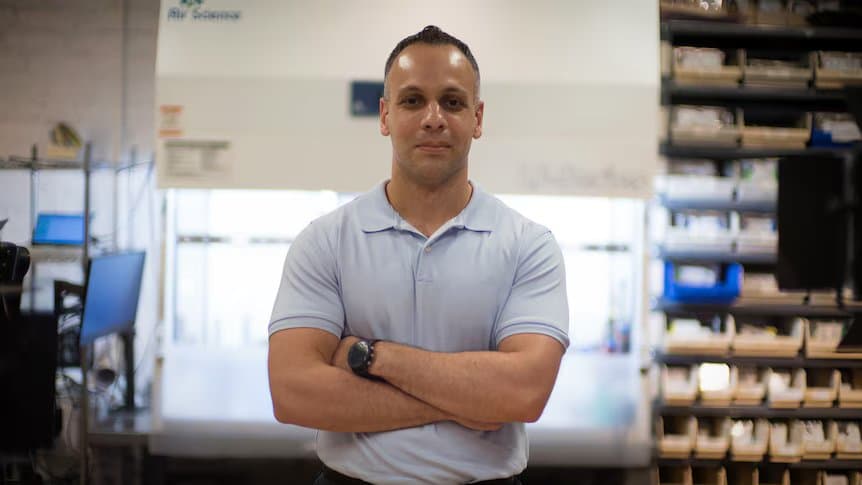
Louis Rossmann
Louis Rossmann's well trained staff review our lab protocols to ensure technical accuracy and honest service. Since 2008, his focus has been on clear technical communication and accurate diagnostics rather than sales-driven explanations.
We believe in proving standards rather than just stating them. We use TSI P-Trak instrumentation to verify that clean-air benchmarks are met before any drive is opened.
See our clean bench validation data and particle test videoWhat Seagate Drive Owners Say
“Sent my hdd for data recovery, process was simple and I was able to pre-authorize an amount. They worked on my drive within 2 days of receiving it and the total cost was literally 1/10th of the amount of another service I got a quote from. Professional, quick, affordable. Nothing to complain about.”
“My satisfaction with Rossmann Repair Group goes beyond just 5 stars. I had a hard drive die some time ago, but I had no idea where I could send it knowing it would be safe, or there being a chance I'd be ripped off.”
“Had a raid 0 array (windows storage pool) (failed 2tb Seagate, and a working 1tb wd blue) recovered last year, it was much cheaper than the $1500 to $3500 Canadian dollars i was quoted by a Canadian data recovery service. the price while expensive was a comparatively reasonable $900USD (about $1100 CAD at the time).”
SkyHawk Recovery FAQ
Can I do a PCB swap on my dead SkyHawk drive?
My NVR says the drive is unformatted. Should I format it?
What is the difference between SkyHawk and SkyHawk AI?
Can you recover overwritten CCTV footage?
How much does SkyHawk data recovery cost?
Why is my surveillance drive clicking after a power outage?
Related Recovery Services
WD Purple AllFrame firmware repair and head swap for DVR/NVR drives
All Seagate families: Barracuda, IronWolf, Exos, Rosewood
Hikvision, Dahua, Swann, Lorex proprietary filesystem parsing
Multi-drive NVR arrays with RAID 5, RAID 6, or spanned volumes
Synology, QNAP, and network-attached storage systems
All HDD brands and models, 5 published pricing tiers
Seagate NAS drives with AgileArray firmware
Need Surveillance Footage Recovered?
Send your SkyHawk drive or complete NVR system to our Austin lab. Free evaluation, no data no fee. Call (512) 212-9111 for questions.