Since 2008 | No Data, No Fee | Nationwide Mail-In | Standard drives $100–$2,000
Sealed helium drives are on their own price list, $200–$5,000+. When a head swap or platter repair opens one, we refill it with helium. That adds $400–$800, and the donor has to be an exact match. Helium drive prices
SAS (Serial Attached SCSI) drives are the backbone of enterprise servers and SAN arrays. They use a different command set, physical connector, and firmware architecture than consumer SATA drives. We image SAS drives in our Austin lab through dedicated SAS host bus adapters. That keeps access to non-standard sector sizes and SAS-specific diagnostic channels. No data recovered = no charge.
SAS and SATA are physically and logically incompatible interfaces. A SAS drive cannot be plugged into a SATA port.
SCSI vs. ATA Command Set
SAS drives respond to SCSI commands (READ(10), READ(16), MODE SENSE, LOG SENSE), while SATA drives use ATA commands (READ DMA, IDENTIFY DEVICE). Firmware recovery procedures, SMART data extraction, and defect list access all differ between the two protocols. SAS recovery hardware has to speak native SCSI.
Dual-Port 12Gbps Interface
Enterprise SAS drives have two physical ports for redundant pathing in server backplanes. The 12Gbps SAS-3 interface doubles the throughput of 6Gbps SATA III. This dual-port design enables multipath I/O in production, but also means recovery hardware must support SAS signaling to establish a connection.
Non-Standard Sector Sizes
Many RAID controllers format SAS drives with 520-byte or 528-byte sectors instead of the standard 512 bytes. The extra 8 or 16 bytes per sector store controller checksums, Data Integrity Fields (DIF), or block guard tags. Imaging must capture these metadata bytes for accurate array reconstruction.
SAS-Specific Failure Modes
How Do Enterprise SAS Drives Fail?
SAS drives fail in ways consumer SATA drives do not. Their enterprise firmware, dual-port interface, and role inside multi-drive arrays create failure patterns that require specialized diagnosis. Two of the common ones are a failed SAS expander backplane and failed heads.
SAS Expander Backplane Failures
Enterprise servers use SAS expander chips (LSI/Broadcom SAS3x36, SAS3x28) on the backplane to multiplex 24 or more drives through a single SAS HBA connection. When an expander fails or loses its routing table, the server reports all drives behind that expander as missing. The drives themselves are healthy. We remove the drives from the server chassis and connect them directly to our own SAS HBAs, bypassing the failed expander entirely. No mechanical work required; only reimaging and array reconstruction.
SAS Head Failures
When the heads fail on a SAS drive, we swap them on the same 0.02µm ULPA-filtered clean bench we use for all mechanical recovery. We match donor heads by model, firmware revision, and head map configuration.
SMART Threshold Exceeded / Grown Defect List Overflow
SAS drives maintain a Grown Defect List (GDList) in SCSI format rather than the SMART attribute table used by SATA drives. When the GDList exceeds the manufacturer's threshold, the RAID controller marks the drive as predictive-fail and takes it offline. The drive often still contains readable data. We image the drive at sector level through our SAS HBA, working around bad sectors with adaptive read routines using configurable retry counts and timeout thresholds.
Common SAS Drive Models
Which SAS Drive Models Do We Recover?
We recover data from all major SAS drive families deployed in enterprise servers and storage arrays.
SAS drives also appear in external JBOD enclosures and storage appliances. Recovery procedure is the same regardless of the host chassis.
Recovery Process for SAS Drives
How Do We Recover SAS Drives?
SAS recovery follows the same imaging-first discipline as every other drive type, with SAS-specific interface and firmware handling. We do physical repair on our 0.02µm ULPA-filtered clean bench. Sector-level imaging runs through a SAS HBA with SCSI READ commands, and we rebuild arrays in Data Extractor Express RAID Edition.
Evaluation and interface identification.
We confirm the drive's SAS generation (SAS-2 at 6Gbps or SAS-3 at 12Gbps), check for non-standard sector sizes, and inspect the PCB for visible damage (burned TVS diodes, cracked motor driver ICs). If the drive was pulled from a RAID array, we document its position and any visible RAID controller metadata stickers.
Physical repair.
Head swaps and PCB-level component repair on SAS drives follow the same procedures used for SATA drives: work is performed on our 0.02µm ULPA-filtered clean bench. Donor heads are matched by model number, firmware revision, head count, and head map. SAS PCB repair often involves TVS diode or motor driver IC replacement; the preamp itself sits on the head stack flex inside the drive, not on the PCB.
Sector-level imaging via SAS HBA.
The drive is connected to our imaging workstation through a SAS HBA (not a SATA port, not an adapter). We read every addressable sector using SCSI READ commands with configurable retry counts and timeout values. For drives with 520-byte or 528-byte sectors, we capture the full sector including the controller metadata bytes.
Array reconstruction.
If the SAS drive was part of a RAID array, we use Data Extractor Express RAID Edition to reconstruct the array from the member images. This includes detecting stripe size, parity rotation, member ordering, and sector size translation (converting 520-byte sectors back to 512-byte for filesystem parsing).
Data extraction and verification.
Recovered data is extracted to a target drive. File integrity is verified by opening representative files from each directory structure. For VMware environments, we deliver extracted .vmdk files that can be directly mounted. For raw filesystem recoveries, we deliver the full directory tree.
Server Platforms
Which Server Platforms Use SAS Drives?
SAS drives are standard in rack-mount and blade servers from every major OEM. The RAID controller and backplane vary by vendor, but the SAS drives themselves follow the same T10 SPC/SBC standards.
Dell PowerEdge
PERC H730 and H740P controllers manage SAS arrays in PowerEdge servers. PERC controllers write SNIA-standard DDF metadata to each member drive. We reconstruct Dell server arrays offline from imaged members without requiring the original PERC card.
HP ProLiant
Smart Array P408i-a, P816i-a, and E208i controllers manage SAS arrays in DL360, DL380, and DL580 Gen10 servers. Smart Array metadata differs from PERC in structure but contains the same critical information: stripe size, parity rotation, and member disk order.
Lenovo ThinkSystem
ThinkSystem SR630, SR650, and ST550 servers use Broadcom MegaRAID 9350 and 9560 controllers (LSI-based). These controllers use the same metadata format as standalone LSI MegaRAID cards, which Data Extractor Express RAID Edition supports natively.
RAID Controller Cross-Reference
How Are SAS RAID Controllers Recovered?
The RAID controller determines how data is striped, mirrored, and checksummed across SAS member drives. When the controller fails or its configuration database becomes corrupted, the data is intact on the member drives but inaccessible through normal means. We image member drives via SAS HBA, parse the controller metadata, and reconstruct the array offline using Data Extractor Express RAID Edition.
Controller
OEM Usage
Recovery Approach
Dell PERC H730 / H740P
PowerEdge
Image members via SAS HBA, parse PERC DDF metadata, reconstruct array in Data Extractor Express RAID Edition
HP Smart Array P408i-a
ProLiant DL360, DL380 Gen10
Image members via SAS HBA, parse Smart Array metadata for stripe parameters and member ordering
LSI MegaRAID 9271-8i
Supermicro, custom builds
LSI DDF metadata parsed natively by Data Extractor Express RAID Edition; sector size translation for 520-byte formats
Broadcom MegaRAID 9460-16i
Lenovo ThinkSystem, Dell (OEM)
Same LSI metadata lineage as 9271 series; supports SAS-3 12Gbps and mixed SAS/SATA configurations
Adaptec SmartRAID 3154-8i
Workstations, mid-range servers
Adaptec metadata format differs from LSI; manual parameter detection may be needed for older firmware versions
If you are still weighing where to send an enterprise drive, our guide to choosing a hard drive recovery service lays out the questions worth asking before you hand over a server pull.
Preamp Revision Matching on SAS Donors
The donor's preamplifier IC revision has to match the patient's. The preamp sits on the head stack flex cable and amplifies signals at the microvolt level before the main read channel sees them. A revision mismatch shifts the gain curve enough that the bit error rate becomes unrecoverable. We pull the preamp marking under magnification before sourcing a donor and verify the revision against the patient.
Donor drives are matching drives used for parts. Typical donor cost: $50–$150 for common drives, $200–$400 for rare or high-capacity models. We source the cheapest compatible donor available. We document the donor before we use it. You see the part before you commit to any donor cost. Read how donor drives are matched for the full screening process.
Hardware Imaging Workflow for Unstable SAS Drives
When read instability would cause a software cloner to hang on bad sectors and accelerate head wear, a dedicated hardware imager handles the imaging job instead. It issues hardware-level device resets and manages per-sector timeouts at the millisecond level to keep the drive responsive. A software cloner waits for kernel-level timeouts measured in seconds; by the time it gives up, the heads have parked and re-loaded enough times to seed new defects.
Reverse-pass imaging changes the logical sector read order. Sectors that fail on a forward pass sometimes resolve on the reverse pass; reverse imaging is a logical LBA-order technique.
How Is a Dual-Port SAS Drive Addressed?
Each of the two ports on a dual-port SAS drive carries its own SAS address, a World Wide Name (WWN) written in NAA format. In a high-availability server those ports can sit behind two different HBAs or two separate expander paths, so the host sees one drive through two addresses & keeps working when either path drops.
We don't rebuild that topology in the lab. The drive goes straight onto our own SAS host bus adapter on one port, with no expander & no second initiator sitting between the drive & the imaging workstation.
Compatibility only runs one way. A SAS host bus adapter runs SATA drives too, & when an expander sits in the path it tunnels that SATA traffic over STP. A SATA host controller has no SAS support, so a SAS drive won't run on one.
T10 Protection Information Tags
On a drive with 512-byte logical blocks, T10 Protection Information appends an 8-byte field to every block of user data. The field splits into three tags:
Guard tag, 16 bits: a CRC computed over that block's 512 bytes of user data.
Application tag, 16 bits: left for the host or array controller to use.
Reference tag, 32 bits: typically the low 32 bits of the block's LBA, so a block that lands at the wrong address fails the check.
A SCSI FORMAT UNIT command re-initializes the drive's logical block length & destroys the existing user data. That's what sg_format does when it's handed a 520-byte drive & a new 512-byte block size. Do not run it on a drive whose data you still need.
Our path leaves the format alone. We image the drive at its native block size through our SAS host bus adapter, all 520 bytes per sector, & do any 520-to-512 translation on the image in software.
Enterprise SAS drives run under continuous load for years in dense server chassis. The failure modes that dominate that environment differ from desktop drive failure patterns:
Motor bearing wear: Five to seven years of continuous spindle hours combined with rack vibration leads to fluid dynamic bearing wear or outright seizure. A seized spindle requires platter migration to a donor chassis without disturbing factory alignment; misalignment of even a few microns destroys the servo lock and the platter reads as blank.
Helium-Sealed Enterprise SAS Drives
Helium belongs to specific drive families, not to SAS as an interface. Seagate Exos X-series drives are helium, while the Exos 7E8 is air-filled. WD/HGST Ultrastar DC HC5xx and later models are helium. The Ultrastar DC HC330 is air. Toshiba's MG08ACA is helium, and its MG08ADA is air.
A helium drive is hermetically sealed by laser welding & has no breather filter. Air drives breathe through one; a helium drive only has an internal recirculation filter. The heads are built to fly on the thinner gas. Spin a helium-tuned head stack in air & the slider leaves the fly-height window its firmware was calibrated for, which risks head-to-platter contact.
Head work happens in-house at our Austin lab, on the same 0.02µm ULPA-filtered clean bench in filtered room air that we use for air-filled drives. Before the platters spin again, we reseal the chassis & refill it with helium. Helium cost: $400-$800 additional for head swap and surface damage tiers. This covers the helium refill required after opening the sealed chamber. Our helium drive recovery work never leaves the building.
That refill is temporary. A lab can't reseal a helium drive to factory spec, so the patient drive is imaged to a new drive & then retired; it doesn't come back as a working device.
Firmware faults are a different job. Service Area repair on a helium drive uses the same methods as on its air-filled relatives, & the chamber stays sealed for all of it.
Enterprise downtime is direct cost: idle staff, missed SLAs, rebuild windows that block production. +$100 rush fee to move to the front of the queue for cases where the drives need to move to the front of the queue.
Pricing
How Much Does SAS Drive Recovery Cost?
Air-filled SAS drive recovery uses our standard HDD pricing tiers. The per-drive cost depends on the failure type (logical, firmware, or mechanical), not the interface. Enterprise helium SAS drives such as Exos X and Ultrastar DC HC5xx use helium HDD pricing. If the SAS drives are part of a RAID array, an additional array reconstruction fee applies.
For enterprise helium SAS drives like the Exos X and Ultrastar DC HC5xx, helium HDD pricing runs from $200–$5,000+. The per-drive cost depends on the failure type, not the interface.
Your drive was dropped, has visible damage, or a head crash scraped the platters
Platter scoring or contamination. Requires platter cleaning and head swap
50% deposit required. Donor parts are consumed in the repair. Most difficult recovery type.
50% deposit required
$2,000
4-8 weeks
Hardware Repair vs. Software Locks
Our "no data, no fee" policy applies to hardware recovery. We do not bill for unsuccessful physical repairs. If we replace a hard drive read/write head assembly or repair a liquid-damaged logic board to a bootable state, the hardware repair is complete and standard rates apply. If data remains inaccessible due to user-configured software locks, a forgotten passcode, or a remote wipe command, the physical repair is still billable. We cannot bypass user encryption or activation locks.
No data, no fee. Free evaluation and firm quote before any paid work. Full guarantee details. Head swap and surface damage require a 50% deposit because donor parts are consumed in the attempt.
Rush fee
+$100 rush fee to move to the front of the queue
Donor drives
Donor drives are matching drives used for parts. Typical donor cost: $50–$150 for common drives, $200–$400 for rare or high-capacity models. We source the cheapest compatible donor available.
Target drive
The destination drive we copy recovered data onto. You can supply your own, or we'll provide one. For larger capacities (8TB, 10TB, 16TB and above), target drives cost $400+ extra. All prices are plus applicable tax.
Sealed helium drives are on their own price list, $200–$5,000+. When a head swap or platter repair opens one, we refill it with helium. That adds $400–$800, and the donor has to be an exact match. Helium drive prices
Helium SAS HDD pricing
01
Low complexity
Simple Copy
Your helium drive works, you just need the data moved off it
Functional drive; data transfer to new media
Rush available: +$100
$200
3-5 business days
02
Low complexity
File System Recovery
Your helium drive isn't recognized by your computer, but it's not making unusual sounds
File system corruption. Accessible with professional recovery software but not by the OS
Starting price; final depends on complexity
From $600
2-4 weeks
03
Medium complexity
Most Common
Firmware Repair
Your helium drive is completely inaccessible. It may be detected but shows the wrong size or won't respond
Your helium drive was dropped, has visible damage, or a head crash scraped the platters
Platter scoring or contamination. Requires platter cleaning, head swap, and helium refill
50% deposit required. Helium cost ($400-$800) and donor drive cost additional. Most difficult recovery type.
50% deposit required
$4,000–$5,000
4-8 weeks
Hardware Repair vs. Software Locks
Our "no data, no fee" policy applies to hardware recovery. We do not bill for unsuccessful physical repairs. If we replace a hard drive read/write head assembly or repair a liquid-damaged logic board to a bootable state, the hardware repair is complete and standard rates apply. If data remains inaccessible due to user-configured software locks, a forgotten passcode, or a remote wipe command, the physical repair is still billable. We cannot bypass user encryption or activation locks.
No data, no fee. Free evaluation and firm quote before any paid work. Full guarantee details. Head swap and surface damage require a 50% deposit because donor parts and helium are consumed in the attempt.
Rush fee
+$100 rush fee to move to the front of the queue
Helium cost
Helium cost: $400-$800 additional for head swap and surface damage tiers. This covers the helium refill required after opening the sealed chamber.
Donor drives
Helium donor drives must be an exact match. Typical donor cost: $200–$600 depending on model and availability, plus helium refill cost ($400–$800) required after opening the sealed chamber.
Target drive
The destination drive we copy recovered data onto. You can supply your own, or we'll provide one. For larger capacities (8TB, 10TB, 16TB and above), target drives cost $400+ extra. All prices are plus applicable tax.
No Data = No Charge: If we recover nothing from your SAS drive or array, there is no recovery fee. Free evaluation, no obligation.
Array reconstruction fee applies per array, regardless of RAID level or member count. Added on top of per-drive imaging fees. Total scales with the number of drives.
Data Recovery Standards & Verification
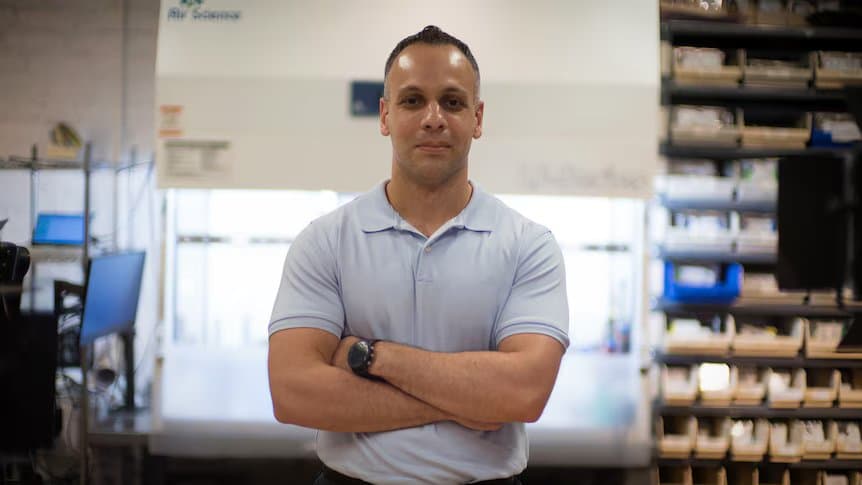
Our Austin lab operates on a transparency-first model. We use industry-standard recovery tools, including PC-3000 and DeepSpar, combined with strict environmental controls to maintain drive integrity. This approach allows us to serve clients nationwide with consistent technical standards.
Serving clients nationwide via mail-in service since 2008. Our lead engineer holds PC-3000 and HEX Akademia certifications for hard drive firmware repair and mechanical recovery.
Our "No Data, No Charge" policy means we assume the risk of the recovery attempt, not the client.
LR
Technical Oversight
Louis Rossmann
Our engineers review all lab protocols to maintain technical accuracy and honest service. Since 2008, his focus has been on clear technical communication and accurate diagnostics rather than sales-driven explanations.
We believe in showing the bench rather than just describing it. Open-drive work runs on a 0.02 micron ULPA-filtered laminar clean bench, and we filmed it.
“Had a raid 0 array (windows storage pool) (failed 2tb Seagate, and a working 1tb wd blue) recovered last year, it was much cheaper than the $1500 to $3500 Canadian dollars i was quoted by a Canadian data recovery service. the price while expensive was a comparatively reasonable $900USD (about $1100 CAD at the time). they had very good communication with me about the status of my recovery and were extremely professional. the drive they sent back was Very well packaged. I would 100% have a drive recovered by them again if i ever needed to again.”
“HIGHLIGHT & CONCLUSION
******Overall I'm having a good experience with this store because they have great customer services, best third party replacement parts, justify price for those replacement parts, short estimate waiting time to fix the device, 1 year warranty, and good prediction of pricing and the device life conditions whether it can fix it or not.”
“Didn't *fix* my issue but a great experience. Shipped a drive from an old NAS whose board had failed. Rossmann Repair wanted to go straight for data extraction (~$600-900). Did some research on my own and discovered the file table was Linux based and asked if they could take a look. They said that their decision still stands and would only go straight for data recovery.”
“I've been following the YouTube tutorials since my family and I were in India on business. My son spilled Geteraid on my keyboard and my computer wouldn't come on after I opened it and cleaned it, laying it upside down for a week. To make the story short I took my computer to the shop while I'm in New York on business and did charged me $45.00 for a rush assessment.”
Can you image SAS drives directly, or do you convert them to SATA?
We image SAS drives at their native interface using SAS host bus adapters (HBAs). SAS drives use the SCSI command set, which differs from the ATA command set used by SATA drives. Converting to SATA would lose access to SAS-specific diagnostic commands and non-standard sector sizes (520 or 528 bytes per sector).
How much does SAS hard drive data recovery cost?
Air-filled SAS drive recovery follows standard HDD tiers: From $250 for filesystem-level recovery, $600–$900 for firmware repair, and $1,200–$1,500 for mechanical work like head swaps. Enterprise helium SAS drives such as Exos X and Ultrastar HC use helium HDD pricing from $200–$5,000+ for firmware or mechanical work. Array reconstruction requires an additional fee per array. No data recovered means no charge.
Do you recover data from SAS drives with 520-byte or 528-byte sectors?
Yes. Many enterprise RAID controllers format SAS drives with non-standard sector sizes (520 or 528 bytes instead of the standard 512 bytes). The extra bytes store controller-specific metadata like checksums and block guards. We handle sector size translation during imaging and array reconstruction.
Can you recover a single failed SAS drive from a RAID array?
Yes. If one SAS drive has failed in a redundant array (RAID 5, 6, or 10), we image the failed member and return it so the array can be rebuilt. If the array itself has degraded beyond rebuild, we image all members and reconstruct the full array offline using Data Extractor Express RAID Edition.
What SAS drive models do you most commonly recover?
Seagate Exos (15E900, 10E2400, X16, X18), WD Ultrastar HC530 and HC560 in SAS variants, HGST Ultrastar C15K600 and C10K1800, and Toshiba AL15SEB series. These are the drives most commonly deployed in Dell PowerEdge, HP ProLiant, and Lenovo ThinkSystem servers.
My server shows a drive as 'foreign' or 'unconfigured.' Is data still recoverable?
In most cases, yes. A drive marked 'foreign' by a RAID controller still contains its data and RAID metadata. The controller is reporting that its configuration database does not match the drive's stored metadata. We image the drive through a SAS HBA (bypassing the controller entirely) and reconstruct the array from the on-disk metadata.