
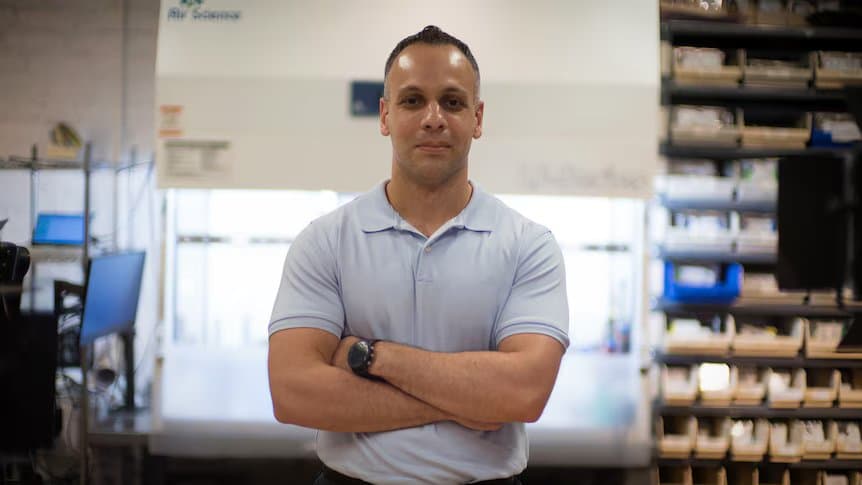
“I consulted Rossmann Repair Group for data recovery services. A new IT client was recently referred to me, because his main computer crashed and his business database went offline as a result. It turned out that the computer crashed because its main storage, a 500 GB Solid State Hybrid Drive, failed. That part was easy - replace it with a new 1 TB SSD and reinstall Windows along with the software he uses. However, the data on the SSHD was critical and would have meant serious problems for his business if he didn't get that back. That's where Rossmann Repair Group came in.”
SK Hynix SSD Data Recovery
SK Hynix is the world's second-largest NAND manufacturer. Their consumer SSDs use proprietary in-house controllers not found in any other brand. The Gold P31 was the first 128-layer TLC NVMe drive and shipped in millions of laptops. The Platinum P41 uses 176-layer NAND with the ACNS075 Gen4 controller. These drives are now reaching the 3-5 year failure window. We recover all SK Hynix consumer models using PC-3000 SSD's dedicated SK Hynix module.
SSD from $200 | No Data, No Fee | Free Evaluation | Since 2008
SK Hynix SSDs We Recover
Gold P31 (ACNT038, 128L TLC, power-efficient laptop SSD)
Platinum P41 (ACNS075, 176L TLC, high-performance Gen4)
Gold S31 (SH87830CC, 72L TLC, older consumer SATA)

How SK Hynix SSD Recovery Works
SK Hynix designs and fabricates its own NAND flash memory and builds its own controllers. Unlike Kingston, Crucial, or ADATA (which source controllers from Phison, Silicon Motion, and Realtek), SK Hynix SSDs use proprietary in-house controllers with custom firmware. Consumer recovery software and generic SSD tools cannot communicate with these controllers when they enter a fault state. PC-3000 SSD has a dedicated SK Hynix module that accesses the controller's diagnostic interface for firmware-level repair. We evaluate your drive for free, provide a firm quote, and charge nothing if we cannot recover your data.
SK Hynix Gold P31: The Laptop Favorite
The Gold P31 was the first consumer NVMe SSD built on 128-layer TLC NAND. SK Hynix paired it with their ACNT038 controller (codenamed Cepheus), an ARM-based design with onboard LPDDR4 DRAM and a 4-channel PCIe Gen3 x4 interface. The P31 became a popular OEM laptop drive and was widely reviewed for its power efficiency: it drew roughly half the active power of competing Gen3 drives.
That power efficiency came from tight integration between the ACNT038 controller and SK Hynix's own NAND. The downside is that no other controller can address this NAND with the same firmware parameters. When the P31's FTL mapping tables corrupt (typically after unexpected power loss), the drive drops offline entirely. Standard NVMe diagnostic tools see the controller but cannot read any user data.
The P31 shipped in capacities from 500GB to 2TB. The 1TB model (SHGP31-1000GM) was the most commonly sold. OEM variants in Dell, HP, and Lenovo laptops may carry SK Hynix part numbers rather than the Gold P31 retail branding, but the internal hardware is the same ACNT038 controller.
SK Hynix Platinum P41: Gen4 Performance
The Platinum P41 is SK Hynix's flagship consumer NVMe SSD. It uses the ACNS075 controller (codenamed Aries, a quad-core Cortex-R8 design) paired with 176-layer TLC NAND and a PCIe Gen4 x4 interface. Sequential read speeds reach 7,000 MB/s. SK Hynix includes onboard LPDDR4 DRAM for FTL caching and AES-256 hardware encryption.
The P41's 176-layer NAND uses smaller cell geometries than the P31's 128-layer design. Smaller cells hold less charge per electron trap, which means the NAND degrades faster under sustained random writes. As cells approach their rated TBW (terabytes written) threshold, page read retries increase until the error rate exceeds the LDPC ECC engine's correction capacity. At that point, the controller marks affected NAND blocks as bad and remaps data to spare blocks. If the spare pool is exhausted, the drive enters read-only mode or drops offline.
The P41 shipped in 500GB, 1TB, and 2TB capacities. The 2TB variant (SHPP41-2000GM) uses a denser NAND configuration and reaches higher temperatures under load, making it more susceptible to thermal throttling in laptops with restricted airflow.
SK Hynix SSD Recovery Pricing
| Service Tier | Price | Description |
|---|---|---|
| Simple CopyLow complexity | $200 | Your drive works, you just need the data moved off it Functional drive; data transfer to new media Rush available: +$100 |
| File System RecoveryLow complexity | From $250 | Your drive isn't showing up, but it's not physically damaged File system corruption. Visible to recovery software but not to OS Starting price; final depends on complexity |
| Circuit Board RepairMedium complexity – PC-3000 required | $600–$900 | Your drive won't power on or has shorted components PCB issues: failed voltage regulators, dead PMICs, shorted capacitors May require a donor drive (additional cost) |
| Firmware RecoveryMedium complexity – PC-3000 required | $900–$1,200 | Your drive is detected but shows the wrong name, wrong size, or no data Firmware corruption: ROM, modules, or system files corrupted Price depends on extent of bad areas in NAND |
| Advanced Board RebuildHigh complexity – precision microsoldering and BGA rework | $1,200–$1,500 | Your drive's circuit board is severely damaged and requires advanced micro-soldering Advanced component repair. Micro-soldering to revive native logic board or utilize specialized vendor protocols 50% deposit required upfront; donor drive cost additional |
Hardware Repair vs. Software Locks
Our "no data, no fee" policy applies to hardware recovery. We do not bill for unsuccessful physical repairs. If we replace a hard drive read/write head assembly or repair a liquid-damaged logic board to a bootable state, the hardware repair is complete and standard rates apply. If data remains inaccessible due to user-configured software locks, a forgotten passcode, or a remote wipe command, the physical repair is still billable. We cannot bypass user encryption or activation locks.
All tiers: Free evaluation and firm quote before any paid work. No data, no fee on all tiers (advanced board rebuild requires a 50% deposit because donor parts are consumed in the attempt).
Target drive: The destination drive we copy recovered data onto. You can supply your own or we provide one at cost. All prices are plus applicable tax.
What Customers Say About Our SSD Recovery
“Went in to ask if they could retrieve my SSD from my Surface Pro 4 for me and they gave me a good rate, but was still a bit too expensive for me. So, they let me use their equipment for about an hour until I was able to fish it out myself and recover my data.”
“Sent in a SSD for data recovery for a client of mine. Data was recovered! What else can I say. Thank you.”
“Amazing place! Super friendly and knowledgeable people! I have a LaCie Rugged Pro SSD that stopped mounting. It turns out the enclosure was the problem, not the SSD itself. They helped diagnose the issue and offered solutions—all free of charge. Great experience, and I highly recommend them! 😊”
SK Hynix Controller Architecture and Recovery Methods
ACNT038
Gold P31 | NVMe Gen3 x4 | LPDDR4 DRAM
ARM-based 4-channel controller (Cepheus) fabricated on SK Hynix's own process node. Paired with 128-layer TLC NAND and onboard LPDDR4 DRAM for FTL caching. The ACNT038 stores its FTL mapping tables in both DRAM (volatile) and NAND (persistent backup). Unexpected power loss during a NAND write can desynchronize the DRAM and NAND copies of the FTL, leaving the controller unable to locate user data blocks. PC-3000 SSD's SK Hynix module reads the NAND-resident FTL backup and reconstructs the mapping. AES-256 encryption is hardware-enforced; chip-off yields only ciphertext.
ACNS075
Platinum P41 | NVMe Gen4 x4 | LPDDR4 DRAM
Quad-core Cortex-R8 controller (Aries), 8-channel NAND interface, PCIe Gen4 x4. Paired with 176-layer TLC NAND and LPDDR4 DRAM. The ACNS075 handles higher throughput than the ACNT038 (7,000 MB/s vs 3,500 MB/s) but runs hotter under sustained loads. Thermal throttling firmware reduces write speeds progressively; if the controller exceeds its thermal envelope, it enters an emergency shutdown state. Repeated thermal shutdowns without clean unmounts accelerate FTL desynchronization. Recovery uses the same PC-3000 SK Hynix module as the P31 but with Gen4-specific initialization parameters.
SH87830CC
Gold S31 | SATA III | LPDDR3 DRAM
Dual-core 8-channel SATA controller (Quartz), descended from Link A Media Devices technology that SK Hynix acquired in 2012. Used in the Gold S31 (250GB, 500GB, 1TB). Paired with 72-layer TLC NAND and LPDDR3 DRAM, an older lithography that provides better endurance per cell than the 128- and 176-layer generations. The SH87830CC is not compatible with any third-party diagnostic software. PC-3000 SSD accesses it through a dedicated SATA-mode SK Hynix utility that differs from the NVMe module used for the P31 and P41.
SK Hynix vs. Solidigm: Two Different Product Lines
In December 2021, SK Hynix completed the acquisition of Intel's NAND flash and SSD business. The acquired division now operates as Solidigm, a wholly-owned SK Hynix subsidiary. Solidigm continues to manufacture and sell Intel-designed SSDs (P41 Plus, P44 Pro, D7-P5520) using Intel firmware and, in many cases, Intel-designed controllers built on Silicon Motion silicon.
SK Hynix-branded SSDs (Gold P31, Platinum P41, Gold S31) were designed and built by SK Hynix's own semiconductor division in Icheon, South Korea. They use proprietary controllers that SK Hynix designed in-house. These controllers share no firmware, no register map, and no diagnostic interface with the Silicon Motion controllers used in Intel/Solidigm SSDs.
The practical implication for recovery: an Intel 670p and an SK Hynix Gold P31 are both "SK Hynix products" at the corporate level, but they use different controllers, different firmware, different NAND configurations, and require different PC-3000 modules for recovery. Sending an Intel SSD to a lab that only has the SK Hynix module (or vice versa) will produce no result.
Gold P31, Platinum P41, Gold S31
Proprietary in-house controllers (ACNT038, ACNS075, SH87830CC)
SK Hynix NAND (128L, 176L, 72L TLC)
PC-3000: SK Hynix module
660p, 670p, P41 Plus, P44 Pro
Silicon Motion SM2259, SM2263, SM2269
Intel/Micron NAND (96L, 144L, 176L)
PC-3000: Silicon Motion module
Common SK Hynix SSD Failure Patterns
Controller firmware lockout after power loss
The most common P31 failure. A power loss during a NAND write operation corrupts the flash translation layer. The controller detects the inconsistency during boot and refuses to present the drive to the host system. The drive may appear briefly in BIOS during POST but disappears before the OS loads, or it may not enumerate at all. PC-3000's SK Hynix module bypasses the normal boot sequence and accesses the NAND directly to rebuild the FTL mapping. Firmware recovery: $900 to $1,200.
NAND page read retry exhaustion
More common on the Gold S31's older 72-layer NAND than on the newer 128- or 176-layer generations. As NAND cells age, the voltage threshold windows narrow. The controller applies read retry sequences with adjusted voltage levels to extract data from marginal cells. When retries exceed the controller's programmed limit, the affected pages are marked as uncorrectable. If enough pages in a block become uncorrectable, the controller may panic and lock the drive. PC-3000 applies extended read retry tables with finer voltage granularity than the controller's built-in sequences.
FTL table corruption from heavy random writes
The P31's ACNT038 controller uses an SLC write cache that absorbs incoming writes at high speed, then background-folds the data into TLC cells. Heavy sustained random write workloads (database journaling, virtual machine disk I/O, swap partitions) keep the SLC cache perpetually full. The controller must fold data to TLC while simultaneously servicing new writes, which increases wear on the FTL metadata blocks. Over time, the metadata blocks degrade faster than user data blocks because they are rewritten more frequently. The drive reports correct capacity in SMART but becomes read-only or shows I/O errors on write-heavy files.
PMIC and voltage regulator failure
The M.2 PCB on both the P31 and P41 carries a small power management IC (PMIC) that regulates voltage from the PCIe slot to the NAND dies and controller. Power surges, motherboard faults, or defective chargers on laptops can damage this component. The drive appears completely dead: not detected in BIOS, no LED activity, no PCIe link negotiation. Because the NAND and controller silicon are intact, board-level repair (replacing the failed PMIC or voltage regulator under microscope) restores access without any data loss. Board repair: $600 to $900.
Encryption and Why Chip-Off Does Not Work
All SK Hynix consumer SSDs (Gold P31, Platinum P41, Gold S31) implement hardware AES-256 encryption at the controller level. The encryption key is generated during the drive's first initialization and stored in a protected region of the controller's internal SRAM. This key never leaves the controller silicon.
Desoldering the NAND chips from a dead P31 and reading them with a NAND programmer produces only AES-256 ciphertext. Without the key from the original ACNT038 controller, the data cannot be decrypted. There is no known method to extract the AES key from a non-functional SK Hynix controller.
Board-level repair is the primary recovery path. Replacing a failed PMIC, voltage regulator, or passive component on the original M.2 PCB restores power to the original controller, which still holds the encryption key. Once the controller boots, PC-3000 accesses the data through the standard diagnostic interface. The NAND contents are decrypted transparently by the controller during read operations.
OEM Variants in Dell, HP, and Lenovo Laptops
SK Hynix supplies OEM versions of the Gold P31 and Platinum P41 to major laptop manufacturers. These drives carry SK Hynix part numbers (e.g., HFM512GD3JX013N for a 512GB OEM P31 variant, HFS001TEJ9X108N for a 1TB OEM P41 variant) rather than the consumer retail branding. The internal hardware is the same SK Hynix controller and NAND.
OEM firmware may differ from retail firmware in minor ways (performance profiles tuned for the laptop vendor's power management), but the diagnostic interface and PC-3000 recovery workflow are identical. If your laptop shipped with an SK Hynix SSD and you are unsure of the exact model, the part number on the M.2 label identifies the controller family. Any part number starting with HFM (NVMe) or HFS (SATA/NVMe) followed by a capacity code (256, 512, 001T, 002T) is an SK Hynix-manufactured drive.
Data Recovery Standards & Verification
Our Austin lab operates on a transparency-first model. We use industry-standard recovery tools, including PC-3000 and DeepSpar, combined with strict environmental controls to make sure your hard drive is handled safely and properly. This approach allows us to serve clients nationwide with consistent technical standards.
Open-drive work is performed in a ULPA-filtered laminar-flow bench, validated to 0.02 µm particle count, verified using TSI P-Trak instrumentation.
Transparent History
Serving clients nationwide via mail-in service since 2008. Our lead engineer holds PC-3000 and HEX Akademia certifications for hard drive firmware repair and mechanical recovery.
Media Coverage
Our repair work has been covered by The Wall Street Journal and Business Insider, with CBC News reporting on our pricing transparency. Louis Rossmann has testified in Right to Repair hearings in multiple states and founded the Repair Preservation Group.
Aligned Incentives
Our "No Data, No Charge" policy means we assume the risk of the recovery attempt, not the client.
Technical Oversight
Louis Rossmann
Louis Rossmann's well trained staff review our lab protocols to ensure technical accuracy and honest service. Since 2008, his focus has been on clear technical communication and accurate diagnostics rather than sales-driven explanations.
We believe in proving standards rather than just stating them. We use TSI P-Trak instrumentation to verify that clean-air benchmarks are met before any drive is opened.
See our clean bench validation data and particle test videoSK Hynix SSD Data Recovery FAQ
Can you recover data from an SK Hynix Gold P31 that is not detected?
Is the SK Hynix Platinum P41 recoverable after firmware failure?
How is SK Hynix SSD recovery different from Intel/Solidigm?
Is chip-off recovery possible on SK Hynix SSDs?
How much does SK Hynix SSD recovery cost?
Do you recover the older SK Hynix Gold S31 SATA SSD?
Related Recovery Services
All SSD brands and controllers
Former Intel NAND division. SM2259, SM2263 controllers.
NVMe M.2 and PCIe SSDs
MKX, Elpis, Phoenix, Pascal controllers
MX500, P2, P3, P5 Plus recovery
Full service catalog
Send Us Your SK Hynix SSD
Free evaluation. Firm quote. No data, no fee. Ship your SK Hynix SSD to our Austin lab.