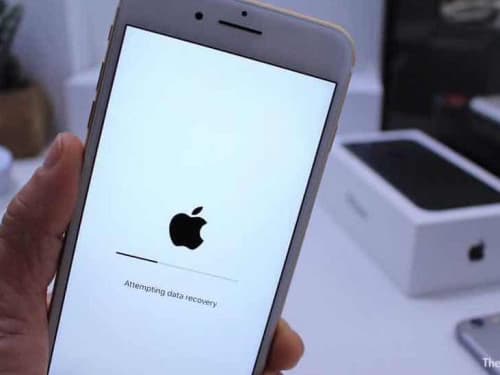
Board-Level Failure Modes on iPhone Logic Boards
Common board faults that read to the owner as lost data are Tristar or Hydra failures, PMIC and power-circuit failures, and NAND or CPU solder-joint fatigue. Each one has its own symptom pattern and its own rework procedure. Identifying which circuit failed determines the repair steps and the tools required to restore a bootable board.
Common board faults that read to the owner as lost data are Tristar or Hydra failures, PMIC and power-circuit failures, and NAND or CPU solder-joint fatigue after a drop or a bad third-party repair. The sections below walk the ones that reach our bench, including the audio codec on iPhone 7 boards and the baseband subsystem after liquid damage.
Each has its own rework procedure performed on Hakko FM-2032 irons, an Atten 862 hot air station, and a Zhuo Mao BGA rework station at our Austin lab.
Tristar and Hydra
Tristar and Hydra are the chips that let the phone talk to a computer. Which one a board carries depends on its generation. Tristar (CBTL1608 family) carries board reference U2 on the iPhone 5, U1700 on the 6, and U4500 on the 6s.
Hydra ships on iPhone 8 through 14. A damaged Hydra can present as a charging fault, or it can leave charging working normally while the USB data line stays dead.
The reason this matters for data recovery: if a phone charges but isn't detected by iTunes or Finder, the fault is often Tristar or Hydra rather than the NAND.
Audio IC Fault on iPhone 7 and 7 Plus
The iPhone 7 and 7 Plus have a known audio IC fault. The documented fix is to remove the chip and run a jumper to the C12 pad. Reflowing the chip by itself doesn't fix it.
A board replacement destroys the data, because the NAND is paired to the original SoC, not to the board itself.
We remove the audio IC with hot air on the Atten 862 rework station and run a jumper to the C12 pad. Then we clean the pads with flux and braid, reball the package on the stencil, and put the IC back in place. This repair doesn't touch the cryptographic pairing between the SoC and NAND.
Once audio is back online, we boot the phone, enter the passcode, and copy your photos and messages. For a phone that was bootlooping on top of the audio fault, we diagnose the secondary cause on the same visit.
Baseband Reflow on Water-Damaged iPhone X and Newer Boards
Which baseband CPU a board carries depends on the generation and the carrier.
Recovery starts with ultrasonic cleaning to halt active corrosion. We then separate the two sandwich layers on the Zhuo Mao rework station, inspect the baseband underfill for residue, and reflow the baseband CPU back onto clean pads.
A baseband reflow isn't a chip swap; the same silicon goes back onto the original pads once the underfill is cleared and the joints are remade. The radio calibration data sits in a separate baseband EEPROM that the reflow does not touch.
If the baseband CPU itself has died, all we can do is the water-damage data copy. Cellular service doesn't come back in that case.
NAND Reball vs Chip Swap
Starting with the iPhone 5s and its A7 chip, the NAND is cryptographically paired to the SoC and its Secure Enclave at the factory.
A chip-off recovery (pulling the NAND and reading the raw flash on a programmer) cannot work on these devices; the raw bytes read from the NAND are ciphertext with no recoverable plaintext. The NAND has to stay paired with the original SoC for the encryption chain to hold.
The recovery procedure we use is a reball, not a swap. If the NAND package has lifted from the pads after a drop or water damage, we remove it with hot air on the Atten 862, clean the BGA pads on both the chip and the board, reball the same package on a stencil, and reflow it back down.
The original NAND goes back onto the original board; it is never moved to a donor board. That keeps the cryptographic pairing of SoC and NAND intact and lets the phone decrypt user data after boot. Moving the NAND alone to another board, or dropping in a donor NAND, leaves the phone unbootable or unable to decrypt.
We do not offer a donor-board transplant at this time, so a case that would need one is not accepted right now. If the SoC or the NAND is physically destroyed, the data is unrecoverable and you pay no recovery fee.
Current turnaround is 2-6 weeks, set by the volume of devices in the queue right now, not by outsourcing.